

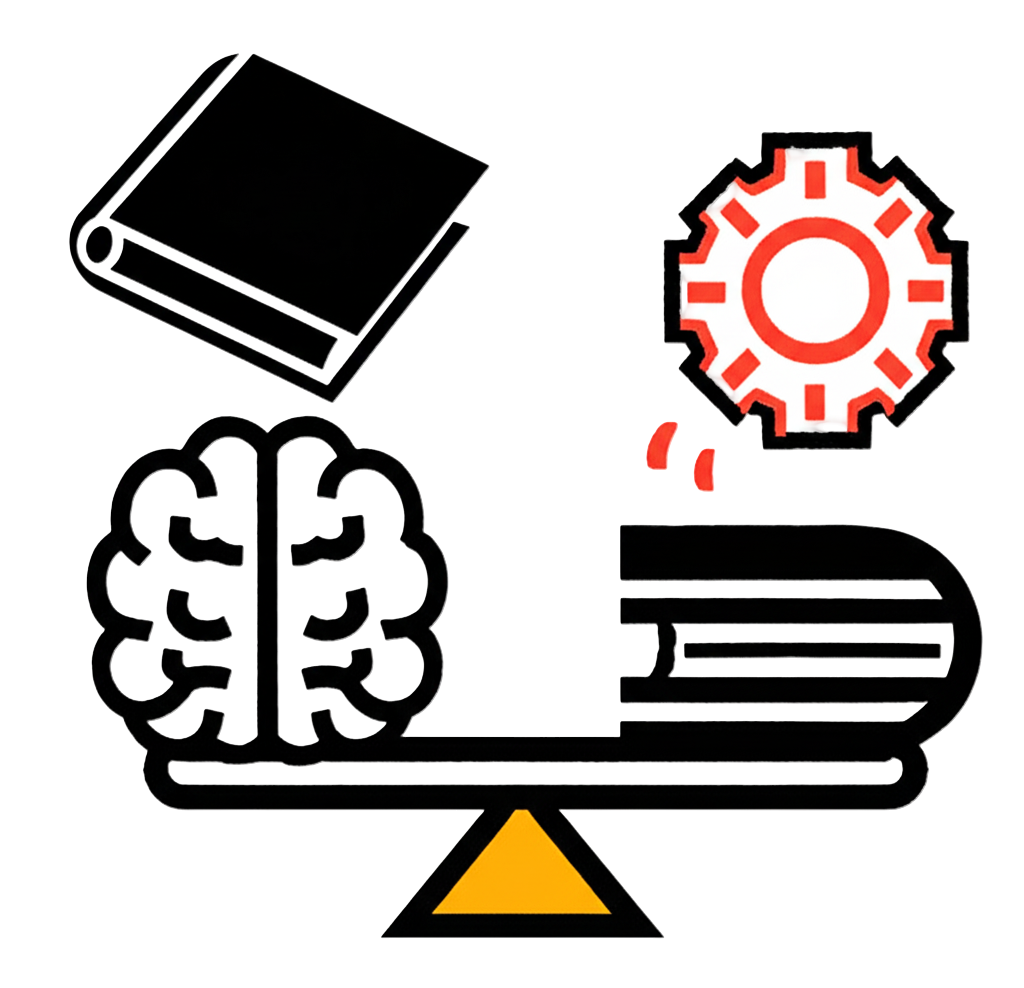
The Cognitive Offloading Crisis Isn't About Cheating. It's About Skill Atrophy.
Last week, I watched a capable student do something that should scare every teacher and school leader.
They submitted a polished response.
Clear structure.
Good vocabulary.
Even a "balanced conclusion."
Then I asked one follow-up question.
"Why did you choose that example?"
Silence.
Not because they were defiant.
Because they didn't know.
They hadn't thought it.
They had outsourced it.
That moment is what I mean when I say we're not facing an AI-plagiarism problem.
We're facing a cognitive offloading crisis—and it's quietly rewiring how students (and adults) learn.
And if we don't design for it, we'll end up with students who can produce excellent-looking work…
…without building the thinking skills that work is supposed to develop.
What Cognitive Offloading Actually Is (And Why It's So Seductive)
Cognitive offloading is when we shift mental work—remembering, reasoning, deciding—onto an external tool.
Sometimes that's healthy.
A calendar is cognitive offloading.
A checklist before a science lab is cognitive offloading.
A graphic organiser is cognitive offloading.
The point is to free attention for the work that matters.
But what's happening with AI in schools is different.
Students aren't offloading support tasks.
They're offloading the learning itself.
They're handing over the messy middle: struggle, drafting, choosing, checking, revising, and explaining.
That messy middle is where learning happens.
And the seduction is obvious.
AI gives you speed.
It gives you polish.
It gives you the feeling of competence.
But that feeling can be a trap—because performance is not the same thing as learning.
Elizabeth and Robert Bjork put it bluntly: conditions that feel easier can create an illusion of learning, while conditions that feel harder often build durable understanding.
The Cost: When "Information at Your Fingertips" Replaces Memory in Your Head
This isn't just a classroom hunch.
There's a decade-plus of research showing what happens when people expect easy future access to information.
In the famous "Google effects on memory" study, Sparrow, Liu, and Wegner found that when people expect they can access information later, they remember less of the information itself and more about where to find it.
That's not moral failure.
That's human cognition adapting to the environment.
Now place that dynamic into a classroom where a student can generate a complete essay in 20 seconds.
What do you think the brain learns to do?
It learns:
"I don't need to build it. I need to retrieve it later."
And that's the crisis.
Because school isn't just about producing outputs.
It's about building internal capacity.
Why This Hits International Schools Especially Hard
If you're a teacher, coach, or curriculum leader in an international school, you're likely dealing with three realities at once:
Your students are high-performing.
Your parents expect strong outcomes.
Your assessments often reward fluent communication.
AI can mimic fluent communication very well.
So the system accidentally starts rewarding the appearance of understanding.
And that's when cognitive offloading becomes invisible.
The output looks "right."
But the thinking isn't there.
And the long-term consequence is brutal. Students become:
- Less able to struggle productively
- Less able to read closely
- Less able to plan
- Less able to defend ideas orally
- Less able to think without a prompt
This Isn't Just a Student Problem (It's a Human Problem)
Here's a proof I keep coming back to, because it applies to adults, not just teenagers.
Microsoft researchers surveyed knowledge workers and found a consistent pattern:
When people had higher confidence in AI, they reported less critical thinking.
When they had higher self-confidence, they reported more critical thinking.
That's a powerful mirror for schools.
Confidence in the tool can quietly shrink effort in the human.
The Real Goal: Don't Ban AI. Redesign for "Human Thinking First."
I'm not interested in banning AI.
Bans are brittle.
Students are agile.
And honestly, the world they're entering won't reward "AI-free purity."
It will reward AI-fluent thinkers.
So the move is not prohibition.
It's architecture.
We redesign workflows so AI supports learning instead of replacing it.
OECD's Digital Education Outlook 2026 makes the same point:
general-purpose GenAI can improve task performance, but it doesn't automatically create learning gains—and cognitive offloading can create "metacognitive laziness and disengagement" over time.
So what do we do?
I use a simple framing with schools:
Protect the thinking. Offload the logistics.
The "AI as Assistant, Not Author" Classroom Workflow (4 Steps)
1) Make thinking visible before AI enters
If AI can generate a first draft, then your first checkpoint must happen before drafting.
Do this instead:
- One-minute claim
- Two bullets of evidence
- One counterargument
- One question you're still unsure about
This forces ownership before assistance.
2) Use AI for variation, not creation
AI is excellent at generating:
- Alternative examples
- Counterarguments
- Analogies
- Practice questions
But students must choose, justify, and refine.
That "choice and justification" step is where the learning lives.
3) Build in retrieval, not just review
Roediger and Karpicke's work on the testing effect shows that retrieval practice strengthens learning more than re-studying.
So after AI support, add a retrieval step:
- Close the laptop
- Explain the idea from memory
- Do a 3-minute "blurting" summary
- Answer a short oral prompt
If they can't retrieve it, they didn't learn it.
4) Require "defence," not just submission
One of the simplest anti-offloading strategies:
Ask students to defend one decision:
- "Why this structure?"
- "Why this example?"
- "What did you reject and why?"
It doesn't need to be punitive.
It needs to be normal.
Team Workflow: How Leaders Prevent Cognitive Offloading at Scale
If you lead a department or a school, individual teacher tactics won't hold unless the organisation backs them.
Here are three moves that actually scale.
1) Define a shared "AI Use Progression"
Not a policy document that nobody reads.
A simple progression that teachers align to:
- AI as dictionary (vocab, grammar)
- AI as explainer (clarify concepts)
- AI as sparring partner (challenge reasoning)
- AI as co-designer (generate options)
- AI as author (restricted / explicitly taught with disclosure)
Clarity reduces inconsistency across classrooms.
2) Build assessment systems that privilege process
If your assessment only rewards final product, cognitive offloading will win.
So build process into the grade:
- Planning artefacts
- Draft history
- Reflection on AI use
- Oral defence
- In-class synthesis tasks
This isn't extra work.
It's aligning assessment with what you value.
3) Create "AI-light spaces" for deep work
Attention is a system issue, not a willpower issue.
Gloria Mark's research on workplace attention shows that average screen attention has dropped dramatically over time, with recent measures around 47 seconds on one screen before switching.
Schools should respond like schools:
build routines that protect focus.
Create:
- AI-free reading blocks
- Device-down discussions
- Writing from memory sessions
- Structured thinking time before tool time
"This Is Too Much to Manage."
Now you might be thinking:
"Vivek, I already have too much to do. I can't police every prompt."
Fair.
You can't.
And you shouldn't.
This isn't about policing.
It's about designing learning so the default behaviour produces thinking.
When you add one "thinking-visible checkpoint" before AI…
…and one "retrieval checkpoint" after AI…
…you've already changed the game.
Not perfectly.
But meaningfully.
What This Looks Like 30 Days From Now
Imagine your students submitting work where:
- They can explain why they made choices
- They can answer follow-up questions without panic
- They use AI to test ideas, not avoid ideas
- Your teachers spend less time playing detective
- Your leaders spend less time fighting tool wars
That's not fantasy.
That's what happens when you redesign for cognition, not compliance.
Getting started
Pick one upcoming assignment.
Just one.
Now ask:
"If a student used AI end-to-end, would they still have to think?"
If the answer is no, change only two things:
Add a pre-AI thinking checkpoint (claim + evidence + question).
Add a post-AI retrieval checkpoint (explain from memory or oral defence).
That's it.
Do it once.
Watch what happens.
While I agree with most points, I wonder if we're underestimating the value of AI for students with certain learning differences. For some, AI as 'author' for a first draft might actually enable them to participate in the 'messy middle' refining process, which they might otherwise skip due to anxiety or writing barriers.