

Article 4 of 9 in a series on pedagogy fundamentals in the AI age.
The tools got faster. The lessons got prettier. The slides got more colorful. The infographics multiplied. The "fun analogies" started rolling off the prompt by the dozen.
And the learning — the actual, durable, transferable, in-the-skull-of-the-kid learning — quietly got worse in a lot of classrooms.
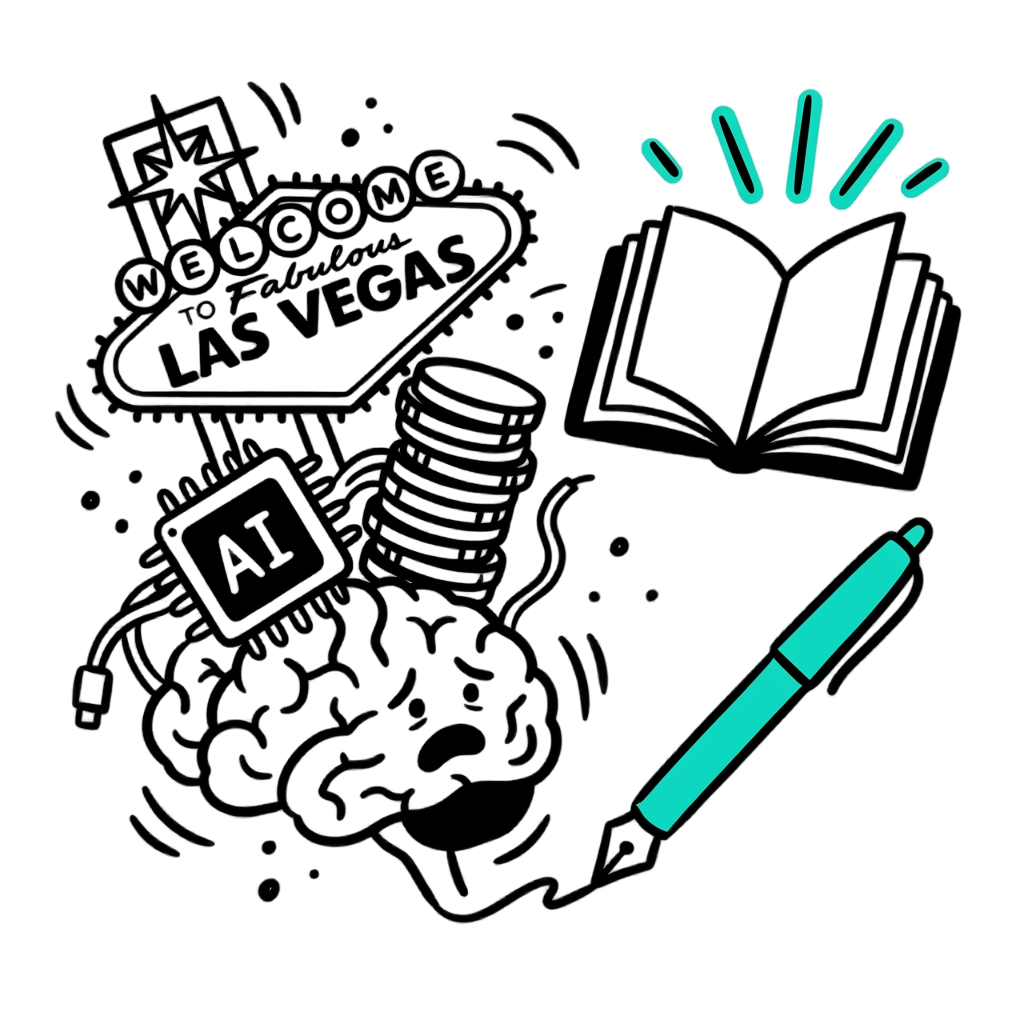
AI is the most powerful Las Vegas machine we have ever built. And our students are the tourists.
The book that named this is e-Learning and the Science of Instruction by Ruth Clark and Richard Mayer. Twenty-five years of empirical research on how multimedia actually teaches a human being.
If you have it on your shelf, pull it down tonight.
The opening salvo, written nearly twenty years before any of us heard the words "generative AI":
Clark & Mayer on Las Vegas
From Las Vegas-style media with games and glitz at one extreme to page turners consisting of text on screens at the other, many e-learning courses ignore human cognitive processes and as a result do not optimize learning.
— e-Learning and the Science of Instruction, Clark & Mayer
That is precisely the lesson AI gives you on its first try. Lights, sounds, motion, jokes, glamour. None of it grounded in how a real human cognitive system actually processes information.
Mayer's life's work is twelve-plus principles — Multimedia, Coherence, Contiguity, Modality, Redundancy, Personalization, Segmenting, Pretraining. Each replicated in dozens of controlled studies. Each with effect sizes that would make a medical researcher weep with joy.
Almost every single one is violated by default in AI-generated lessons. Not because AI is bad — because AI was trained on the engagement-optimized internet. So when you ask for a lesson, you get a lesson that looks great and teaches badly.
The cure isn't less AI. The cure is the editor — you — who knows the principles.
The seductive idea underneath every shiny AI lesson
Engagement equals learning.
We've all said it. "The kids loved it!" as proof a lesson worked.
It's the most seductive idea in our profession. AI just put it on steroids — vivid color, perky analogies, pop-culture hooks, "fun fact" sidebars, animated diagrams.
It will deliver glitz. It is a glitz machine.
Engagement is not learning. Mayer has the receipts.
What Clark & Mayer actually say
Coherence — every seductive detail is a working-memory thief.
"The added sounds, graphics, and words are examples of seductive details, interesting but irrelevant material added to a multimedia presentation in an effort to spice it up."
In study after study, students perform worse on retention tests when interesting-but-irrelevant material is added. Effect sizes greater than 1 — the kind that, in medical research, would shut a clinical trial down for ethical reasons.
There is no neutral decoration. There is no free seductive detail.
"A lesson that follows a Las Vegas approach to learning by including heavy doses of glitz may overload learners, making it difficult to process information in working memory."
The AI loves Las Vegas. You have to be the one who turns the lights down.
Redundancy — narration AND on-screen text AND a diagram is less learning, not more.
"Adding redundant on-screen text to narrated graphics tends to hurt learning. Because of the limited capacity of the human information processing system, it can be better to present less material than more material."
Working memory has two channels — auditory and visual. When you have a complex diagram on screen and a wall of text and narration reading the same text, the visual channel is asked to do two jobs. It collapses.
Same content, audio carrying the words and the diagram carrying the visuals: lightning-formation studies showed transfer-test performance more than doubled.
AI doesn't know this. It loves to copy-paste.
Pretraining — don't introduce new vocabulary and a complex causal model at the same time.
"Pretraining can help beginners to manage their processing of complex material by reducing the amount of essential processing they do at the time of the presentation. If they already know what terms like 'upper esophageal sphincter' mean, they can devote their cognitive processing to building a mental model of how that component relates to others in the causal chain."
The polite, frozen, "I'm pretending to follow" face on a sixth-grader watching a Krebs cycle video is the universal face of cognitive overload. The AI hands you one fluid, beautiful, totally cognitively impossible block of prose. Pre-teach the vocabulary. Then run the model.
Personalization — voice matters, but only subtly.
"The psychological advantage of conversational style, pedagogical agents, and visible authors is to induce the learner to engage with the computer as a social conversational partner."
Swap "the diaphragm" for "your diaphragm." Eleven words across a lesson. Effect sizes greater than 1. Doubling of learning.
But Mayer is also clear you can over-do it:
"There are cases in which personalization can be overdone… 'Wow, hi dude, I'm here to teach you all about..., so hang onto your hat and here we go!'"
AI's two natural defaults — robotic textbook OR cringey-bro hype-man — are both wrong. The sweet spot is subtle. A whisper, not a shout.
Segmenting — continuous video kills learning.
"When the material is complex, you can't make it simpler by leaving out some of the elements. However, you can help the learner manage the complexity by breaking the lesson into manageable segments — parts that convey just one or two or three steps in the process."
Same words. Same animation. Same teacher. Different chunking. Median effect size of about 1. Just from chopping it up.
Contiguity — labels go next to the thing they label.
"Place printed words near the part of a graphic to which they refer."
Sounds obvious. Constantly violated. Caption boxes get tucked at the bottom while the diagram lives at the top. Working memory has to spend its capacity searching for which word goes with which part — capacity that should be spent understanding.
What you do on Monday
1. Coherence Pass. For every element in an AI lesson — every paragraph, image, "fun fact," joke — ask: "If I removed this, would the student still hit the learning objective?" If yes, delete. Not "save it for next time." Delete.
"Apply Mayer's Coherence Principle to the lesson above. List every element that is NOT essential to achieving the learning objective — 'fun facts,' decorative graphics, pop-culture analogies that don't directly map onto the target concept, background music, thematic embellishments. Then propose a leaner version with those elements removed."
The first time, you'll be embarrassed. The AI will list fifteen elements it added "for engagement" with no instructional purpose.
2. Channel Hygiene. Complex graphic on screen → words go in audio narration, not on-screen text. If on-screen text exists, strip the narration of redundant content. Don't do both.
"For any slide with a meaningful graphic or diagram, move explanatory words into the audio narration script and remove them from the slide. Leave on-screen text only for: short labels, directions, key technical terms, or content the learner needs to re-read."
3. Pre-Teach Pass. Before the main lesson, generate a separate pretraining module that does one job: introduce the names and characteristics of every key concept the main lesson will use.
"List every technical term, named part, or key concept the main lesson will use. For each one, give: the name, a one-sentence definition in plain language, and a simple visual or familiar example. Format this as a 5-to-10-minute warm-up the learner completes BEFORE the main lesson. In the main lesson, assume those terms are already known."
This is also the secret to making AI actually help your strugglers.
4. Conversational Rewrite. Three rules. Change "the" to "your" wherever it refers to something the learner can imagine doing or possessing. Convert at least one passive sentence per paragraph into second-person active voice. Convert direct commands into polite invitations. Do not go further. No "hey dude." No exclamation marks. No emoji. A whisper, not a shout.
5. Segment and Gate. Break any lesson into segments of 60-to-120 seconds of new content. Between segments, insert a gate — a retrieval question, a "predict what happens next" prompt, a "summarize the previous segment in one sentence" box, or a "click to continue" button.
The gate is the pause. The pause is where the learning sets.
6. Stick the Label. For every diagram, run two checks. Spatial: are the words physically next to the part they describe — connected by labels or pointer lines — not in a separate caption box? Temporal: when narration describes a part, does the corresponding part appear at the same moment? If either answer is no, fix it.
Cognitive friction drops. The kids stop searching. They start learning.
The slogan
Kent Beck has a line I steal whenever I can: Invest in the design of the system every day.
The educator's version, for this book:
Edit the cognitive load every day.
That's the job now. AI can produce a lesson in nine seconds. What it cannot do — what you must do — is hold the whole thing up to the light, look at it through the eyes of a sixth-grader's working memory, and ruthlessly edit out the fat. The seductive details. The redundant text. The unintroduced vocabulary. The robotic voice. The unsegmented monologue. The split-up label.
Mayer's principles are a checklist. The editor's red pen. They take five minutes to learn and a career to wield well.
Right now, they may be the most under-priced asset in education. Almost nobody applying AI in classrooms knows them. The AI itself will never apply them on its own.
If this is landing, the EDodo flagship — AI-Powered Learning Design — is the cohort version of all this. Eight weeks of project-based building, peer review, real artifacts.
If you've been running Coherence Passes on your own work for years before AI made it urgent — and you speak fluent AI on top of it — I'd like to hear from you. We're building a faculty.
Source: Clark, R. C., & Mayer, R. E. (2016). e-Learning and the Science of Instruction (4th ed.). Wiley. All quotes verbatim.
Stick the Label is so obvious in retrospect. Why does every textbook still violate it?