

Article 8 of 9 in a series on pedagogy fundamentals in the AI age.
AI can produce a slide deck in nine seconds. It cannot produce a cognitive arc. The cognitive arc is the lesson. You are the only one in the building who can design it.
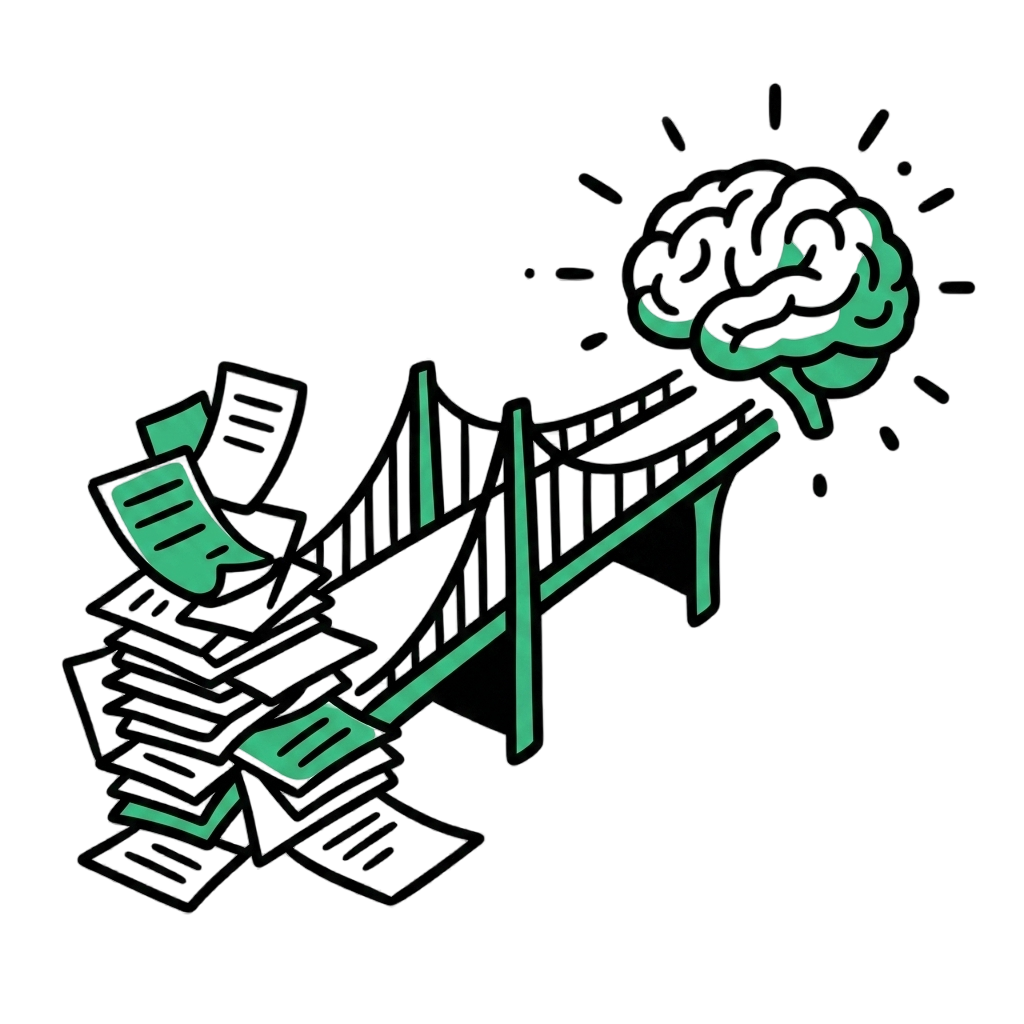
A stack of content is not a lesson. A lesson is a sequence of cognitive operations that take a brain from "doesn't know" to "can do." The stack and the sequence look the same on a slide. They are not the same in a kid.
The book that names the cognitive arc — and gives us a checklist for it — is The Conditions of Learning by Robert Gagne. Written in 1965. Refined for decades. Sitting in every instructional design textbook on Earth.
Why it matters now: Gagne tells you what each step in a lesson is for cognitively, and the AI does not know.
The AI knows what a lesson looks like. It does not know what a lesson does.
Gagne's core idea
Instruction is the set of planned external events which influence the process of learning and thus promote learning.
— Robert Gagne, Conditions of Learning
Each event is an external action you take. That action exists because it is supposed to trigger an internal process in the kid's head. Gain attention triggers Reception. State the objective triggers Expectancy. Recall prior learning triggers Retrieval. Present content triggers Selective Perception. And so on.
Nine external actions. Nine internal processes. A precise mapping.
The AI was trained on a billion documents that look like lessons. So when you ask it to make a lesson, it produces a document that looks like a lesson. It will give you a "Hook" because hooks appear in lessons it has seen. It will not give you Reception, because Reception is not a section heading. It is a thing that happens, or fails to happen, in a child's nervous system.
The lessons it gives you are structurally hollow. The bones of pedagogy without the marrow.
What Gagne actually says
I'll walk through six events worth fixing.
Event 1 — Gain attention.
"The first event, Gaining Attention, is the critical starting point for all effective instruction. Its purpose is to transition learners from their pre-existing mental state — distracted by work, life, or other thoughts — into a focused, mentally engaging learning environment."
Not a "warm-up." Not a vocabulary review. A transition from one mental state to another. A doorway. The brain has to cross over.
"Without successful reception, all subsequent information may be filtered out as noise."
The AI doesn't know the room is cold. It doesn't know your kids spent the previous period in a fluorescent-lit math test and arrived at your door already half-broken.
Event 2 — State the objective.
The AI returns: "Students will understand the causes of the Industrial Revolution. Students will know about the major inventions. Students will appreciate the impact on society."
Understand. Know. Appreciate. Three of the most useless verbs in the English language for designing instruction.
"The second event involves clearly communicating the learning objectives to the learners. This sets expectations and provides a transparent overview of what they will be able to do by the end of the instructional unit."
What they will be able to do. The cognitive process is Expectancy — the kid's brain prepares a "mental file folder" for the new content. You can only prepare a folder if you know what is going inside it.
Event 3 — Recall prior learning.
"Learning is not a process of filling an empty vessel; it is a process of connecting new information to what is already known."
The AI treats every learner like a freshly formatted hard drive. The kids are not freshly formatted. They walk into your room with eight years of half-built schemas about photosynthesis or fractions or government. Unless you bring those schemas to the surface, nothing you teach attaches.
Events 4-7 — Present, guide, elicit, feedback.
"The middle events — Presenting Content (4), Providing Guidance (5), Eliciting Performance (6), and Providing Feedback (7) — frequently form an iterative loop. An instructor will present a manageable 'chunk' of content, offer guidance on it, ask the learner to practice with that specific chunk, and provide immediate feedback. This 4-5-6-7 cycle may repeat multiple times within a single lesson."
The heartbeat of a real lesson. Chunk, guide, practice, feedback. Three or four times.
The AI, left alone, will give you one massive Event 4 followed by one practice problem at the very end. That is not a lesson. That is a textbook chapter with a worksheet stapled to it.
Event 7 (deeper) — Feedback.
"Effective feedback is not just a grade; it is information that helps the learner understand the gap between their current performance and the desired performance, and how to close that gap."
"Evaluative: Informs the learner about the accuracy of their response. Remedial: Guides the learner to find the correct answer without giving it away. Descriptive/Analytic: Offers specific suggestions for improvement."
The AI default is Evaluative only — correct/incorrect, here's the answer. The cheapest form. The form that produces the least learning.
Event 9 — Enhance retention and transfer.
"The ultimate goal of instruction is not just for learners to perform well on a test, but for them to transfer their new knowledge and skills to their jobs and lives."
The AI does not think in next weeks. It thinks in single artifacts. The default lesson ends with an exit ticket, says "great work," and stops. There is no spacing. No novel context. No "teach this to your sibling tonight."
What you do on Monday
1. Doorway Hook (Event 1). Before you ask the AI for any content, ask it for one thing only: the door.
"My students are [age, context, mental state when they arrive]. The topic is [topic]. Do not give me a lesson. Give me three candidate Doorway Hooks — each under 60 seconds of class time — that would shift the room from distracted to leaning forward. Each candidate should specify the exact stimulus and the precise opening line I would say."
The AI will produce ten times better hooks when it's doing one job instead of nine.
2. Anchor Before Add (Event 3). Before any new content gets presented, run a deliberate retrieval move that surfaces what kids already think — including what they think wrongly.
"Here is what my students likely already believe about [topic], including their common misconceptions: [list]. Design a 3–5 minute Anchor activity that surfaces these specific beliefs in the room before any new content is taught. The activity must produce a visible artifact I can refer back to during the lesson. Do not teach the content. Only design the surfacing."
The AI doesn't know what your kids think. You do. That is the asset.
3. Behavior-Condition-Criterion (Event 2). Every objective must contain three things:
- Behavior — an observable action. (Identify, classify, construct, defend, calculate.)
- Condition — the situation. (Given a primary source. During a class debate. In a 90-second response.)
- Criterion — what counts as good enough. (At least two causes. With evidence from the text. Without using a calculator.)
"Rewrite each objective using Behavior + Condition + Criterion. Reject any verb that is not directly observable (no 'understand,' 'know,' 'appreciate'). For each rewritten objective, also state the exact assessment item that would prove the student can do it."
You suddenly have a folder, a target, and an assessment that can actually align.
4. The 4-5-6-7 Loop (Events 4-7). No content section is longer than one cognitive chunk. Break the lesson's new content into 3-4 chunks. For each chunk, design four micro-events: Present (one paragraph max, the one most important word bolded); Guide (an example, analogy, or worked solution); Elicit (a 60-second attempt); Feedback. Repeat for each chunk.
"Restructure this lesson into a 4-5-6-7 Loop. Break the new content into 3 chunks. For each chunk give me: Present (one paragraph max, single most important term bolded); Guide (one worked example or analogy); Elicit (one 60-second student attempt); Feedback (model response showing what 'good' looks like and one common error). Do not produce a wall of content. Do not save practice for the end."
This single prompt gives a lesson a heartbeat.
5. Three-Lane Feedback (Event 7). Every piece of feedback travels three lanes:
- Evaluative — Did they get it right? (One sentence.)
- Remedial — If wrong, point at the part of their reasoning that broke, without giving the answer.
- Descriptive — Name one specific move that would make the next attempt stronger.
"You are giving feedback on student work. Never use only 'correct' or 'incorrect.' Every response must travel three lanes: Evaluative, Remedial, Descriptive. Even when the student is correct, give a Descriptive lane that pushes them toward a more sophisticated version of the same idea."
Single-lane feedback is not feedback. It is scoring. Scoring does not teach.
6. Transfer Tail (Event 9). Every lesson ends with a tail that reaches into next week, next unit, or next year.
- Spaced retrieval — schedule the concept to reappear 2 days, 1 week, and 2 weeks after the lesson.
- Novel context — name one situation, outside this lesson, where the kid will use this concept.
- Convert or teach — convert the idea into a new format, or teach it to someone outside the class.
An exit ticket closes the door. A tail keeps it propped open.
A note on order
The events are not a flowchart. They are a cognitive checklist. Gagne says it himself:
"While the chronological sequence represents a highly effective and cognitively logical default path, it can and should be adapted to suit the specific context, the learners' prior knowledge, and the nature of the content. The key is to ensure the conditions for learning are met, even if the order of events is modified."
With experts, you might start at Event 6 — give them a hard problem first, see what breaks, then teach. With a brand-new topic, you might dwell on Events 4 and 5 for a long time before getting to practice.
The AI does not know what order your kids need. It will default to the textbook flow. You decide whether that flow is right for this room, this week.
The slogan
Engineer the conditions for learning every day.
That phrase is straight from Gagne:
"By mastering this blueprint, the instructional designer is equipped not just to create a lesson, but to reliably and effectively engineer the conditions for learning."
The part the machine can do — formatting, drafting, generating examples, writing slides, producing worksheets — keeps getting cheaper, faster, and more confident.
The part that is irreducibly you — knowing whether the door has been opened, knowing what schemas your kids are walking in with, refusing the wishy-washy "students will understand," chunking the content so working memory survives, demanding three-lane feedback, engineering the transfer tail — is the cognitive architecture of the lesson.
It is the thing AI does not have a model for. It is the thing Gagne wrote down sixty years ago.
You are the architect. AI is the nine-second drywaller. The drywaller is fast and sometimes brilliant. But the drywaller does not know which wall is load-bearing.
You do. Gagne told you which.
If this is landing, the EDodo flagship — AI-Powered Learning Design — is the cohort version of all this. Eight weeks of project-based building, peer review, real artifacts.
The events have not changed. Reception, Expectancy, Retrieval, Selective Perception, Encoding, Responding, Reinforcement, Retrieval, Generalization. Those nine cognitive processes are how a human brain learns. They were how a brain learned in 1965. They are how a brain will learn in 2065.
AI does not change the brain. AI changes how cheaply we can produce documents that look like lessons.
Source: Gagne, R. M. (1965, 1985). The Conditions of Learning. Holt, Rinehart and Winston. Subsequent editions and applied "Gagne Blueprint" practitioner synthesis. All quotes verbatim.
The 4-5-6-7 Loop saved my unit on photosynthesis last week. Same content. Different rhythm. Kids actually retained.