

Article 1 of 9 in a series on pedagogy fundamentals in the AI age.
There's a hum sitting under the sternum of every teacher I talk to.
It says: the AI can already do what I do — explain the concept, summarize the chapter, generate the worksheet, walk the kid through the problem at midnight when I'm asleep — so what, exactly, am I still here for?
Here is the thesis of this entire series.
Every single thing the AI does fluently — explain, summarize, smooth, auto-complete, never let the student sit in confusion — is a thing learning science has been screaming for forty years that you must not do if you actually want a human being to learn.
The AI isn't better than you. The AI is, by default, the most efficient anti-learning machine ever built.
The only person who can stand between the kid and that machine is the educator who knows the science of how learning actually sticks.
That science was already written. Make It Stick by Peter Brown, Henry Roediger, and Mark McDaniel — Harvard University Press, 2014 — is the synthesis. Every chapter reads differently in the AI age. Every chapter is now a warning, and a job description.
Here is the line for your laptop sticker:
From Chapter 1
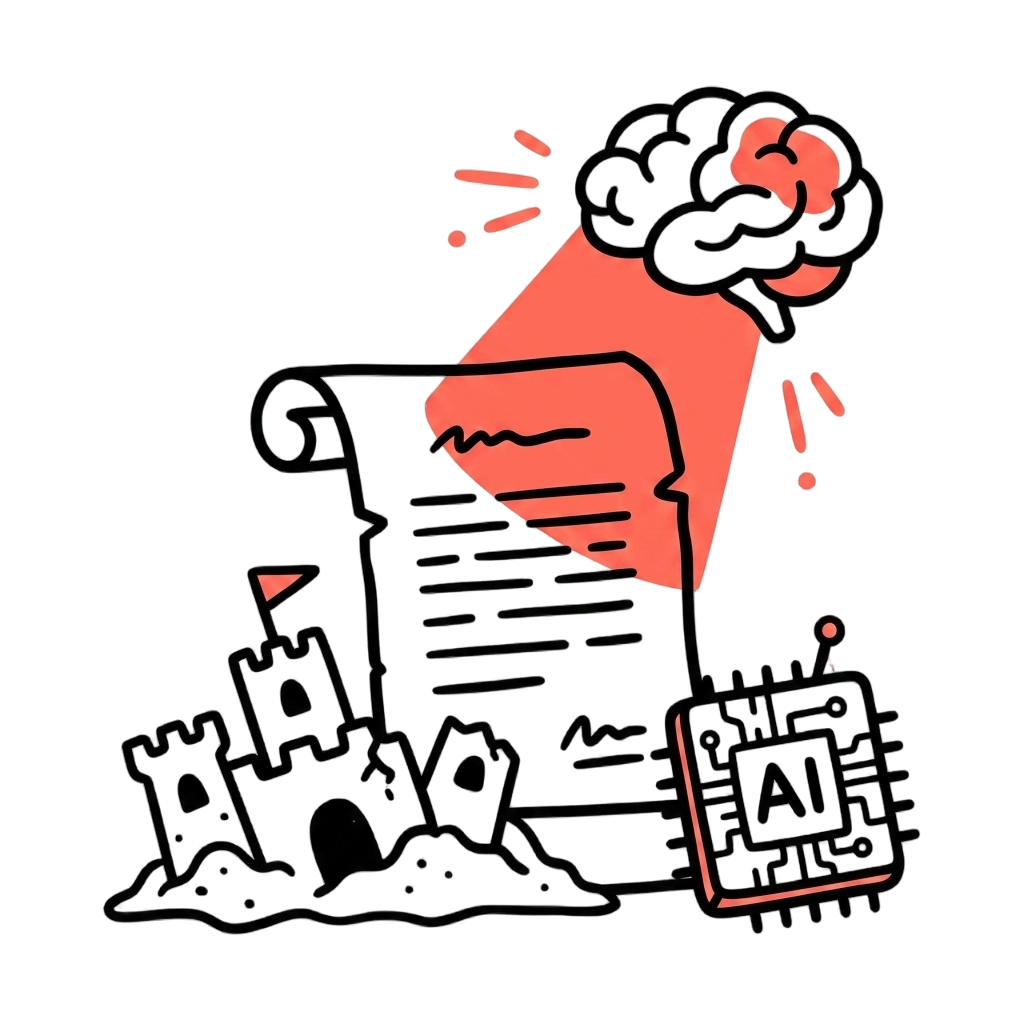
Learning that's easy is like writing in sand, here today and gone tomorrow.
— Make It Stick, Brown, Roediger, McDaniel
Now look at every AI tutor your students are using. Smooth. Frictionless. Auto-explained. Auto-summarized. The product designers spent millions to remove every speck of difficulty — because that's how you win at product design.
In winning at product design, they have lost at education.
They've built the most beautiful, twenty-four-seven sand-writing machines the world has ever seen.
The illusion of fluency
The book has a name for what's happening:
"Rereading and massed practice give rise to feelings of fluency that are taken to be signs of mastery, but for true mastery or durability these strategies are largely a waste of time."
— Make It Stick, Chapter 1
The kid isn't lying when they tell you they understand. They genuinely feel like they understand. Smooth explanation, smooth analogy, smooth follow-up — the kid follows perfectly, feels mastery, learns nothing.
The next day, you give them a problem. They can't do it. They look at you confused, because they were so sure last night.
This is now the dominant student experience in any subject the AI can explain.
Five mechanisms AI is silently undermining
Retrieval beats re-exposure.
"Practicing retrieval makes learning stick far better than reexposure to the original material does." — Chapter 2
An AI summary is re-exposure in a smoother form. The kid didn't pull anything out of their own head. So nothing changed in their head.
Generation beats reception.
"It's better to solve a problem than to memorize a solution. It's better to attempt a solution and supply the incorrect answer than not to make the attempt." — Chapter 4
The wrong answer isn't a failure. The wrong answer is the mechanism. The AI's "show me the answer" button skips the step where learning actually happens.
Desirable difficulty beats fluency.
"The more effort you have to expend to retrieve knowledge or skill, the more the practice of retrieval will entrench it." — Chapter 4
Effort is not the cost of learning. Effort is the mechanism. Smooth out the effort, you get less learning — period.
Spacing beats cramming.
"The rapid gains produced by massed practice are often evident, but the rapid forgetting that follows is not." — Chapter 3
The AI is happy to run a three-hour cram at 11 PM the night before the test. It has no opinion about whether the kid should have started Sunday. It's not a teacher. It's a service.
Interleaving beats blocking.
"The mixing of problem types boosted final test performance by a remarkable 215 percent — and actually impeded performance during initial learning." — Chapter 3
The AI lets you mass-practice yourself into a false sense of mastery, topic by topic. That false sense collapses on the cumulative final.
What you do on Monday
Five skills. One per mechanism.
1. Closed-Book First. Before a student opens AI to learn a concept, five silent minutes writing — closed-tab — what they already think they know. After the AI session, they close it again and write, from memory, what they now understand. Steps 1 and 4 are the only points in the encounter where actual learning happens.
2. Struggle Before Snippet. Ten minutes of honest, screen-down struggle before any AI is consulted. The student must produce something — a wrong answer, a sketch, a question. The first AI message isn't "give me the answer." It's the artifact of the struggle.
"I have already attempted this. Here is what I tried: [PASTE]. Do not give me the answer. First, tell me which part of my attempt was on track and which part went wrong, and ask me what I want to fix first."
3. The Five-Day Drip. Replace any AI study session of more than 30 minutes with five sessions of 10–15 minutes spread across five days. The forgetting between sessions isn't a bug. It's the entire point.
4. Brain Dump Before Summary. After reading, close the book. Ten-minute timer. Write everything you remember. Only then may you open the AI — and only for one job: hand it your dump and ask what you missed.
5. Shuffle the Deck. Once a unit is past introduction, no AI practice session is single-topic. Pull from at least three topics in random order. The AI is forbidden from telling the student which topic a problem is from. Identifying the kind of problem is graded equally with the solution.
The slogan
Learning that's easy is like writing in sand, here today and gone tomorrow.
Be the person in the room who refuses to let learning be easy when easy means empty. Inject the desirable difficulties that the AI's product designers, no matter how well-meaning, are paid to remove.
The AI is built to please. You are built to teach. Those are now opposite jobs.
The fundamentals are not the past. In the AI age, the fundamentals are the moat.
If any of this resonates, the EDodo flagship — AI-Powered Learning Design — is built on these fundamentals. Eight weeks of project-based building, peer review, real artifacts. Educators who care deeply about pedagogy quietly find each other there.
If you're already running closed-book starts, spaced retrieval, mixed practice, and reflection rituals well in your own classroom, I'd like to hear from you. We're building a faculty, not a stage.
Source: Brown, P. C., Roediger, H. L., & McDaniel, M. A. (2014). Make It Stick: The Science of Successful Learning. Harvard University Press. All quotes verbatim.
Closed-Book First is the one I'm trying tomorrow. Such a small move and so much leverage.