

Most AI Training for Teachers Misses the Point
Last month, I ran an AI workshop for 40 teachers at an international school.
Ninety minutes. High energy. Lots of "aha" moments.
At the end, a veteran science teacher pulled me aside.
"Vivek, this was great. But I'll be honest. I went to three AI workshops last year. I left all of them excited. And I used nothing."
She wasn't being negative.
She was being accurate.
Because here's what most AI professional development looks like:
Tool demo. Cool prompt. Gasps of amazement. Back to classroom. Forget everything by Thursday.
The problem isn't teachers. It's the training.
Most AI PD teaches tools without a system. It shows what AI can do without addressing what's safe, what's effective, and what's sustainable.
This isn't a discipline problem. Nobody failed.
The training just never gave teachers a framework they could return to, week after week, task after task.
And without that framework, two very predictable failure modes show up.
Every time.
The Two Failure Modes Schools Walk Into
1. Confidently wrong output
AI generates convincing text that contains errors, fabrications, or misleading claims.
This isn't a fringe risk. NIST's AI 600-1 profile lists confabulation (what most people call "hallucination") as one of twelve documented generative AI risk categories. Their definition: "The production of confidently stated but erroneous or false content."
You've seen this. A teacher generates quiz questions using AI. Three of them contain factual errors. The teacher catches two. The third goes out to students.
That's not a technology failure. It's a governance failure.
2. Cognitive offloading becomes the default
Brain imaging research from MIT found that participants who relied heavily on ChatGPT showed the weakest neural connectivity, weaker than search-engine users and no-tool users. When those same participants later wrote without AI, they showed reduced engagement patterns.
The researchers called it "cognitive debt."
Students (and teachers) stop doing the hard thinking. The AI handles it. The output looks polished. The learning is hollow.
UNESCO's global guidance emphasises exactly this: AI should improve learning without weakening agency or widening inequity.
The answer isn't "ban AI."
It's design for thinking with AI.
And for that, you need a framework, not another tool list.
The 5-Level AI + Learning Design Framework
I built this framework after running bootcamps with over 2,000 educators across 12 countries.
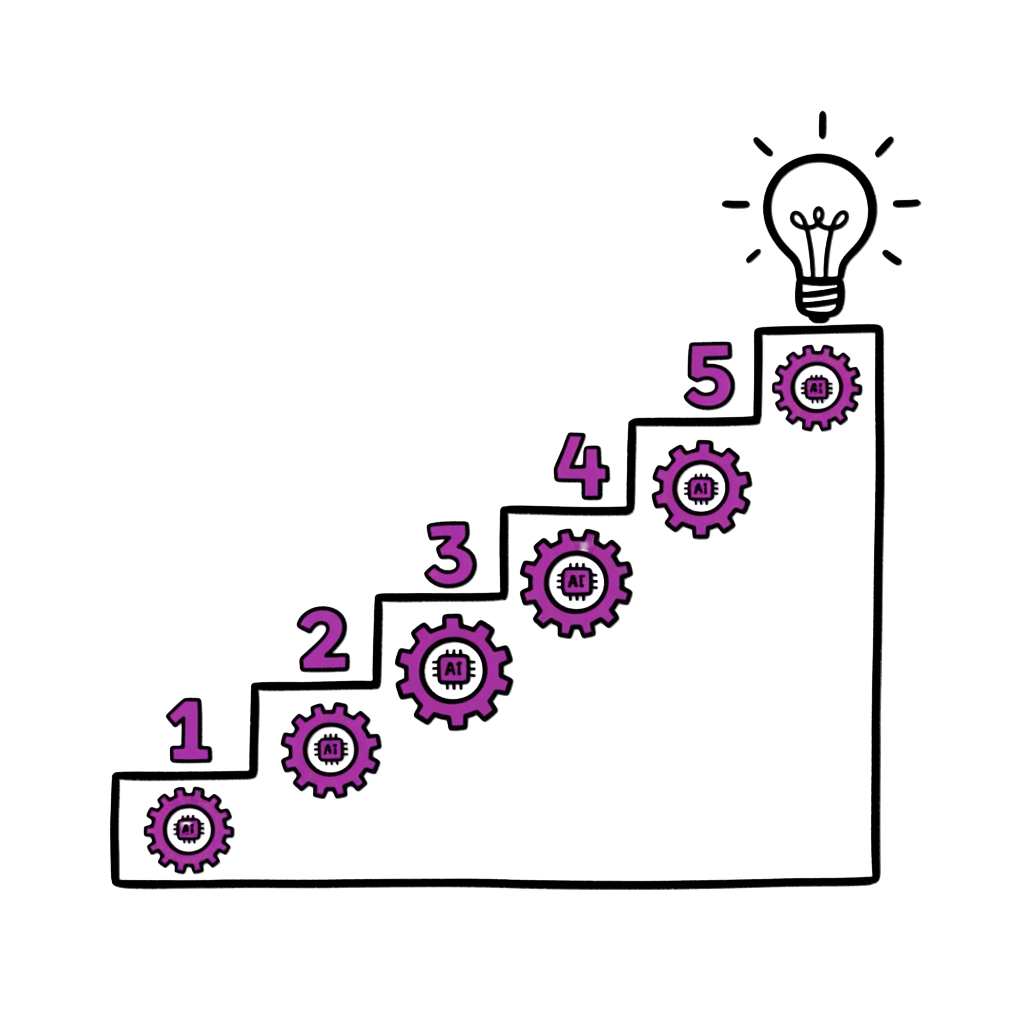
Think of it as a maturity ladder. Each level shifts the impact from teacher time saved to student learning gained to whole-school transformation.
You don't climb it once. You move up and down depending on the task.
But most schools are stuck at Levels 1–2.
The real compounding gains start at Level 3.
| Level | Name | Primary Goal | What AI Does | What You Must Do |
|---|---|---|---|---|
| 1 | Time Back | Reduce workload | Drafts, formats, summarises | Verify, adapt, remove errors |
| 2 | Quality Up | Improve lesson quality | Alignment checks, rubrics, misconception hunting | Provide outcomes, constraints, quality criteria |
| 3 | Learning Gain | Increase retention and mastery | Retrieval practice, feedback stems, targeted mini-tasks | Ensure correctness, spacing, feedback quality |
| 4 | Student Agency | Teach learners to think with AI | AI-supported inquiry, critique, reflection | Set boundaries, integrity norms, transparency |
| 5 | System Change | Make AI safe, equitable, repeatable | Policy, tooling, PD systems, risk management | Lead governance, procurement, PD design |
Level 1: Time Back
This is where everyone starts. And it's genuinely useful.
Best use cases (high frequency, lower stakes):
- Parent emails, newsletters, meeting summaries
- First-draft lesson outlines
- Differentiation drafts (three reading levels, language supports)
- Slide skeletons, worksheet formatting, question bank drafts
The guardrails that aren't optional
No student PII in public AI tools. Follow your district or country's guidance on vendor vetting.
The Trust Ladder: AI draft → teacher verification → classroom use. Never skip the middle step. NIST flags reliability and information integrity as core GenAI risks. Your verification is the risk control.
A reusable prompt pattern (copy this)
Every time you use AI for prep, include four elements:
- Role: "You are a lesson-prep assistant."
- Context: Grade, subject, time, constraints, learner needs.
- Output format: Headings, bullets, durations, materials.
- Verification request: "Flag anything you are uncertain about."
That last line matters. It forces the AI to signal where you should double-check.
Level 2: Quality Up
This is where AI becomes valuable because you provide structure.
Most teachers I work with reach Level 2 within a single bootcamp session. But they only stay here if they understand two things: constructive alignment and Bloom's taxonomy.
Constructive alignment: the non-negotiable check
Constructive alignment means your outcomes, activities, and assessments point in the same direction. When they don't, students find workarounds, and AI makes those workarounds faster.
Before you use any AI-generated lesson material, run this two-minute check:
- What will students know or do by the end (observable)?
- Which activity forces them to think at the target Bloom level?
- Does the assessment measure the same thing the activity teaches?
- What misconceptions might appear, and how will you surface them?
Two minutes. Four questions. Prevents hours of wasted effort.
Bloom's taxonomy as your AI quality filter
Revised Bloom's gives you a Knowledge × Cognitive Process lens. It's the fastest way to check whether AI-generated content targets the right cognitive level.
The most common mistake I see: AI generates content at the "Remember" level when the outcome requires "Analyse" or "Evaluate."
Fix: specify the Bloom level in your prompt. "Generate questions that require students to evaluate two competing theories" produces dramatically different output than "Generate questions about this topic."
Level 3: Learning Gain
Level 3 is where AI stops being "teacher productivity" and starts being "learning science at scale."
This is the level most schools never reach. And it's the level where the research is strongest.
Retrieval practice: make memory stick
Retrieval practice (pulling information from memory rather than re-reading it) improves long-term retention more than almost any other strategy.
Roediger and Karpicke's landmark 2006 study showed that students who practiced retrieval significantly outperformed students who restudied the material, even though the restudying group felt more confident in the moment. The testing effect is now one of the most replicated findings in cognitive science.
AI is excellent at generating large numbers of retrieval items. But the teacher must ensure accuracy and appropriate spacing.
The "Practice Loop" (a weekly reusable routine)
- Identify the 5–8 "must-remember" ideas from your unit.
- Use AI to generate 20 retrieval questions (mixed difficulty).
- Schedule spaced checks: Day 1, Day 3, Day 7, Day 14.
- Use results to reteach only what's needed.
This loop is repeatable. Week after week. Unit after unit. The AI generates. You verify. The spacing does the heavy lifting.
Feedback: high impact, but quality varies wildly
A large meta-analysis found feedback has meaningful positive effects on learning, but the effects range widely, including negative effects when feedback is poorly designed.
AI can draft feedback. But unedited AI feedback tends toward the generic.
Use these three stem types (edit them for your subject):
- Task level: "You correctly identified X. Next, fix Y."
- Process level: "Try this strategy: …"
- Self-regulation level: "Check your work by …"
Those categories come from Hattie and Timperley's feedback framework. They give AI-generated feedback a structure worth keeping.
Level 4: Student Agency
At Level 4, students use AI in visible, accountable ways that strengthen thinking rather than replace it.
This is the hardest level for schools. It requires trust, clear norms, and redesigned assessments.
Four classroom norms that actually work
I've tested these across dozens of classrooms. Four norms, all non-negotiable:
- Transparency: "If AI helped, show what it did and what you changed."
- Attribution: Students annotate AI contributions.
- Verification: Students provide evidence for claims, not just AI output.
- Reflection: "What did I learn? What did AI do? What will I do differently next time without AI?"
The integrity design move that replaces "AI-proof" assessments
Stop trying to make assessments AI-proof. Start making them AI-resistant.
Require thinking that AI can't shortcut:
- Oral defence of written work
- Process logs showing revision stages
- Source checking and critique of AI output
- Compare-and-revise tasks (student draft vs. AI draft)
These approaches don't ban AI. They make AI use visible and accountable.
UNESCO's AI Competency Framework for Teachers maps exactly this territory: five areas: human-centred mindset, ethics, AI foundations, AI pedagogy, and professional development. It's a roadmap for everything Level 4 asks of teachers.
Level 5: System Transformation
Level 5 is where schools stop running random experiments and start building a repeatable, safe capability.
Most schools aren't here yet.
TeachAI reports that only 18% of U.S. principals said they had AI guidance, and that drops to 13% in high-poverty schools. Many systems are building policy capacity from scratch.
The minimum viable governance set
You need five things. Not twenty. Five.
- Vision and principles: human-centred, equitable, learning-first.
- Tool approval and vendor vetting: privacy, data retention, transparency.
- Staff PD pathway: baseline → advanced → champions.
- Assessment integrity guidance: what's allowed, where, how.
- Quarterly review cycle: risks, incidents, improvements.
UNESCO's global guidance and TeachAI's editable toolkit give you starting templates. You don't have to build from zero.
"This Sounds Like a Lot"
I hear that in every workshop.
And it's true, if you try to operate at all five levels next Monday.
Don't.
Start where you are. If you're at Level 1, good. Get your guardrails in place and move to Level 2. If you're at Level 2, start one retrieval practice loop (Level 3) this week.
The framework is a ladder, not a checklist. You climb one rung at a time.
But here's what changes when you have this map: you stop asking "What cool AI thing should I try?" and start asking "What level am I working at, and what would the next level look like?"
That question changes everything.
How Each Level Prevents the Two Failure Modes
Against hallucinations and false authority
- Levels 1–2: Teacher verification + "flag uncertainty" prompts catch most errors before they reach students.
- Level 3: Correctness checks before retrieval questions and feedback go live.
- Level 4: Students are required to justify, cite, and revise.
- Level 5: Approved workflows and governance catch systemic gaps.
Against cognitive offloading
- Level 2: Constructive alignment ensures activities force thinking at the right level.
- Level 3: Retrieval practice requires students to recall, not re-read.
- Level 4: Transparency and reflection norms make AI use visible.
- Level 5: Assessment integrity guidance prevents outsourcing by design.
Design for thinking with AI, not outsourcing thinking to AI.
What I've Seen When Schools Use This Framework
A curriculum coordinator at an international school started with this framework in September.
She focused her department on Level 2 alignment checks for the first term. Just the four-question checklist. By December, her teachers were spending noticeably less time on lesson revisions, because the AI-generated content was better from the start. Aligned prompts produce aligned output.
Then she introduced the Level 3 practice loop in January.
Within six weeks, her department had a shared bank of 400+ verified retrieval questions across three subjects. Teachers stopped building questions from scratch. They refined what the AI generated. The quality improved with each cycle.
Different teachers. Different subjects. Same framework. Same trajectory.
And here's the thing that surprised her most: the framework reduced teacher anxiety about AI. When you know which level you're working at, you stop worrying about "doing AI wrong." You just do the work.
The Weekly AI Instructional Sprint (30 Minutes)
This is the section you'll come back to.
Four weeks. Rotating focus. Thirty minutes each. It turns AI from an occasional experiment into a steady, sustainable practice.
Week A: Plan
- Choose 1 lesson → run the Level 2 alignment check (four questions).
- Generate 10 retrieval questions for your unit (Level 3).
- Draft 3 differentiation variants (Level 1).
Week B: Teach
- Run a short retrieval warm-up (5 minutes, start of class).
- Capture misconceptions that surface.
- Use AI to draft a 5-minute reteach script. Then verify it.
Week C: Assess and Reflect
- Convert 1 assessment to a "process-visible" version (Level 4).
- Add a student reflection: "What did AI do? What did you change?"
Week D: Improve the System
- Share 1 best prompt + 1 risk lesson learned with your department.
- Update team guidance or policy if needed (Level 5).
Then repeat.
After four cycles, this becomes automatic. After a term, it transforms your practice.
From Framework to Classroom: How to Move Faster
I designed this framework to be self-serve. You can run the weekly sprints on your own.
But if you want to compress months into days, three things accelerate the work.
Bootcamps move educators from Level 1 to Level 3 in a single session. Teachers leave with an aligned lesson, a retrieval practice set with spacing plan, a feedback stem bank, and a classroom AI transparency protocol, all ready to use Monday morning. Not theory. Artefacts.
Courses build progression over weeks: AI literacy, ethics, pedagogy integration, and professional growth. This prevents "one-and-done PD" and builds lasting capability, aligned with UNESCO's teacher competency framework areas.
Consultations handle what individual teachers can't solve alone: vendor vetting, policy drafting, PD pathway design, assessment integrity frameworks. This is Level 5 work. And it needs someone who's done it before.
Why does it work fast? Because teachers don't just learn what AI can do, they leave with ready-to-run instructional assets and a repeatable process, grounded in constructive alignment, Bloom's, and retrieval science.
That's the difference between "inspiring" and "operational."
Three Staff PD Videos Worth 15 Minutes Each
If you're building team capability, start with one of these per staff meeting. Watch it. Discuss for 10 minutes. You'll cover more ground than most full-day PD events.
Sal Khan: How AI Could Save Education (TED) Use for: vision-setting + "AI as tutor" discussion.
UNESCO: Teacher to Teacher, AI Reshaping Education? Use for: equity, ethics, and classroom realities.
Ethan Mollick: Co-Intelligence in the Classroom Use for: prompt habits and practical adoption culture.
Your Assignment
Don't bookmark this and forget it.
Do one thing this week:
- Open the 5-level table above.
- Identify which level you spend most of your time at.
- Pick one action from the next level up.
- Do it before Friday.
That's it. One rung. One week.
This framework will be here when you come back for the next one.
References
- UNESCO, Guidance for Generative AI in Education and Research (2023): unesdoc.unesco.org
- NIST, AI 600-1: Generative AI Profile (2024): doi.org/10.6028/NIST.AI.600-1
- UNESCO, AI Competency Framework for Teachers (2024): unesdoc.unesco.org
- Biggs, Constructive Alignment: tru.ca
- Krathwohl, Revised Bloom's Taxonomy (2002): ihmc.us
- Roediger & Karpicke, The Power of Testing Memory (2006): wustl.edu
- Wisniewski et al., Power of Feedback Revisited (meta-analysis): pmc.ncbi.nlm.nih.gov
- MIT Media Lab, Your Brain on ChatGPT: media.mit.edu
- TeachAI Toolkit: teachai.org/toolkit
- Student Privacy Compass, State AI Guidance: studentprivacycompass.org
Just used this in our PD session. Teachers loved having a clear progression path instead of vague "use more AI" advice.