Workshops
Capturing Students’ Thinking: Insights That Guide Inquiry
See what a student's notes tell you while the lesson is still running, and tell a stuck student from one who is thinking.
What’s inside
Capturing Students’ Thinking: the recording
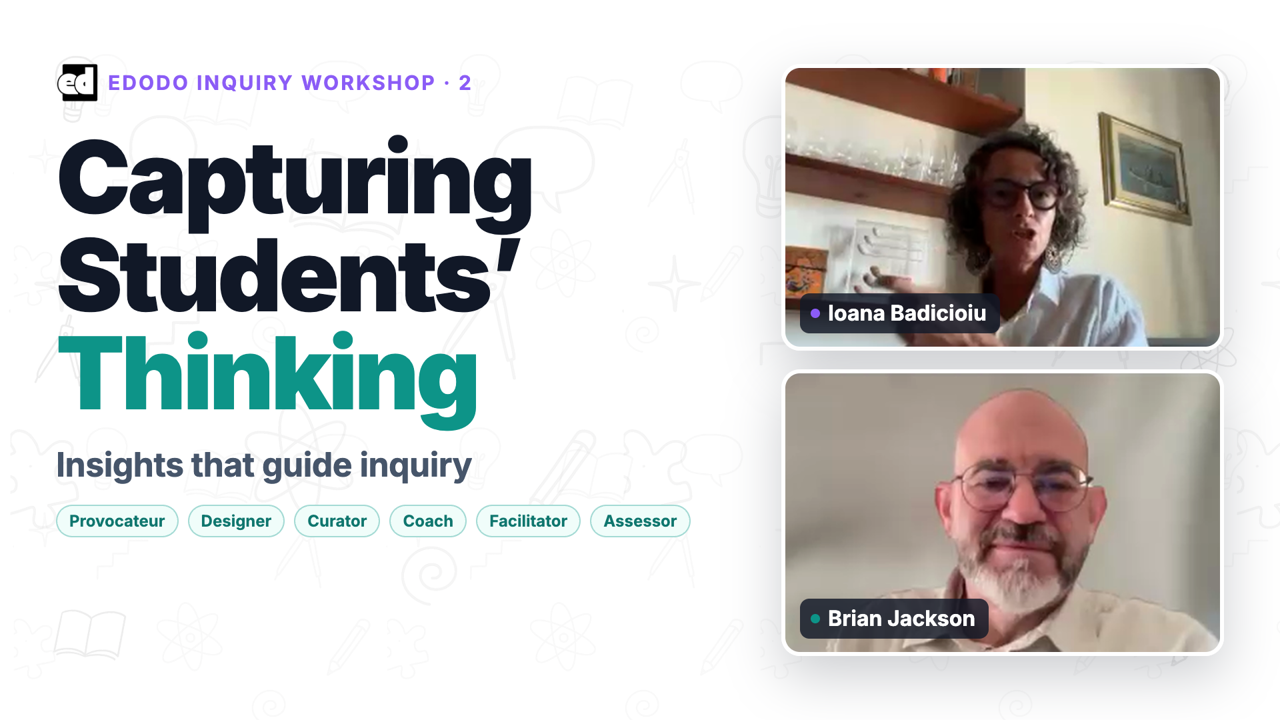
Led by Ioana Badicioiu and Brian Jackson.
A recording of a session held on Aug 15, 2026 · 49 min
Capturing Students’ Thinking: notes from the session
The six roles, and what each one reads in a student's notes.
10 pages
The Cornell Notes pack
A page to print, with Cues questions written for humanities, science and maths, and design and the arts.
9 pages
Who it’s for
School teachers, in an IB programme or any inquiry-based curriculum, who set work that students research on their own.
About this resource
A clean final essay no longer proves that a student did the thinking. It could be their best week, or a few minutes with a chatbot. So look at the messy middle: the notes they write while they work.
This is a recording of a session held online and led by Ioana Badicioiu and Brian Jackson. Ioana teaches language and literature, and Brian has taught many subjects for over twenty years. They use a Cornell Notes page to read a student's thinking during a lesson, through six roles a teacher plays as that lesson runs.
What you'll take away
- How to read a Cues column at a glance. A blank one and one full of hard questions need opposite responses.
- What to do for a stuck student in about ninety seconds, in place of rescuing them or walking past.
- What to say when the room goes silent: ask students to read out a question they already wrote.
- Why the summary at the end should never get a grade. Once notes are graded, students perform for you.
- A Cornell Notes page to print, with Cues questions already written for three groups of subjects.