
Lightning Round
At a Glance
- Time: 60-90 seconds
- Prep: None
- Group: Whole class (individual participation)
- Setting: In-person (requires space for movement)
- Subjects: Universal (especially effective for math, vocabulary, sequences)
- Energy: High
Purpose
Jump-start physical and mental engagement by combining rapid movement with content recall. Use this at the beginning of class to wake up sleepy students or mid-lesson to reset energy and reinforce foundational knowledge like multiplication tables, vocabulary, or sequences.
How It Works
Step-by-step instructions:
- ANNOUNCE (5 seconds) - "We're doing Lightning Round! Stand up. You'll do 10 jumping jacks while reciting multiplication tables out loud. Ready?"
- DEMONSTRATE (10 seconds) - Show the first 2-3 jumping jacks while counting and saying a multiplication fact
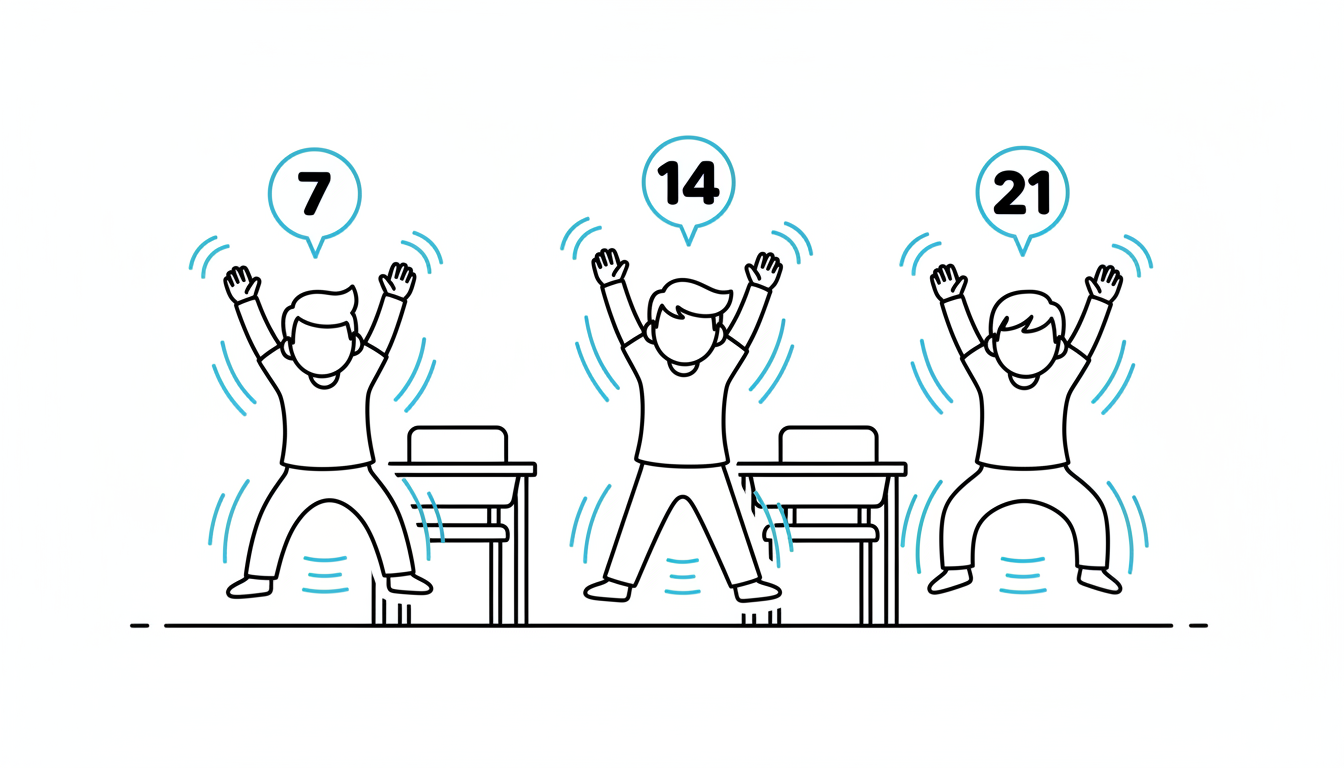
- EXECUTE (60 seconds) - Students perform 10 jumping jacks while reciting (e.g., "1 times 7 is 7, 2 times 7 is 14..." or counting by 7s)
- FINISH (5 seconds) - "Excellent! Sit down. Brains are awake. Let's use them."
What to Say
Opening: "Energy check—how are we feeling? Sleepy? Let's fix that. Stand up. You're going to do 10 jumping jacks while reciting the 7 times table out loud. If you can't remember all of them, count by 7s. I'll do it with you. Ready? Let's go!"
During: Count along with them: "One! Two! Three!" or call out the multiplication facts: "7! 14! 21!"
Closing: "Nice work! Feel that? Your brain just got a burst of oxygen. That's going to help you focus for the next 15 minutes. Let's put that energy to work."
Why It Works
Physical activity increases blood flow and oxygen to the brain, measurably improving focus, concentration, and alertness. Combining movement with cognitive recall (reciting facts) engages both body and mind simultaneously, creating a powerful attention reset. The brief burst of exercise releases endorphins and dopamine, improving mood and motivation. This is embodied cognition in action—movement enhances learning.
Research Citation: Multiple studies on physical activity and cognitive function demonstrate improved attention and focus following brief exercise (Ratey & Hagerman, 2008).
Teacher Tip
Do it WITH them, not just to them. When you participate—jumping and reciting alongside students—you model enthusiasm and signal that this is a valued part of class, not just a time-filler. Your energy is contagious. If you're half-hearted, they will be too.
Variations
For Different Subjects
- Math: Multiplication tables, skip counting, number sequences, reciting formulas
- Language Arts: Spelling high-frequency words aloud, reciting vocabulary definitions, alphabet backwards
- Science: Reciting periodic table symbols, order of planets, parts of a cell
- History: Chronological order of events, presidents, capitals
- Foreign Language: Counting in target language, days of the week, colors
For Different Settings
- Large Class (30+): Everyone does it at once (controlled chaos is fine!)
- Small Class (5-15): Can go around in a circle, each person doing one jumping jack and one fact
- Limited Space: Modify to arm circles, desk push-ups, or standing toe-touches instead of jumping jacks
For Different Ages
- Elementary (K-5): Keep it to 5-8 jumping jacks. Use simple sequences like counting by 2s or 5s. Make it silly and fun.
- Middle/High School (6-12): Standard 10 jumping jacks. Can increase difficulty by using more complex content (square roots, historical dates, etc.).
- College/Adult: Same as above, but frame it as "brain activation" rather than "fun game." Adults respond well to the neuroscience explanation.
Online Adaptation
Tools Needed: None (Zoom, Teams, or any video platform)
Setup: Have students turn cameras on and stand up in frame.
Instructions:
- "Stand up where I can see you on camera."
- "We're doing 10 jumping jacks while reciting the 7 times table. Mute yourself or unmute—your choice. I want to see movement!"
- Demonstrate first jumping jack and fact.
- Do it together. Count out loud.
Pro Tip: Make it a "popcorn" style where you call on students to unmute and shout out the next fact while everyone jumps. Creates energy and accountability.
Troubleshooting
Challenge: Students are self-conscious or refuse to participate. Solution: Start by doing it yourself first. Say, "Watch me." Do 3 jumping jacks enthusiastically. Then say, "Your turn—stand up." Lead by example. After 2-3 times doing this activity, resistance disappears.
Challenge: Some students can't do jumping jacks (physical limitations, injuries). Solution: Offer modifications ahead of time: "If jumping doesn't work for you, do arm circles or march in place. Just keep moving and reciting."
Challenge: The content (multiplication tables) is too easy or too hard. Solution: Differentiate. "If 7s are easy, challenge yourself with 12s. If 7s are hard, do 2s or 5s." Or allow students to count by any number they choose.
Extension Ideas
- Deepen: After the jumping jacks, ask a quick comprehension question: "Why did we just recite the 7 times table? Where will we use this today?" Connect it to the lesson.
- Connect: Track improvement. "Last week, most of you got stuck around 7 x 6. This week, everyone made it to 7 x 10! Growth!"
- Follow-up: Challenge them to practice at home. "Tomorrow, Lightning Round will be the 8 times table. Practice tonight if you want to crush it."
Related Activities: Shake It Off, Robot Walk, Air Writing