
Think-Pair-Share
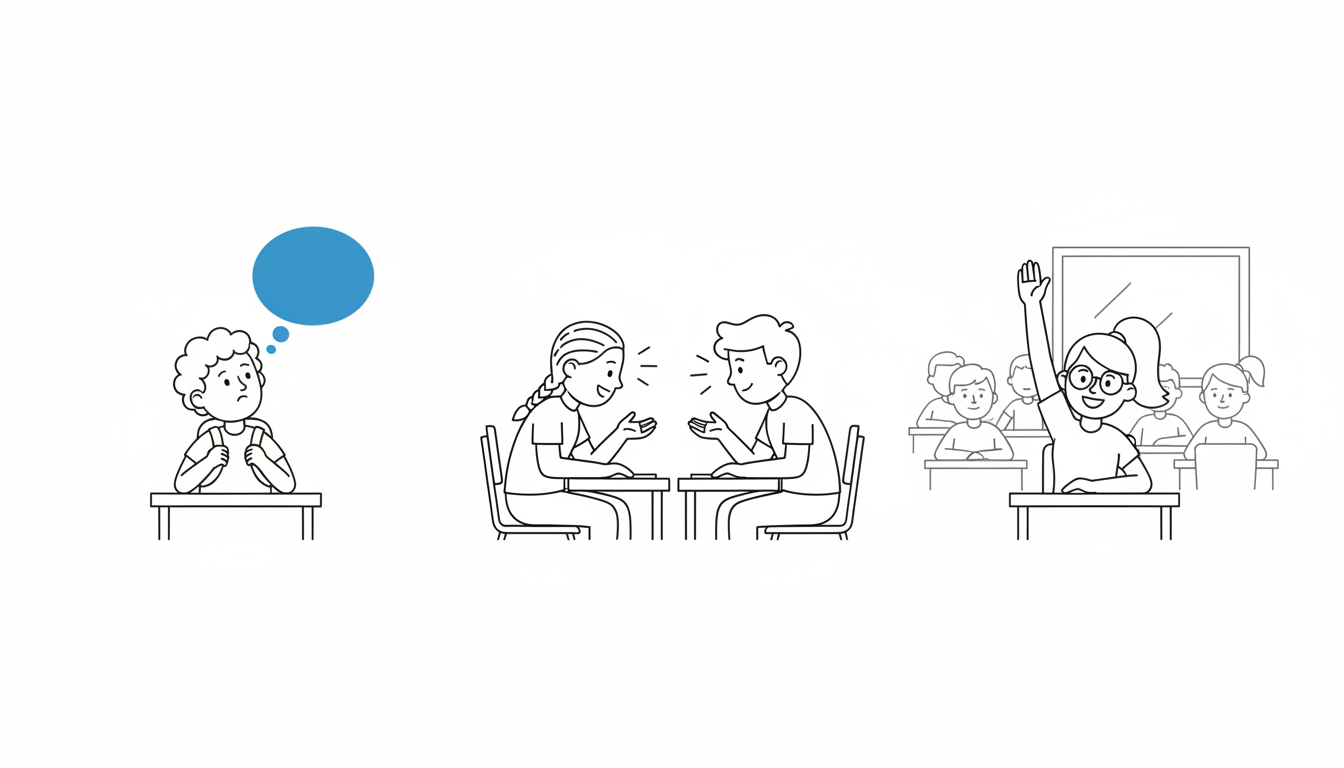
At a Glance
- Time: 3-5 minutes
- Prep: None
- Group: Pairs
- Setting: Any classroom context
- Subjects: Universal - works in any discipline
- Energy: Low to Medium
Purpose
Think-Pair-Share is the cornerstone collaborative learning technique that transforms passive classrooms into active learning environments. Use it when you want every student to engage with a question or concept—not just the three students who always raise their hands. This activity ensures 100% participation by giving learners time to formulate thoughts individually before testing ideas in a low-stakes peer conversation.
How It Works
Step-by-step instructions:
-
POSE THE QUESTION (10 seconds) - Present a higher-order thinking question to the entire class. Write it on the board or display it visually so students can reference it.
-
THINK INDIVIDUALLY (30-60 seconds) - Students sit silently and think about their response. Optional: have them jot down notes.
-
PAIR UP (10 seconds) - Students turn to a neighbor to form pairs. If you have an odd number, create one trio.
-
SHARE IDEAS (60-90 seconds) - Partners take turns explaining their thinking. Each person should get roughly equal airtime.
-
WHOLE CLASS SHARING (1-2 minutes) - Call on a few pairs to share key ideas that emerged from their conversations with the full group.
What to Say
Opening: "I'm going to ask you a question that requires some thinking. First, you'll have 30 seconds to think about it on your own—silently, without talking. Then you'll turn to a partner and share your ideas. Here's the question: [POSE YOUR QUESTION]. Start thinking now."
During: "Remember, each person should get a chance to explain their thinking. Listen actively to your partner—their ideas might give you a new perspective."
Transition to Whole-Class: "I heard some fantastic conversations. Who would like to share something interesting that came up in your discussion? You can share your own idea or something your partner said that made you think differently."
Closing: "Thank you for engaging so thoughtfully. Notice how your understanding became clearer when you had to explain it to someone else."
Why It Works
Think-Pair-Share leverages multiple research-backed learning principles:
Individual Processing Time: The "Think" phase gives all students—especially introverted or slower processors—time to develop their ideas before social pressure to respond kicks in.
Rehearsal Effect: Articulating ideas to a peer serves as a low-stakes rehearsal before potentially sharing with the whole class. This builds confidence and refines thinking.
Social Learning Theory: Students learn through observation and discussion with peers who use more accessible language than teachers often do.
Engagement Multiplier: Instead of one student responding while 29 listen (or tune out), all 30 students are actively processing the content simultaneously.
Research Citation: Lyman (1981) developed Think-Pair-Share as part of the Cooperative Learning movement. Studies show it increases student participation by 300-400% compared to traditional question-and-answer methods (Chickering & Gamson, 1987).
Teacher Tip
The most common mistake with Think-Pair-Share is not waiting long enough during the "Think" phase. The silence feels uncomfortable, so teachers rush to the "Pair" step. Resist this urge. Use a visible timer and honor the full 30-60 seconds. You'll notice that by second 20, students who were initially staring blankly start showing signs of mental engagement—looking at their notes, nodding slightly, or writing something down. That cognitive shift is exactly what you're waiting for.
Variations
For Different Subjects
-
Math/Science: "Think about how you would solve this problem. When you pair up, explain your solution strategy step by step, not just the answer."
-
Humanities: "Think about the author's purpose in this passage. When you share with your partner, support your interpretation with specific textual evidence."
-
Foreign Language: "Think about how you would describe [concept] in [target language]. Share your description with your partner and help each other refine pronunciation and grammar."
For Different Settings
-
Large Class (30+): Use a randomization method for pairing (e.g., "Turn to the person behind you" or "Find someone wearing a similar color") to ensure students interact with different people each time.
-
Small Seminar (5-15): After pair discussions, have every pair share briefly rather than just calling on volunteers, ensuring all voices are heard.
-
Lab/Studio Setting: Students can Think-Pair-Share while remaining at their workstations—no need to move around.
For Different Ages
-
Elementary (K-5): Reduce think time to 20 seconds for younger learners. Use concrete questions: "Think about your favorite character. What makes them special?"
-
Middle/High School (6-12): Standard 30-60 second think time works well. Increase complexity of questions to match developmental level.
-
College/Adult: Can extend to 90-120 seconds for complex conceptual questions. Students may appreciate jotting down notes during think time.
Online Adaptation
Tools Needed: Video conferencing platform with breakout rooms (Zoom, Google Meet, Microsoft Teams)
Setup: Prepare your question in advance and have it ready to screen-share or post in chat.
Instructions:
- Pose your question and ask everyone to mute and turn off cameras for individual thinking (30-60 seconds)
- Use the "Breakout Rooms" feature to automatically pair students (or create rooms manually)
- Set a timer for 90 seconds and let the platform auto-return students to the main room
- Debrief by calling on pairs to share their ideas
Pro Tip: In virtual settings, use the chat function during the "Think" phase—have students type their initial thoughts privately (not send). This serves as their "notes" and helps them commit to an idea before hearing others.
Troubleshooting
Challenge: Students finish their pair discussion in 20 seconds and then sit silently.
Solution: Give more specific discussion prompts: "First person, share your main idea for 30 seconds. Second person, share yours for 30 seconds. Then together, identify one place where your ideas differ." Structured turn-taking prevents one student from dominating.
Challenge: During whole-class share, students only report "We said the same thing as everyone else."
Solution: Reframe your call for sharing: "Tell us one specific example or piece of evidence that came up in your discussion" rather than asking for general summaries. Specificity reveals the unique thinking that occurred.
Challenge: Some students don't have a partner because of absences or odd numbers.
Solution: Form one trio and give them the same amount of time—three students can cycle through sharing quickly, or operate in a listener-speaker-observer rotation.
Extension Ideas
-
Deepen: Add a "Square" step (Think-Pair-Square) where two pairs join to form a group of four and synthesize the best ideas from both conversations.
-
Connect: Use sequential Think-Pair-Shares throughout a lesson at key transition points to build understanding progressively.
-
Follow-up: Create a variation called "Pair-Share-Repeat" where after the first pair discussion, students find a NEW partner and share what they learned from their first conversation. This cross-pollinates ideas across the classroom.
Related Activities: Pair-Share-Repeat, Turn and Talk, Buzz Groups