
Logic Puzzles
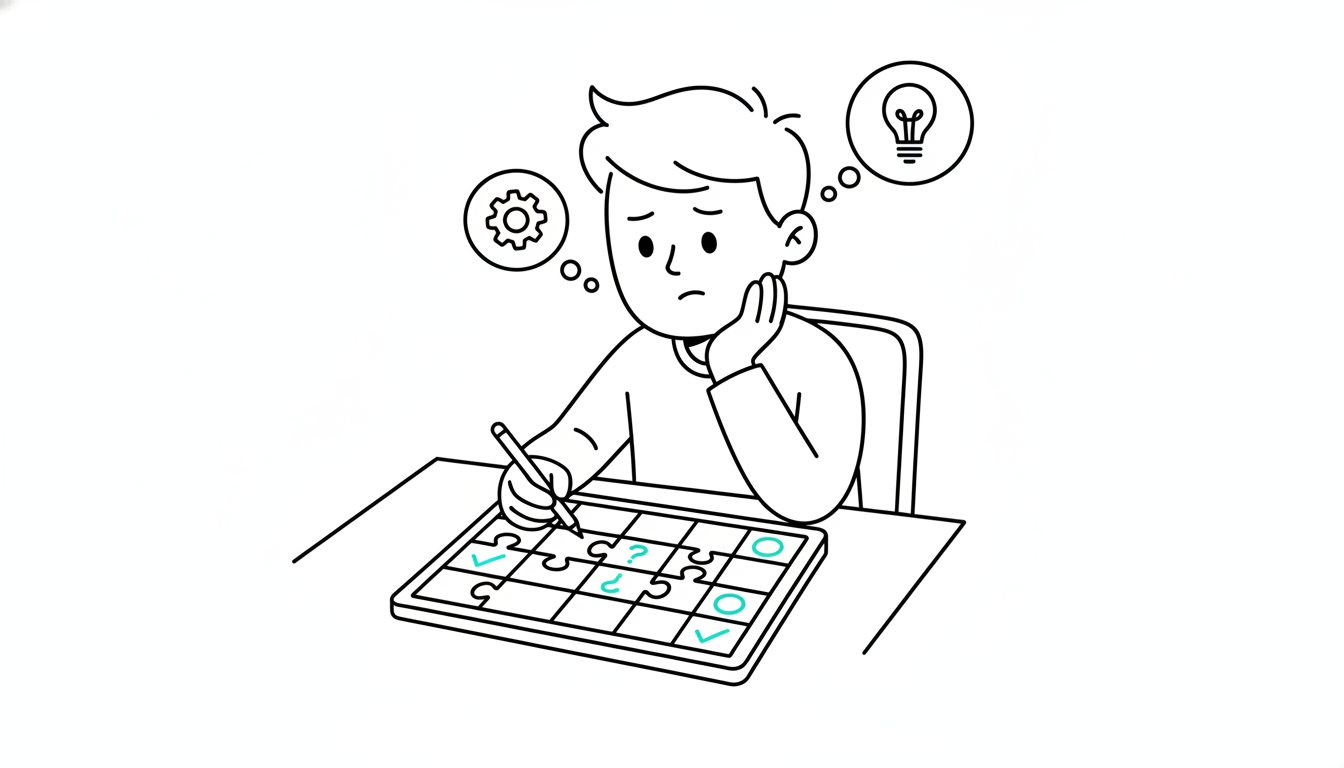
At a Glance
- Time: 3-5 minutes
- Prep: Minimal (select or create appropriate puzzle)
- Group: Individual or pairs
- Setting: Any classroom
- Subjects: Universal (transferable reasoning skills)
- Energy: Low-Medium
Purpose
Develop deductive reasoning, systematic problem-solving, and attention to detail through engaging brain teasers that require students to use given information to reach logical conclusions. Use this as a warm-up, transition activity, or to build reasoning skills that transfer across disciplines.
How It Works
Step-by-step instructions:
-
Present the puzzle (30 seconds) - Display a logic puzzle: a classic logic grid (Einstein's riddle), a riddle requiring deduction, or a spatial/pattern reasoning challenge. Ensure all necessary information is clearly visible
-
Solve individually or in pairs (2-4 minutes) - Students work systematically through the given clues, using deductive reasoning to eliminate possibilities and identify solutions. Encourage writing things down rather than solving entirely mentally
-
Share solution and reasoning (30-60 seconds) - Reveal the answer and, crucially, walk through the logical steps: "If X is true, then Y can't be true, which means Z must be true..." Emphasize the reasoning process, not just the answer
What to Say
Opening: "Here's today's logic puzzle: Five students—Alex, Blake, Casey, Dana, and Elliot—each like a different subject. Using these clues, can you figure out who likes what? Clue 1: The person who likes Math sits next to Blake. Clue 2: Casey doesn't like Science... Work with a partner. You have 3 minutes. Go!"
During: "Start by writing down what you know for certain... What can you eliminate?... If that's true, what else must be true?... Work systematically—don't just guess... Use a grid or chart to track possibilities..."
Closing: "Time's up! The answer is: Alex-History, Blake-Math, Casey-English, Dana-Science, Elliot-Art. Who got it? More importantly, let's trace the logic: From Clue 1, we knew Math wasn't Blake, so... This type of systematic reasoning—eliminating possibilities, testing hypotheses—is exactly what scientists, programmers, and detectives do."
Why It Works
Logic puzzles require focused, systematic thinking that builds transferable reasoning skills. Unlike problems with obvious solutions, logic puzzles force students to hold multiple pieces of information simultaneously, test hypotheses, and work through implications methodically. The engaging format (riddles, grids, patterns) makes abstract logical reasoning concrete and fun. Success builds confidence in tackling complex problems that initially seem overwhelming. The clear right-or-wrong answer provides immediate feedback on reasoning accuracy.
Research Connection: Training in formal logic and deductive reasoning improves students' ability to evaluate arguments, identify fallacies, and solve novel problems across domains (Nisbett et al., 1987; Lehman & Nisbett, 1990).
Teacher Tip
Don't let students shout out answers—this robs others of the thinking process. Instead say: "If you've solved it, write your answer down but don't share yet. Give everyone thinking time." The goal isn't getting the answer quickly; it's developing the reasoning pathway to get there systematically.
Variations
For Different Subjects
- Math/Science: Logic grid puzzles involving numbers, sequences, or scientific classification. "Using these chemical properties, identify which element is which"
- Humanities: Mystery scenarios, "whodunit" puzzles, riddles requiring historical knowledge or literary analysis
- Universal: Classic puzzles (river crossing, hat riddles, grid logic puzzles), Sudoku, lateral thinking riddles
For Different Settings
- Large Class (30+): Project puzzle on screen; students work individually first, then compare answers with a neighbor before whole-class reveal
- Small Group (5-15): Work as partners, then pairs share strategies and compare solutions
For Different Ages
- Elementary (K-5): Simpler puzzles with visual supports: "Three animals—cat, dog, bird—each like one food. Use picture clues to match them." Pattern completion puzzles
- Middle/High School (6-12): Classic logic grid puzzles, moderately complex riddles, multi-step deductive reasoning challenges
- College/Adult: Einstein-level puzzles, complex logical paradoxes, formal logic problems
Online Adaptation
Tools Needed: Screen share for puzzle presentation, collaborative docs for solving
Setup: Display puzzle clearly on screen; share text version in chat for accessibility
Instructions:
- Present puzzle via screen share with all clues visible
- Students work in breakout rooms or independently with scratch paper
- Use poll feature for answer reveal: "Which solution is correct: A, B, C, or D?"
- Screenshare solution process, walking through logical steps
Pro Tip: Use websites like Puzzle Baron's Logic Puzzles or BrainBashers—you can link directly to online interactive versions students can solve digitally
Troubleshooting
Challenge: Students guess randomly instead of using systematic reasoning Solution: Require them to show their work: "Draw a grid, cross out impossibilities, track what you know." Model the first step explicitly: "From Clue 1, we can eliminate these three possibilities. Now what?"
Challenge: Puzzle is too hard—students give up quickly Solution: Provide a scaffold: "Start by listing everything you know for certain from the clues... Now what's the first thing you can eliminate?" Or simplify: use a puzzle with fewer variables
Extension Ideas
- Deepen: After solving, have students create their own logic puzzle following the same format: "Write 4 clues that lead to one unique solution—test it on a partner"
- Connect: Discuss real-world applications: "Programmers debug code using deductive reasoning just like this... Doctors diagnose by eliminating possibilities based on symptoms... Where else do we use 'if-then' logic?"
- Follow-up: "Puzzle of the Week" challenge: post a new puzzle Monday, reveal solution Friday, track which students solve it for optional recognition
Related Activities: Divergent Thinking Prompts, One-Minute Problem Solving, Fact or Fiction