
Empathy Mapping
At a Glance
- Time: 4-5 minutes
- Prep: None
- Group: Individual or pairs
- Setting: Any classroom
- Subjects: Humanities, Social Sciences (adaptable to any content involving people/perspectives)
- Energy: Low-Medium
Purpose
Develop deep empathy and perspective-taking by creating a four-quadrant map showing what a person (character, historical figure, user) Says, Thinks, Does, and Feels. Use this to analyze motivations, understand stakeholders, or prepare for persuasive writing.
How It Works
Step-by-step instructions:
-
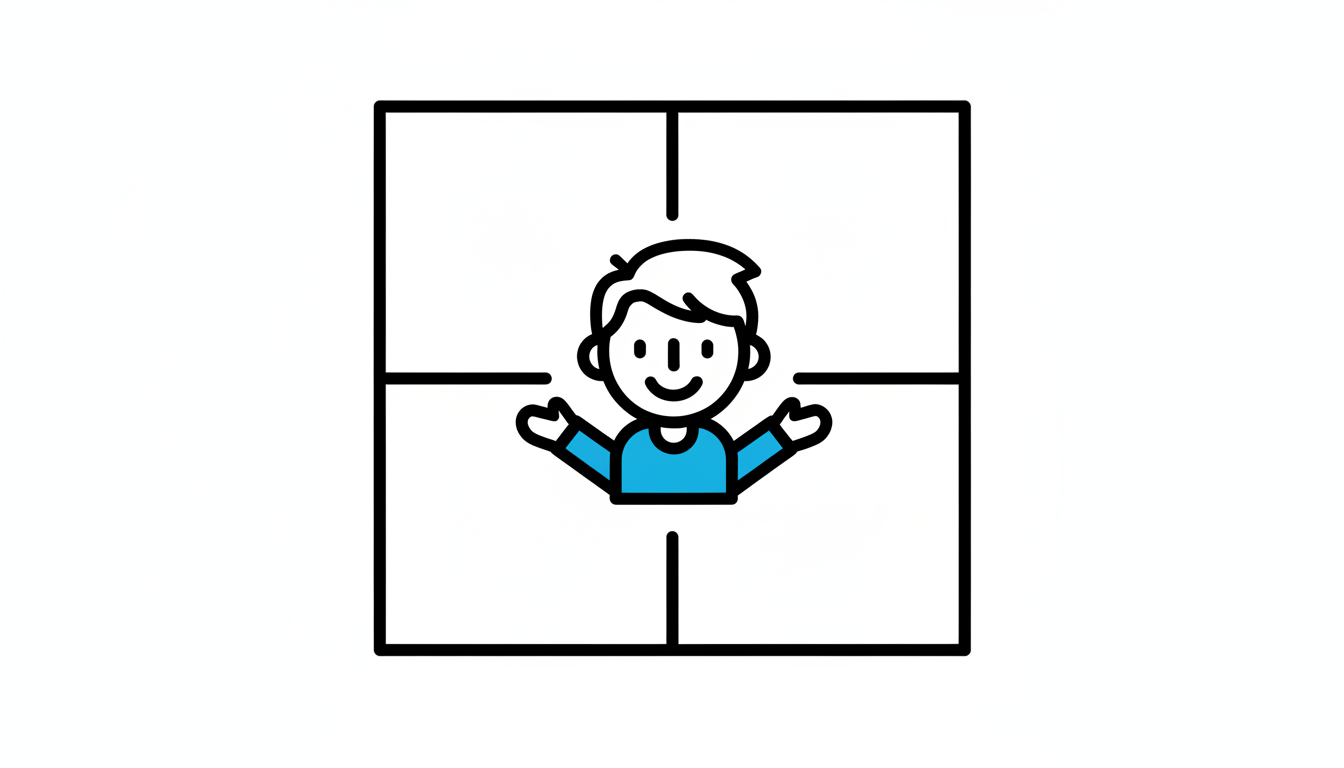
Set up the framework (30 seconds) - Draw a four-quadrant map. Label sections: SAYS (external communication), THINKS (internal thoughts), DOES (observable actions), FEELS (emotions). Place the target person's name/face in the center
-
Fill the quadrants (3-4 minutes) - Students analyze the assigned person and fill each quadrant with specific details. Push beyond surface-level: What do they say publicly? What might they actually think privately? What actions do we observe? What emotions drive them?
-
Synthesize insights (1 minute) - Look for gaps between quadrants: Where do their words not match their actions? What emotional needs drive their behavior? What motivations lie beneath surface actions?
What to Say
Opening: "We're creating an empathy map for Romeo at the moment he meets Juliet. Four quadrants: What does Romeo SAY at the party? What does he THINK internally? What does he DO—his observable actions? What does he FEEL emotionally? Be specific. Use evidence from the text. Go!"
During: "Don't just list—dig deeper... What's the difference between what he says and what he thinks?... What emotions are driving his actions?... Where's the tension between quadrants?... What does this reveal about his motivations?"
Closing: "Look at the full map. What gaps do you see? Romeo SAYS he loves Rosaline, but DOES nothing about it—what does that tell us? When Juliet appears, all four quadrants align immediately. This tool helps us move from 'what happens' to 'why it happens'—the difference between plot summary and character analysis."
Why It Works
Empathy mapping forces systematic consideration of both external (observable) and internal (inferred) dimensions of experience. The four-quadrant structure prevents one-dimensional thinking—students must consider words, thoughts, actions, and emotions simultaneously. Comparing quadrants reveals contradictions, tensions, and authentic motivations that drive behavior. This tool builds theory of mind—the ability to attribute mental states to others—which is fundamental to social cognition, persuasion, and collaborative problem-solving.
Research Connection: Perspective-taking exercises improve empathy, reduce bias, and enhance understanding of complex human behavior across contexts (Gehlbach et al., 2012; Todd et al., 2011).
Teacher Tip
The real insight comes from analyzing GAPS between quadrants. Someone who Says one thing but Does another? That's cognitive dissonance worth exploring. Feels one way but Thinks another? That's emotional conflict. Make the gaps visible and have students explain them—that's where deep understanding happens.
Variations
For Different Subjects
- Literature: "Map protagonist at key turning point, antagonist's perspective, author's stance"
- History: "Map historical figure at moment of decision, opposing sides in conflict, stakeholders in event"
- Science: "Map patient experiencing symptoms, researcher facing ethical dilemma, community affected by environmental issue"
- Design/Business: "Map user experiencing a product, customer facing a problem"
For Different Settings
- Large Class (30+): Individual maps, then pair-share to compare interpretations before whole-class discussion
- Small Group (5-15): Create one collaborative empathy map on chart paper as a class
For Different Ages
- Elementary (K-5): Use simpler labels: "Says, Thinks, Does, Feels" with picture supports; apply to storybook characters
- Middle/High School (6-12): Standard format with textual evidence requirements
- College/Adult: Add complexity: create maps for multiple stakeholders, then compare to analyze conflict or design solutions
Online Adaptation
Tools Needed: Collaborative whiteboard (Jamboard, Miro) or Google Slides template
Setup: Create four-quadrant template shared with students
Instructions:
- Share empathy map template on screen
- In breakout rooms or independently, students add sticky notes to each quadrant
- Return to main room to compare maps
- Use annotation tools to highlight gaps/tensions between quadrants
- Discussion: What did different students infer differently? Why?
Pro Tip: Use Miro's empathy map template—it's pre-formatted and students can work simultaneously
Troubleshooting
Challenge: Students fill "Says" and "Thinks" with the same content Solution: "That's rare—most people don't say exactly what they think! What might they say publicly vs. think privately? Where's the filter? The performance? The politeness? Find the gap."
Challenge: "Feels" section is vague emotions without nuance Solution: "Not just 'sad'—what specific emotional cocktail? Frustrated AND hopeful? Angry BUT guilty? Emotions are complex. Layer them."
Extension Ideas
- Deepen: After creating one map, create a second for the same person at a different time point. How do the quadrants shift? What changed?
- Connect: Create empathy maps for opposing sides in a debate or conflict, then use them to craft arguments that address each side's actual concerns
- Follow-up: Write from the perspective: "Write a diary entry from this person's point of view, using insights from your empathy map to capture their internal experience"
Related Activities: Perspective Flip, Reframing, Optimist-Pessimist