
Peer Review Writing
At a Glance
- Time: 5-10 minutes (for brief drafts; longer for full essays)
- Prep: Minimal - students need draft writing to exchange
- Group: Pairs
- Setting: Any classroom context
- Subjects: Writing-intensive courses (all disciplines)
- Energy: Low to Medium
Purpose
Peer Review Writing transforms students into critical readers and constructive critics. Use this when you want students to give and receive feedback on writing, develop meta-cognitive awareness of what makes writing effective, and practice revision skills. The structured protocol prevents vague feedback like "It's good" and pushes students to provide specific, actionable suggestions.
How It Works
Step-by-step instructions:
-
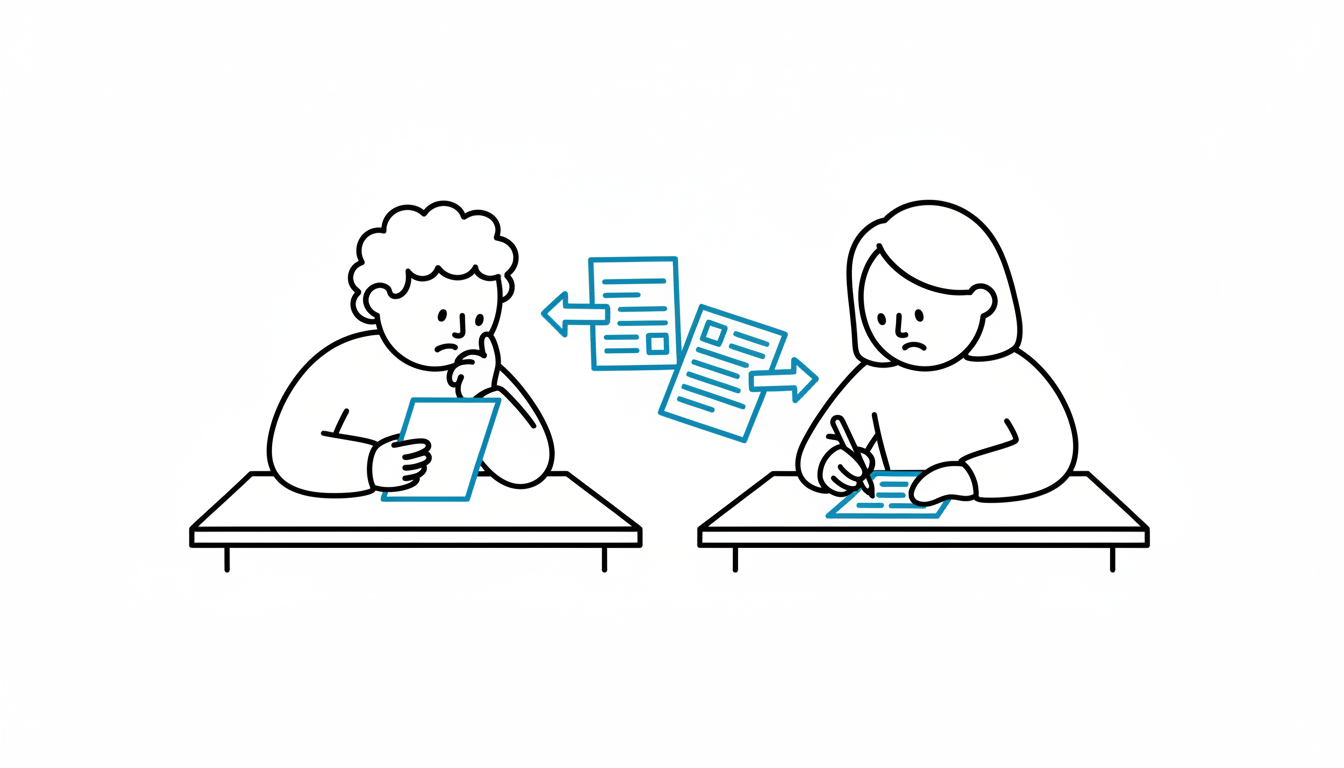
EXCHANGE DRAFTS (30 seconds) - Partners physically or digitally exchange their draft writing.
-
SILENT READING (2-3 minutes) - Each person reads their partner's draft silently without commenting yet.
-
STRUCTURED FEEDBACK ROUND 1: STRENGTHS (60 seconds) - Partners take turns sharing: "One thing your writing does well is..."
-
STRUCTURED FEEDBACK ROUND 2: QUESTIONS (60 seconds) - Partners take turns sharing: "One question I have after reading is..."
-
STRUCTURED FEEDBACK ROUND 3: SUGGESTIONS (60 seconds) - Partners take turns sharing: "One specific suggestion for revision is..."
-
OPTIONAL: WRITTEN FEEDBACK (2 minutes) - Partners write brief feedback directly on the draft or on a feedback form.
-
REFLECTION (1 minute) - Writers note which piece of feedback they plan to act on first.
What to Say
Setup: "You're going to exchange drafts with a partner and give each other feedback. Good peer review follows a structure: TAG—Tell something good, Ask a question, Give a suggestion. This ensures your feedback is both positive and constructive."
Reading Time: "First, read your partner's draft silently. As you read, think about these questions: What is the main point? Where is the writing strongest? Where did you get confused? You have 2 minutes of silent reading time."
Feedback Round 1: "Start with strengths. Tell your partner one specific thing their writing does well. Not just 'It's good,' but something specific like: 'Your opening sentence immediately grabbed my attention' or 'Your example about X really helped me understand the point.'"
Feedback Round 2: "Now ask a question. What did you wonder about while reading? This might be 'Can you explain more about why...?' or 'What do you mean when you say...?' Questions help writers see where readers get confused."
Feedback Round 3: "Finally, give one specific suggestion for making the writing stronger. This might be about organization, evidence, clarity, or style. Make it actionable: 'What if you moved this paragraph earlier?' or 'Could you add an example here?'"
Why It Works
Peer Review Writing develops multiple competencies simultaneously:
Critical Reading Skills: To give good feedback, students must read closely and analytically—skills that transfer to their own revision process.
Meta-Cognitive Awareness: Seeing common problems in peers' writing (weak thesis, insufficient evidence, unclear transitions) helps students recognize those issues in their own drafts.
Revision Motivation: Peer feedback feels less threatening than teacher feedback and often motivates revision because students want to address questions their peers raised.
Audience Awareness: Writing for real peer readers (not just "the teacher") strengthens students' sense of audience and purpose.
Community of Writers: Peer review creates a classroom culture where writing is seen as a collaborative, iterative process rather than a solitary, one-and-done task.
Research Citation: Research on peer review shows that students who both give and receive peer feedback improve their writing quality more than students who only receive teacher feedback (Cho & MacArthur, 2010).
Teacher Tip
The first time you use peer review, students will give vague feedback: "It's good. I liked it." Prevent this by modeling specific feedback yourself. Project a sample paragraph and think aloud: "The strength I notice is this vivid verb choice. My question is: who is 'they' in sentence 3? My suggestion is to add a transition between these two ideas." After seeing a model, students can replicate the specificity.
Variations
For Different Subjects
-
Science Lab Reports: Peer review Methods and Results sections for clarity and completeness.
-
Math Problem Solutions: Partners review each other's written explanations of how they solved a problem, checking for logical steps.
-
History/Social Studies: Peer review thesis statements and use of evidence in argument essays.
-
Any Subject: Peer review single paragraphs (not full essays) for quick, focused feedback in 5 minutes.
For Different Settings
-
Large Class (30+): After pair feedback, group 4 students together to compare the feedback each person received. What patterns emerge?
-
Small Class (8-15): Can do whole-group peer review where one volunteer's anonymous writing is projected and the class gives collective feedback (with kindness norms established first).
-
Online: Use Google Docs commenting feature or learning management system peer review tools.
For Different Ages
-
Elementary (K-5): Use simpler protocol: "Two Stars and a Wish" (two things done well, one wish for improvement). Can peer review single sentences or paragraphs.
-
Middle/High School (6-12): Standard TAG protocol works well. Can handle full essays.
-
College/Adult: Can use sophisticated protocols like calibrated peer review or double-blind peer review modeled on academic publishing.
Online Adaptation
Tools Needed: Google Docs (with commenting enabled) or learning management system peer review feature
Setup: Before class, pair students and share document links so each student can access their partner's draft.
Instructions:
- Students read partner's draft asynchronously or in breakout rooms
- Use Google Docs "Comment" feature to provide TAG feedback (Tell, Ask, Give)
- Optional: Reconvene in main room or follow-up breakout for verbal discussion of feedback
Pro Tip: Google Docs "Suggesting Mode" is perfect for peer review. Reviewers can suggest specific edits without permanently changing the writer's text. Writers can accept or reject each suggestion.
Troubleshooting
Challenge: Students focus only on surface errors (spelling, punctuation) and ignore content or organization issues.
Solution: Explicitly redirect: "Do NOT focus on spelling and grammar right now. Your job is to help your partner improve their ideas, evidence, and organization. If the content is strong, they can fix typos later."
Challenge: Some students give harsh or mean-spirited feedback that discourages the writer.
Solution: Teach feedback language: Always start with strength, frame suggestions positively ("What if you tried...?" rather than "This is bad"), and focus on the writing, not the writer ("This paragraph is unclear" not "You're a bad writer").
Challenge: Partners finish in 2 minutes instead of 10 because they rush through.
Solution: Require written feedback. "You must write at least 3 sentences on your partner's draft. That takes time. Use it."
Extension Ideas
-
Deepen: After receiving feedback, have writers complete a "Revision Plan" form: "Based on feedback, I will revise by... (specific actions)."
-
Connect: Do multiple rounds of peer review throughout the writing process: once on the outline, once on the first draft, once on the revised draft. This normalizes revision as a multi-stage process.
-
Follow-up: After students revise based on peer feedback, have them write a reflection: "One change I made based on peer feedback was... This improved my writing by..."
Related Activities: Gallery Walk, Critical Friends Protocol, Peer Teaching Pairs