
Human Periodic Table
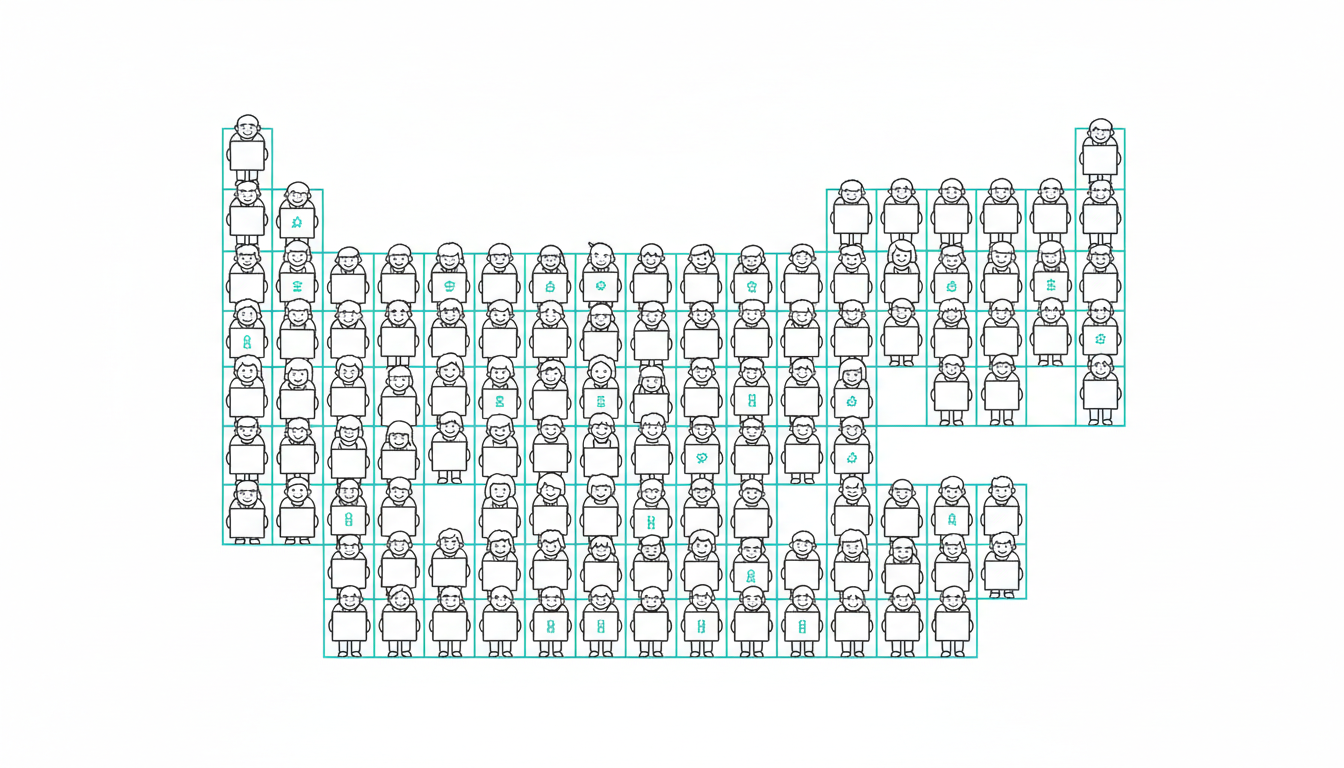
At a Glance
- Time: 4-5 minutes
- Prep: Minimal (element cards/labels or student-created signs)
- Group: Whole class (ideal for 18-30 students)
- Setting: Classroom or space large enough for students to arrange in grid formation
- Subjects: Science (chemistry), adaptable to other organizing systems
- Energy: Medium
Purpose
Transform abstract organizational systems into tangible spatial understanding by having students physically become elements of the periodic table and arrange themselves according to atomic number, period, group, or other properties, creating kinesthetic memory of patterns and relationships that are difficult to grasp from a 2D chart alone.
How It Works
- Assign elements (45 sec) - Give each student a card with an element name, symbol, and key info (atomic number, group, period); or have students create their own element cards from memory
- Provide organizing challenge (15 sec) - "Arrange yourselves to form the periodic table. Use atomic number to find your position. You have 3 minutes."
- Students self-organize (2-3 min) - Students move around space, discussing with each other, negotiating positions, and forming the correct grid structure of periods (rows) and groups (columns)
- Check and adjust (30 sec) - Teacher or students check arrangement; groups self-correct any errors
- Explore patterns (45 sec) - Once arranged: "Alkali metals, raise your hands! Noble gases, step forward! Notice how the groups are all in the same column?"
- Brief reflection (20 sec) - "What patterns did you notice by standing in the table?"
What to Say
Opening: "Each of you is now an element. Your card shows your atomic number, period, and group. In 3 minutes, arrange yourselves to form the periodic table. Periods are rows across. Groups are columns down. Atomic number increases as you go. Work together!"
During: "Talk to the people around you. Where do you belong? What period are you in? Which group? Help each other find the right spots."
Pattern exploration: "Stay in your positions. Everyone in Group 1, raise your hands - these are the alkali metals! Group 18, step forward - noble gases! Everyone in Period 2, wave - these are all second-shell elements!"
Closing: "Notice how being IN the table helped you see patterns you might miss on paper. The periodic table isn't random - it's organized by powerful patterns you just experienced physically."
Why It Works
Embodied learning research shows that physically experiencing spatial relationships creates stronger memory traces than viewing them on paper (Kontra et al., 2015). When students must negotiate and problem-solve to find their correct position, they engage deeply with the organizing principles of the periodic table (atomic number, periods, groups). The social collaboration required adds motivation and immediate peer feedback, while the kinesthetic element engages spatial reasoning and procedural memory pathways that reading alone cannot activate.
Research Citation: Embodied cognition in STEM learning (Abrahamson & Lindgren, 2014)
Teacher Tip
Don't give too much help during the organizing phase. The productive struggle of figuring out "Where do I go?" is where the learning happens. Students must grapple with concepts like "I'm in period 3 because I have 3 shells" or "I'm in group 2 because I have 2 valence electrons." That active problem-solving creates understanding that direct instruction cannot replicate.
Variations
For Different Subjects
- Math: Human number line, coordinate plane (students become coordinate points), or Venn diagrams (students sort themselves by properties)
- Humanities: Timeline (students become historical events and arrange chronologically), or sorting activity (arrange by regions, time periods, themes)
- Universal: Any classification system - biological taxonomy, grammatical structures, literary genres arranged by characteristics
For Different Settings
- Large Class (30+): Perfect size - assign first 30-40 elements; remaining students become "quality checkers" who verify arrangement
- Small Group (10-20): Assign fewer elements (first 20 elements only), focus on Periods 1-3; or do multiple rounds with different students
For Different Ages
- Elementary (K-5): Simplify to first 10 elements, or adapt to simpler organizing systems (alphabetical order with vocabulary, counting number positions)
- Middle School (6-8): Standard approach with first 20-30 elements; include atomic number as primary organizing principle
- High School/College: Use complete periodic table (if large enough class); add complexity by arranging based on electron configuration or atomic radius trends
Online Adaptation
Tools Needed: Collaborative digital whiteboard (Jamboard, Miro, Google Slides) with grid template
Setup: Create blank periodic table grid; give each student a virtual card with element info
Instructions:
- Each student receives an element card digitally
- Students collaboratively drag their element card to correct position on shared digital grid
- Use breakout rooms (5-6 students) to arrange smaller sections (one group does periods 1-2, another does period 3, etc.)
- Combine groups back in main room to assemble complete table
Pro Tip: The digital version has advantage of easy rearrangement and leaves a visible artifact students can screenshot for reference.
Troubleshooting
Challenge: Students don't know where to start; stand frozen Solution: Provide scaffolding: "First, everyone find which PERIOD you're in by counting electron shells. Call out your period number! Now Periods line up in rows..."
Challenge: Table gets disorganized quickly; students confused Solution: Start simpler: "First, just arrange by atomic number in one single line, smallest to largest. Good! Now we'll bend that line into rows of the right length to create periods."
Challenge: Classroom space isn't large enough for full arrangement Solution: Go outside, use hallway, or do it in sections (Period 1-2 on Monday, Period 3-4 on Tuesday) or use scaled-down version with first 20 elements only.
Extension Ideas
- Deepen: Once arranged, call out properties and have students physically demonstrate: "Everyone who's a metal, sit down. Everyone who's a nonmetal, stay standing. See the pattern?"
- Connect: Take photos of the human periodic table and annotate it digitally with the patterns students noticed
- Follow-up: Next day: "Without looking at your notes, who can tell me which element was standing where? Let's rebuild our mental map of the table."
Related Activities: Four Corners, Human Spectrum, Hula Hoop Venn