
Study Buddy Matching
At a Glance
- Time: 3-4 minutes
- Prep: None
- Group: Individual reflection then partner finding
- Setting: Any classroom
- Subjects: Universal
- Energy: Low-Medium
Purpose
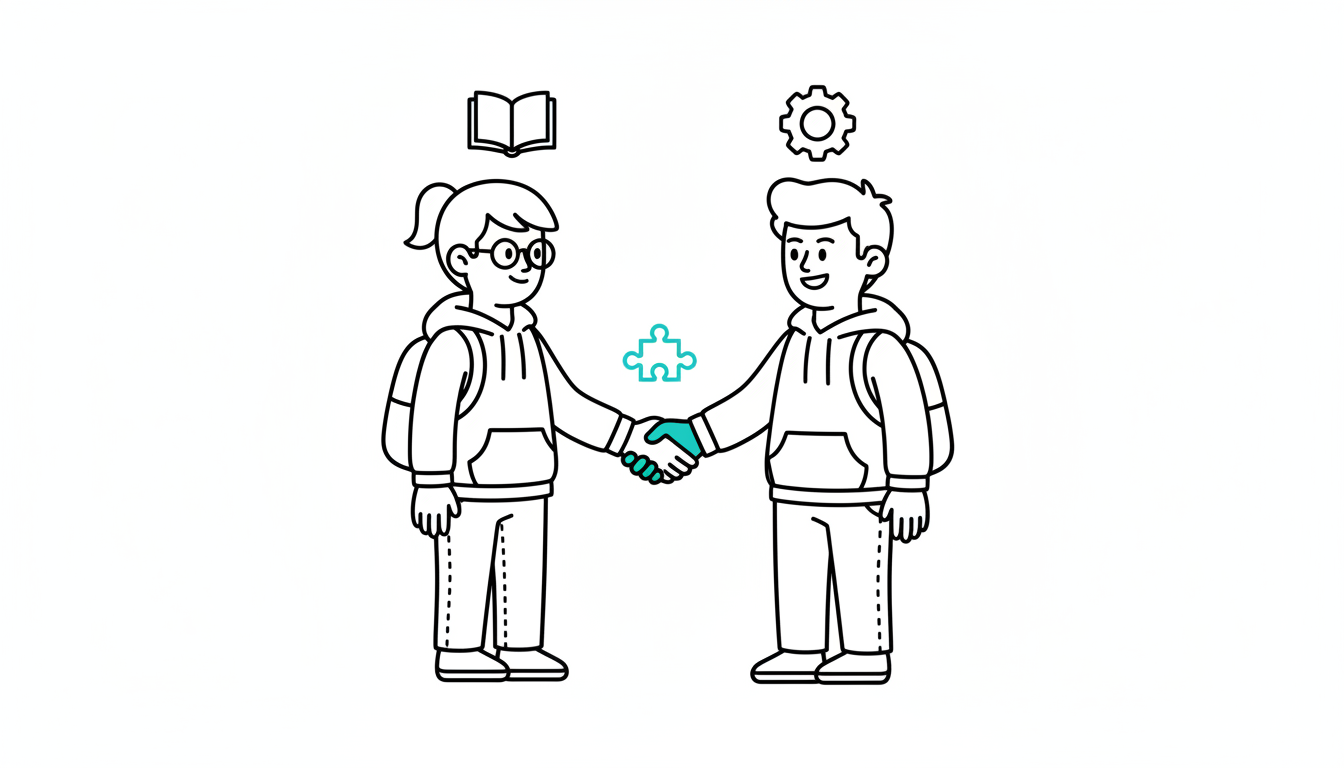
Facilitate effective peer collaboration by having students explicitly identify their strengths and gaps, then strategically match with partners whose skills complement their own, teaching students that productive study partnerships leverage different expertise rather than pairing identical skill levels.
How It Works
- Self-assessment (60 sec) - Students list: (1) one concept/skill they're strong in from this unit, (2) one concept/skill they need help with
- Find complementary partner (90 sec) - Students circulate to find someone whose strength matches their need (and vice versa)
- Exchange contact info (30 sec) - Partners exchange names/contact for future study support
- Metacognitive reflection (30 sec) - "Why is a study partner with different strengths better than one with identical skills?"
What to Say
Opening: "Think about this unit. What's ONE thing you're really strong at? Where could you teach someone else? Write it down. Now, what's ONE thing you're struggling with? Where do you need help? Write that too."
During: "Stand up. Find someone whose STRENGTH matches your STRUGGLE—and whose struggle matches your strength. You're looking for complementary skills, not identical ones. Someone who's good at what you need help with."
Once matched: "Exchange names. This is your study buddy for this unit. You'll help each other—not by doing the work, but by explaining what you understand."
Closing: "The best study partners aren't the same level at everything. They have different strengths. You help each other fill gaps."
Why It Works
Research on peer tutoring shows benefits for both tutor and tutee (Topping, 2005). The tutor deepens understanding through explanation (protégé effect), while the tutee receives personalized, just-in-time support. Strategic matching based on complementary skills ensures reciprocal benefit—both students give and receive help, maintaining equity and motivation. This also teaches students that productive collaboration involves div vision of cognitive labor based on expertise, not simply working alongside someone identical to you.
Research Citation: Peer tutoring effectiveness (Topping, 2005)
Teacher Tip
Frame this as "trading expertise" not "pairing strong with weak." Both students are experts in different areas. Emphasize reciprocity: "You'll BOTH teach AND learn. No one is just the helper or just the helped." This maintains dignity and motivation for all students.
Variations
For Different Subjects
- Math/Science: Match by specific problem types or concepts within the unit
- Humanities: Match by skills (thesis writing vs. evidence analysis; comprehension vs. interpretation)
- Universal: Match by learning preferences (visual learner with verbal learner can offer different explanatory approaches)
For Different Settings
- Large Class (30+): Use board where students write their strength and need; scan to find matches
- Small Group (5-15): Create trios instead of pairs so each student has multiple sources of support
For Different Ages
- Elementary (K-5): Teacher facilitates matching; students identify what they're "really good at" and "want to get better at"
- Middle/High School (6-12): Standard approach; students self-match
- College/Adult: Can extend to form study groups (3-4 people with diverse strengths covering all unit concepts)
Online Adaptation
Tools Needed: Shared document (Google Jamboard, Padlet) or breakout room assignments
Setup: Create two-column board: "I can help with..." and "I need help with..."
Instructions:
- Students add sticky notes to both columns (strength and need)
- Students scan the board to identify complementary matches
- Use private chat to connect with potential study buddy
- Confirm match in main room chat
- Teacher creates breakout rooms for matched pairs to meet briefly
Pro Tip: Create persistent "Study Buddy Board" accessible all semester; update as skills develop.
Troubleshooting
Challenge: Students claim they're not strong at anything Solution: Reframe: "What's the LEAST hard thing for you? What would you choose to explain if you HAD to explain something?"
Challenge: Multiple students need help with same concept; no one strong in it Solution: This is diagnostic! Note it for re-teaching. For now, match these students together to "figure it out as a team" or assign them to review specific resources together.
Challenge: Students want to match with friends regardless of complementary skills Solution: Allow one "bonus" match for social reasons, but require primary match to be skills-based: "Your main study buddy should complement your skills. You can study with friends separately."
Extension Ideas
- Deepen: "Expertise Inventory"—students create comprehensive list of all unit concepts, rate themselves 1-5 on each, share with potential partners
- Connect: Schedule actual study buddy sessions (10 min in class or homework partnership); follow up on how it went
- Follow-up: After test, reflect: "Did studying with your buddy help? How? Would you choose a different type of partner next time?"
Related Activities: Learning Strategy Sharing, Peer Teaching Pairs, Teacher and Student