
Statue Freeze
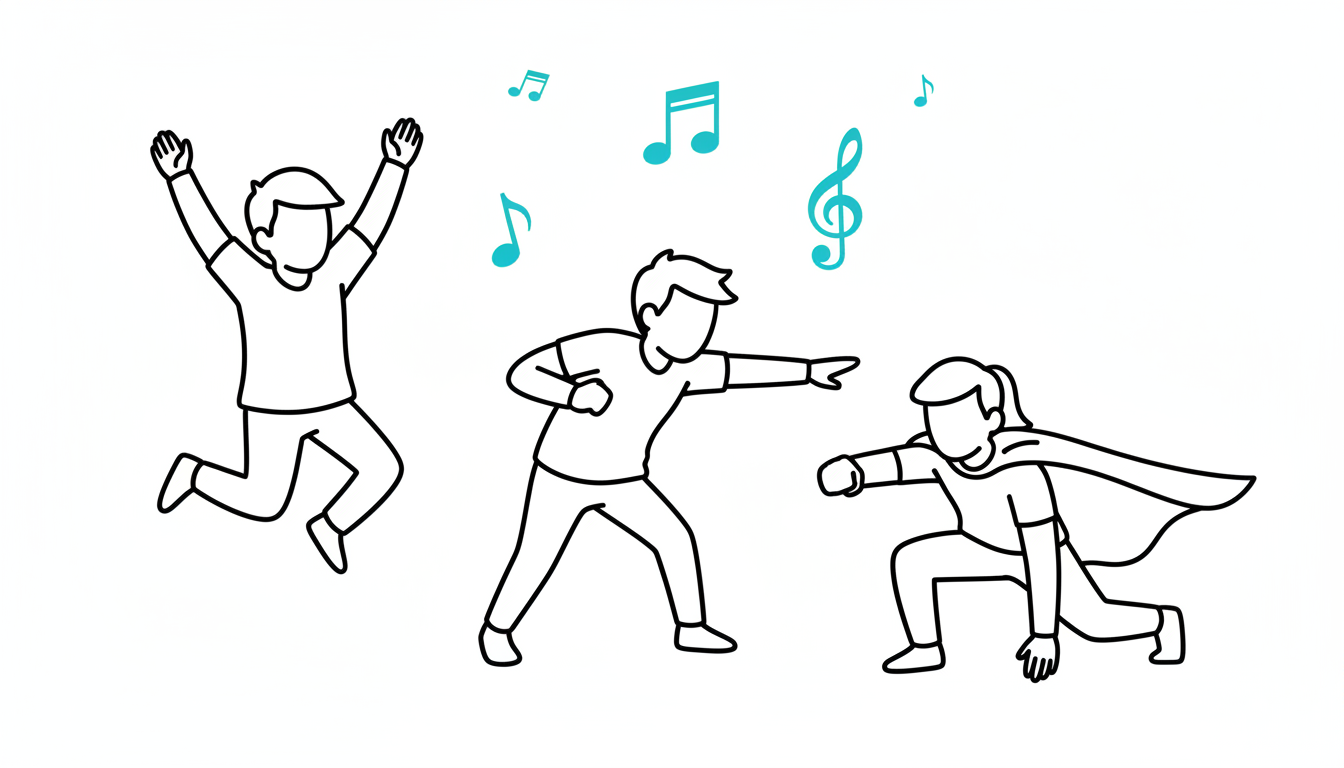
At a Glance
- Time: 60-90 seconds
- Prep: Minimal (music player optional, but not required)
- Group: Whole class (individual participation)
- Setting: In-person (requires movement space)
- Subjects: Universal
- Energy: High
Purpose
Create a burst of joyful movement followed by focused stillness, practicing self-regulation and attention control. Use this to release pent-up energy, transition between activities, or reset focus when students are restless or distracted.
How It Works
Step-by-step instructions:
- ANNOUNCE (10 seconds) - "We're playing Statue Freeze! When I play music (or clap), dance and move however you want. When the music stops, FREEZE like a statue and hold your pose for 10 seconds."
- DEMO (10 seconds) - Demonstrate: dance briefly, then freeze mid-movement
- PLAY (60 seconds total) - Do 3-4 rounds:
- Music on/clapping (10 seconds): Students dance
- Music stops (10 seconds): Students freeze completely
- Repeat 3-4 times
- FINISH (10 seconds) - "Final freeze! Hold it! ...And sit down. Excellent self-control."
What to Say
Opening: "Stand up! Clear some space. We need to move! This is Statue Freeze. When I clap, you dance—move any way you want. When I stop clapping, you FREEZE like a statue. Hold your pose perfectly still for 10 seconds. Can you do it? Let's find out!"
During:
- (While clapping/music plays): "Dance! Move! Use your whole body!"
- (Music stops): "FREEZE! Don't move a muscle! Hold that pose! 10...9...8...everyone still...3...2...1...Move again!"
- Repeat 3-4 times
Closing: "Last round! Dance! ...FREEZE! Perfect! Look at all these amazing statues. Hold it...and sit down. We just practiced controlling our bodies AND our attention. Let's use that focus now."
Why It Works
This activity combines high-energy release with precise control, teaching self-regulation. The alternation between movement and stillness activates the prefrontal cortex (executive function), which is responsible for attention and impulse control. The physical exertion releases endorphins and reduces restlessness. The brief "hold still" moments mimic meditation and mindfulness, creating a calm-yet-alert state ideal for learning. It's also just fun, which releases dopamine and creates positive associations with class.
Research Citation: Activities that alternate movement and stillness improve self-regulation skills in children and adolescents (Diamond & Lee, 2011).
Teacher Tip
Celebrate creative freezes. After a freeze, quickly narrate what you see: "I see someone frozen mid-jump! Someone's a superhero statue! Amazing!" This recognition encourages creativity and full participation next time.
Variations
For Different Subjects
- History/Social Studies: "Dance like people in the 1920s! Freeze!" Or "Move like a Roman soldier! Freeze!"
- Science: "Move like molecules heating up! FREEZE when they reach absolute zero!"
- Physical Education/Drama: Add character freezes: "Dance like a robot! Freeze!" "Dance like you're underwater! Freeze!"
- Language Arts: "Move like the main character! Freeze when they face their conflict!"
For Different Settings
- Large Class (30+): Works perfectly. The more people, the more energy. Embrace the controlled chaos.
- Small Class (5-15): Same format, but you can call out specific poses: "Freeze in a shape that's symmetrical!"
- Limited Space: Use only upper body movements—arms, shoulders, heads. "Seated Statue Freeze."
For Different Ages
- Elementary (K-5): LOVE this activity. Can do 5-6 rounds. Add silly themes: "Dance like spaghetti! Freeze!"
- Middle/High School (6-12): Keep it to 3-4 rounds. Play popular music (if appropriate) to increase buy-in. They'll engage if you frame it as a "quick break."
- College/Adult: Frame it as "movement break for cognitive reset." Adults will participate if you explain the neuroscience and keep it brief (2 rounds).
Online Adaptation
Tools Needed: Zoom, Teams, video platform with music share capability (optional)
Setup: Students turn cameras on and stand where they can be seen.
Instructions:
- "Stand up and make sure I can see you on camera."
- "When I say 'Dance,' move however you want. When I say 'FREEZE,' stop completely."
- Call out "Dance!" for 10 seconds, then "FREEZE!" for 10 seconds.
- Repeat 3 times.
Pro Tip: If you have music, use "share computer sound" feature in Zoom to play it for everyone. Or just use vocal cues: "Dance! ...FREEZE!" Works just as well.
Troubleshooting
Challenge: Some students are too self-conscious to dance. Solution: Say, "There's no right or wrong way to move. Sway, wiggle, wave your arms—anything counts as dancing. This is just about moving your body." Model simple movements yourself.
Challenge: Students can't hold the freeze—they giggle or move. Solution: That's okay! It's part of the fun. Say, "I saw some movement! Let's try again and see if we can all hold perfectly still this time." Make it a friendly challenge, not a punishment.
Challenge: The activity gets too chaotic. Solution: Shorten the dance segments to 5 seconds instead of 10. The shorter bursts keep it controlled. Also, count down during the freeze: "Hold...5...4...3...2...1!" The countdown helps them regulate.
Extension Ideas
- Deepen: After the activity, ask: "Why was it hard to freeze mid-movement? That's how your brain feels when I ask you to stop talking and focus. We just practiced that skill."
- Connect: Use it as a metaphor: "In history, wars have moments of intense action and moments of tense stillness. We just experienced that."
- Follow-up: "Tomorrow, we'll add a twist—you have to freeze in a pose that represents today's topic. Start thinking about it!"
Related Activities: Mirror Madness, Robot Walk, Superhero Poses