
Reflection Rapid Fire
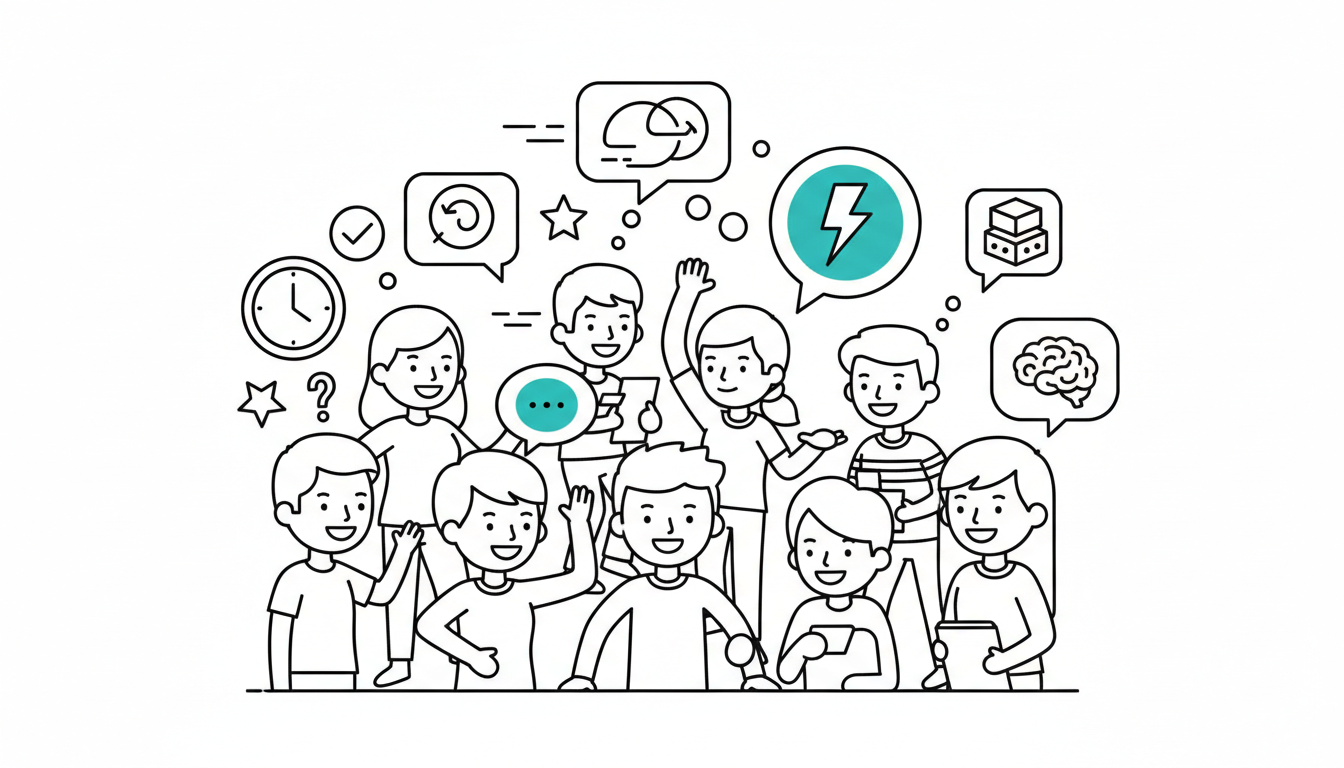
At a Glance
- Time: 2-3 minutes
- Prep: None (or pre-select prompts)
- Group: Whole class popcorn style or pair-share
- Setting: Any classroom
- Subjects: Universal
- Energy: Low-Medium
Purpose
Create efficient, engaging closure by having students rapidly respond to quick reflection prompts about today's learning, ensuring every student articulates at least one key takeaway while providing teachers with formative assessment data about what stuck, what confused, and what resonated across the class.
How It Works
- Pose rapid-fire prompt (10 sec) - Choose from bank: "One thing you learned today is...", "One question you still have is...", "One word to describe today's lesson...", etc.
- Rapid responses (90-120 sec) - Students popcorn-style call out responses (5-10 seconds each), OR pair-share then sample to whole class
- Optional follow-up (30 sec) - If pattern emerges (e.g., many students confused about same concept), briefly address or note for tomorrow
- Closing (15 sec) - "You've named what you learned. Now you own it."
What to Say
Opening: "Quick reflection before you go. I'll give you a prompt. You'll have just a few seconds to think, then we'll hear from as many of you as possible—rapid fire, keep it brief. Ready?"
Prompt options:
- "One thing that clicked for you today was..."
- "One thing you found challenging was..."
- "One word to describe your understanding right now..."
- "One question you still have is..."
- "One way you might use this outside class is..."
During: "Keep it moving. One idea, one sentence, no speeches. Popcorn style—jump in when you're ready."
Closing: "Lots of different takeaways in the room—that's perfect. You all focused on different parts of today's learning. The act of NAMING what you learned helps cement it in memory. Thank you."
Why It Works
Retrieval practice—actively recalling information—strengthens memory more effectively than passive review (Roediger & Karpicke, 2006). Rapid-fire reflection forces every student to mentally retrieve and articulate at least one element of today's learning, which consolidates that memory. The public, fast-paced format lowers stakes (no one answer is scrutinized) while maintaining engagement (students hear diverse perspectives, which broadens their own understanding). For teachers, patterns in responses provide immediate formative assessment about what resonated and what needs clarification.
Research Citation: Retrieval practice and learning (Roediger & Karpicke, 2006)
Teacher Tip
Listen actively for misconceptions or gaps that emerge in student responses. If multiple students name confusion about the same concept, acknowledge it: "I heard several of you mention [X] was tricky. We'll start tomorrow with more on that." This responsiveness shows students their reflections matter and that you're adapting instruction to their needs.
Variations
For Different Subjects
- Math/Science: "One problem type you now understand...", "One formula you can now use is...", "One thing you're still confused about..."
- Humanities: "One theme you noticed was...", "One character's motivation is...", "One historical connection you made..."
- Universal: "One skill you practiced today...", "One aha moment...", "One thing you want to explore more..."
For Different Settings
- Large Class (30+): Use chat waterfall (online) or written exit slips (in-person) rather than oral popcorn to ensure all students participate
- Small Group (5-15): Go-around circle where each student briefly responds to prompt
For Different Ages
- Elementary (K-5): Simplify prompts: "One thing you learned today...", use thumbs-up/down to show confidence level
- Middle/High School (6-12): Standard rapid-fire; can add meta-reflection: "One way you LEARNED today was..."
- College/Adult: Can include application focus: "One way this applies to your field...", "One question for further research..."
Online Adaptation
Tools Needed: Chat function or shared response tool (Mentimeter, Padlet)
Setup: Prepare prompt on slide
Instructions:
- Display prompt on screen
- Give 20 seconds silent think time
- "On the count of 3, everyone type your response in chat—don't hit send yet. Ready? 1-2-3, SEND!" (waterfall effect)
- Scroll through responses quickly, reading select highlights aloud
- Address any common patterns or questions that emerge
Pro Tip: Use Mentimeter word cloud for "one word to describe..." prompt—visual representation of collective sentiment appears in real-time.
Troubleshooting
Challenge: Same few students dominate popcorn responses; others stay silent Solution: Use equity strategies: "I need to hear from someone I haven't heard from yet," or use written/chat responses so everyone must contribute
Challenge: Students give surface-level responses ("I learned stuff") Solution: Model specificity: "That's a start. Let's try: 'I learned that [specific concept]' or 'I can now [specific skill].' Be precise."
Challenge: Responses reveal widespread confusion about key concept Solution: Don't ignore it. Acknowledge: "I'm hearing a lot of confusion about X. Let's spend 60 seconds on that right now," then briefly clarify or schedule deeper re-teaching for tomorrow.
Extension Ideas
- Deepen: "Two-Prompt Rapid Fire"—first round: "One thing you learned," second round: "One thing you're STILL wondering"
- Connect: Weekly version: "Rapid Fire Friday"—students reflect on whole week's learning with prompt: "Biggest aha moment this week was..."
- Follow-up: Start next class by revisiting responses: "Yesterday many of you said X was confusing. Today we're going to tackle that head-on."
Related Activities: 3-2-1 Bridge, Exit Tickets, One Word Storm