
KWL Chart
At a Glance
- Time: 3-4 minutes
- Prep: Chart or board space
- Group: Whole class
- Setting: Any
- Subjects: Universal
- Energy: Low
Purpose
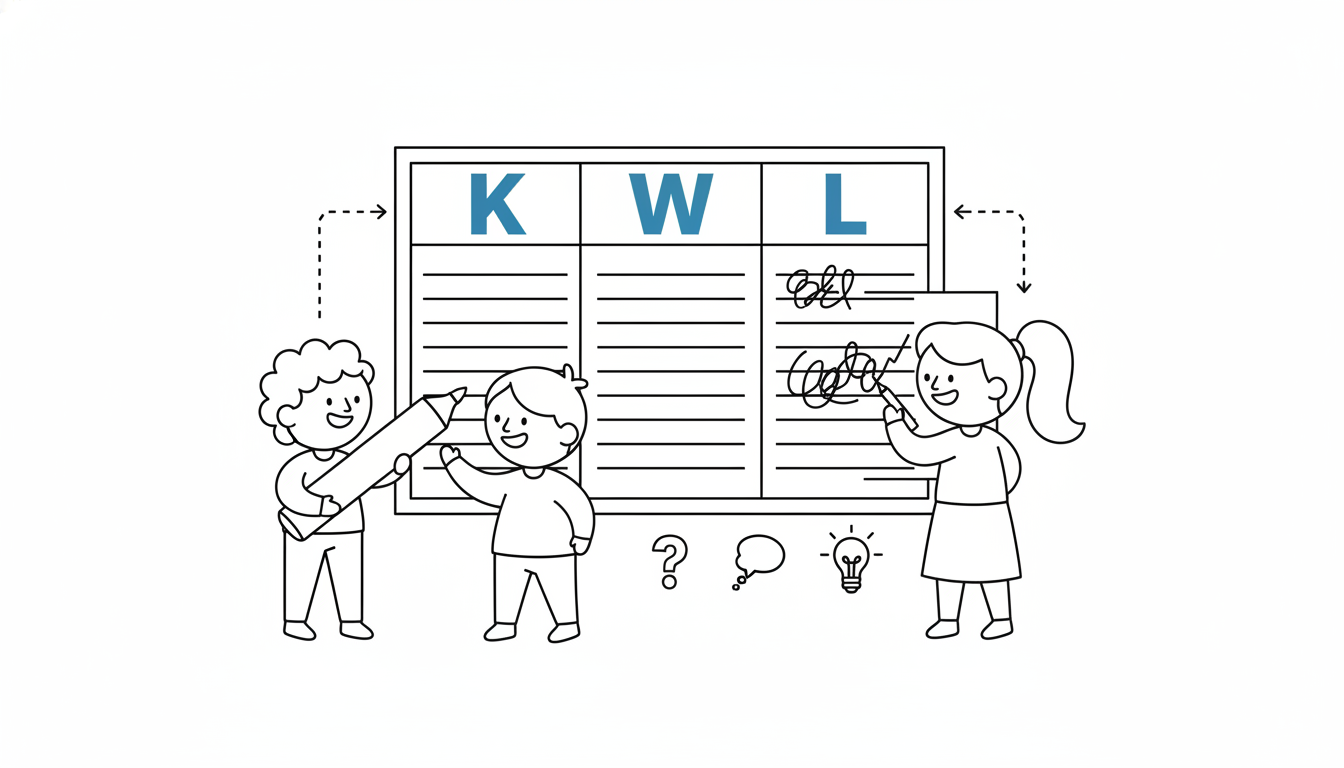
Activate prior knowledge, generate curiosity, and create a learning roadmap using the classic K-W-L framework: What do we Know? What do we Want to know? What did we Learn? This structure makes thinking visible and creates natural engagement through student-generated questions.
How It Works
- DRAW CHART (20 seconds) - Create three columns: K / W / L
- K: KNOW (90 seconds) - "What do we already know about [topic]?" Students share; teacher records
- W: WANT (90 seconds) - "What do we want to learn?" Students share questions; teacher records
- TEACH - Proceed with lesson
- L: LEARNED (end of lesson) - "What did we learn?" Students reflect and share
What to Say
"We're starting a new topic: [topic]. Let's use a KWL chart to organize our thinking. I'm drawing three columns: K, W, and L.
First, the K column: What do we already KNOW about [topic]? Raise your hand and share something you know—or think you know. I'll write it down."
(Record 5-7 student responses in K column)
"Now, the W column: What do we WANT to learn? What questions do you have? What are you curious about?"
(Record 5-7 student questions in W column)
"Great! We have our roadmap. As we learn today, we'll see if our 'Know' column is accurate and if we answer our 'Want to know' questions. At the end, we'll fill in the L column: what we Learned."
Why It Works
The K column activates schema and reveals misconceptions. The W column creates intrinsic motivation—students are more engaged when pursuing answers to their own questions. The L column (at lesson's end) provides closure and metacognitive reflection. The visual chart makes thinking tangible and tracks the learning journey. Students see that learning is an active, iterative process, not passive reception.
Research Citation: KWL charts improve comprehension and engagement by activating prior knowledge and setting purpose (Ogle, 1986).
Teacher Tip
Accept all responses in the K column without judgment, even incorrect ones! Write them down. At the end of the lesson, revisit the K column: "Let's check—was this accurate?" This explicitly teaches that learning involves testing and revising what we think we know.
Variations
Extended Versions
KWHL: Add "How will we learn?" (process/strategy column) KWLQ: Add "New Questions" (what questions do we now have after learning?) KWLS: Add "Still want to learn" (ongoing curiosity)
Content Examples
- Science: Topic: Ecosystems. K: "Animals live there." W: "How do they survive?" L: (end of unit)
- Math: Topic: Fractions. K: "They have a numerator and denominator." W: "How do you multiply them?"
- Literature: Topic: Shakespeare. K: "He wrote plays." W: "Why is he considered so important?"
- History: Topic: Civil Rights Movement. K: "Martin Luther King Jr. was involved." W: "What were the major events?"
For Different Settings
- Large Class: Teacher records on board
- Small Class: Co-create on chart paper
- Online: Use shared Google Doc or digital whiteboard
- Individual: Students create personal KWL charts in notebooks
For Different Ages
- Elementary (K-5): Use simple language; add visuals/drawings
- Middle/High School (6-12): Students can create their own individual KWLs
- College/Adult: Use for complex topics; more sophisticated questions in W column
Online Adaptation
Excellent for Online:
- Use Jamboard, Miro, or shared Google Doc
- Students type in chat; teacher adds to chart
- Collaborative digital chart that evolves over time
- Take screenshot for before/after comparison
Troubleshooting
Challenge: Students can't think of anything for K column. Solution: Prompt: "What does the word [topic] make you think of? Where have you heard it before? What images come to mind?"
Challenge: K column items are incorrect. Solution: Write them anyway! Say: "Interesting—let's check that as we learn." Address misconceptions during instruction.
Challenge: W column questions are too basic or off-topic. Solution: Celebrate all questions, then add: "Here's another question I'm curious about..." Model sophisticated inquiry.
Challenge: Running out of time. Solution: Do K and W at the start (3 min). Save L for the end of the lesson or next class period.
Challenge: Students forget about the chart. Solution: Keep it visible! Reference it during the lesson: "Remember, we wanted to know... Let's see if this answers it!"
Extension Ideas
- Color Code: Use different colors for confirmed knowledge (K) vs. corrected misconceptions
- Question Hunt: During lesson, students check off W questions as they're answered
- Exit Ticket: Students individually write L column reflections
- Before/After Photos: Take pictures of K and L columns; compare the growth
- Student-Led: In small groups, students create their own KWL charts, then share with class
Related Activities: Think-Pair-Share, Anticipation Guide, Brainstorm Web