
Group Juggle
At a Glance
- Time: 4-5 minutes
- Prep: Minimal (3-5 soft balls, bean bags, or rolled socks)
- Group: Whole class or groups of 10-15
- Setting: Any space where students can form a circle
- Subjects: Universal - excellent ensemble-building activity
- Energy: Medium
Purpose
Build group awareness, focus, and coordination through a progressive challenge where students toss balls across a circle while maintaining eye contact and saying names, creating a playful low-stakes environment that develops attention, listening skills, and collective responsibility for success.
How It Works
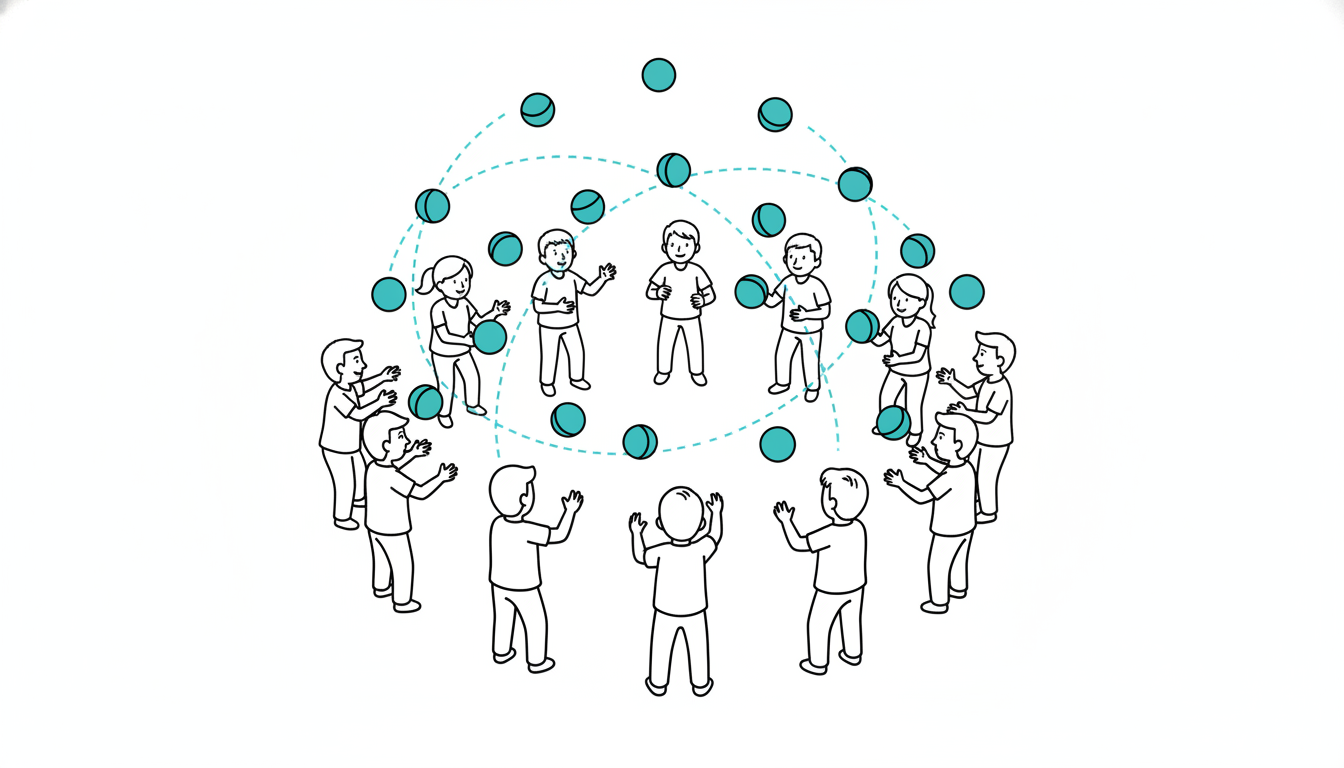
- Form circle and establish pattern (60 sec) - Students stand in circle; one person tosses soft ball across circle saying receiver's name and making eye contact; that person tosses to someone new, continuing until everyone has received once and pattern is set
- Repeat pattern (60 sec) - Group practices the same pattern 2-3 times to solidify it
- Add complexity (90 sec) - Add a second ball following the same pattern, then a third, increasing difficulty
- Debrief (30 sec) - "What did you have to do to keep all those balls going? How did you support each other?"
What to Say
Opening: "Form a circle. I'm going to toss this ball to someone, say their name, and make eye contact first. That person will toss to someone new—not to the people next to them—and say that person's name. Everyone will receive the ball exactly once. The last person tosses back to me. Let's establish our pattern."
After first round: "Great! That's our pattern. Let's repeat it exactly the same way two more times to lock it in."
Adding balls: "Now here's the challenge: I'm adding a second ball that will follow the exact same pattern. Stay focused! Here comes ball number two... and here comes number three!"
Closing: "That required serious focus from everyone. One person losing concentration affects the whole group. That's the kind of team attention we need for our next task."
Why It Works
Group Juggle activates sustained attention, working memory (remembering the pattern), and social coordination simultaneously. The activity requires each participant to track multiple variables (where balls are, whose turn is next, maintaining the pattern) while remaining aware of the group's collective success. The progressive difficulty creates flow state conditions: clear goals, immediate feedback, and challenge matched to skill level (Csikszentmihalyi, 1990).
Research Citation: Ensemble-building and flow theory (Sawyer, 2003)
Teacher Tip
The key to success is establishing a SOLID pattern before adding balls. Resist the urge to rush to the "multiple balls" phase. If the group can't repeat the single-ball pattern smoothly three times in a row, they're not ready for more. Also, use soft objects (foam balls, bean bags, stuffed animals) to keep energy playful and eliminate fear of being hit.
Variations
For Different Subjects
- Math/Science: Toss with content - "Say a multiple of 7 instead of the person's name" or "Name an element" or "Give one fact about our current unit"
- Humanities: Vocabulary juggle - "Say a vocabulary word instead of their name" or "Name a character from the novel" or "State a historical fact"
- Universal: Emotion juggle - toss the ball with a specific emotion (excitement, suspicion, joy) expressed through voice and movement
For Different Settings
- Large Class (30+): Create multiple circles of 10-12 students each; all circles juggle simultaneously; compare which group can handle the most balls
- Small Group (5-10): Start with 2 balls immediately since pattern is simpler with fewer people
For Different Ages
- Elementary (K-5): Stick with 1-2 balls maximum; emphasize names and eye contact; celebrate successes enthusiastically
- Middle/High School (6-12): Can add up to 4-5 balls; introduce competitive element (time how long pattern can continue without drops)
- College/Adult: Add complex variations like reversing the pattern or adding balls that go counterclockwise
Online Adaptation
Tools Needed: Video platform with gallery view; optional collaborative tool like Jamboard
Setup: This is challenging online but can be adapted as a focus/memory game
Instructions:
- Create a "virtual toss" pattern: First person says a word and tags someone in chat
- Tagged person says related word and tags someone new
- Continue until everyone has been tagged once
- Repeat the EXACT pattern 2-3 times
- Add second "ball" (second pattern running simultaneously)
Alternative: Use a shared digital tool where students "pass" an object by moving it to another person's virtual space
Pro Tip: This works better in smaller breakout rooms (6-8 students) than with large groups online.
Troubleshooting
Challenge: Balls are dropped frequently; group gets frustrated Solution: Pause and practice just the single-ball pattern again. Remind students: "The goal isn't to go fast. The goal is precision. Slow down."
Challenge: Students forget the pattern or throw to wrong person Solution: Stop and restart from the beginning with one ball to re-establish the pattern: "Let's lock in our pattern again before adding more balls."
Challenge: Students don't make eye contact or say names clearly Solution: Stop activity: "Freeze. This only works with eye contact and clear names. Let's try that again with exaggerated eye contact and loud, clear names."
Extension Ideas
- Deepen: Once pattern is solid with multiple balls, try to complete 3 full rounds without drops; track improvement over time
- Connect: Add a "reverse" ball that goes backward through the pattern while forward balls continue
- Follow-up: Use as a class ritual before tests or presentations: "Let's do a quick 2-ball juggle to get our focus sharp"
Related Activities: Ball Pass Review, Mirror Movements, Give and Take