
Walk and Talk
At a Glance
- Time: 3-5 minutes
- Prep: None
- Group: Pairs
- Setting: Hallway, outdoor space, or large classroom
- Subjects: Universal - works for any discussion-based content
- Energy: Medium
Purpose
Combine physical movement with cognitive processing by having students discuss academic content while walking together, leveraging the research-backed connection between bilateral movement and creative thinking to deepen conversations, reduce social anxiety around academic discourse, and provide a refreshing environmental change that resets attention and engagement.
How It Works
- Assign discussion partners and prompt (30 sec) - "Partner with the person next to you. Your question is: [specific discussion prompt related to lesson]"
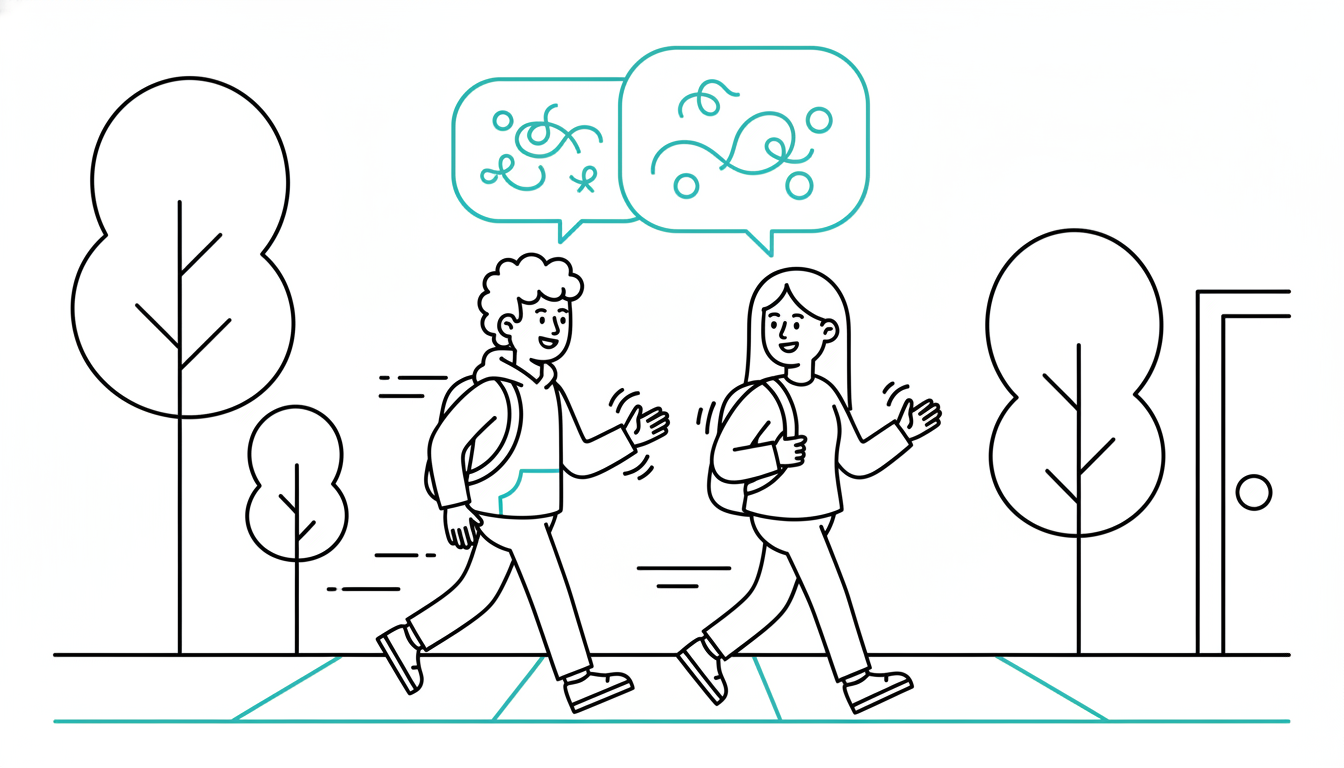
- Walk and discuss (3-4 min) - Pairs walk around designated space (hallway loop, outdoor path, or large classroom perimeter) while discussing the prompt; side-by-side walking, not face-to-face
- Return and share (30 sec) - Pairs return to classroom; optionally share one key insight from their conversation
What to Say
Opening: "Partner up! You're going to take a walk-and-talk to discuss this question: [prompt]. Walk side-by-side in the hallway, maintaining conversation the entire time. I'll call you back in 3 minutes. Go!"
During (if monitoring): "Keep walking! Keep talking! I should hear academic conversations the whole time."
Return: "Welcome back! Before sitting, turn to your partner and summarize in one sentence the most important thing you discussed."
Optional share-out: "Who had an interesting insight during your walk? Pair up with new partners and share what you learned."
Why It Works
Bilateral movement (walking while both legs alternate) activates both hemispheres of the brain and has been shown to enhance creative problem-solving and associative thinking (Oppezzo & Schwartz, 2014). Walking side-by-side reduces the intensity of face-to-face eye contact, lowering social anxiety for students who find academic discussions intimidating. The environmental change (leaving the classroom) creates a context shift that refreshes attention, while the steady rhythm of walking creates a meditative state that can actually deepen focus on the conversation at hand.
Research Citation: "Give Your Ideas Some Legs" study on walking and creativity (Oppezzo & Schwartz, 2014)
Teacher Tip
Provide specific, focused prompts that require genuine discussion, not quick right/wrong answers. Instead of "What caused the Civil War?" try "If you had to explain the causes of the Civil War to a third-grader, what metaphor would you use?" The more open-ended and thought-provoking the prompt, the richer the walking conversation becomes. Also, odd-numbered classes: join the conversation yourself or create one trio.
Variations
For Different Subjects
- Math/Science: "Explain [concept] as if teaching a younger student," "What real-world example demonstrates this principle?" "How would you apply this formula to [scenario]?"
- Humanities: "What's a modern parallel to this historical event?" "What would you say to this character if you met them?" "How does this text connect to your life?"
- Universal: Reflection prompts ("What was challenging about today's task?"), metacognition ("What strategy helped you learn this?"), application ("Where will you use this outside school?")
For Different Settings
- Large Class (30+): Stagger releases by rows to avoid hallway congestion; or use outdoor space where many pairs can walk different paths
- Small Group (5-15): Everyone can walk simultaneously even in smaller spaces; consider creating a defined walking path in the classroom (perimeter loop)
- No hallway access: Walk in place while talking, or walk around classroom tables, or standing walking-pace march
For Different Ages
- Elementary (K-5): Shorter duration (2-3 minutes); provide sentence stems for discussion; may need adult monitoring in hallway
- Middle/High School (6-12): Standard approach; can be entrusted with independent hallway walking; deeper, more abstract prompts
- College/Adult: Can extend to 10-15 minute walks; excellent for office hours, study groups, or peer review sessions
Online Adaptation
Tools Needed: This activity requires physical walking, so pure virtual adaptation is limited
Hybrid option: Students who are physically together can walk and talk while connected via phone/tablet to remote partner who "walks" along virtually (remote student could do walking-in-place while talking)
Alternative: "Stand and stretch talk" where pairs have video discussion while standing at their desks and doing gentle stretches, maintaining physical engagement even without walking
Pro Tip: If in-person learning resumes after remote period, walk-and-talk is excellent for rebuilding social connections and conversation skills students may have lost during isolation.
Troubleshooting
Challenge: Students use walking time to socialize off-topic Solution: Give accountability upon return: "Be ready to share your partner's answer, not your own." Knowing they'll be asked keeps conversation academic.
Challenge: Hallway space is unavailable or shared with other classes Solution: Walk around classroom perimeter, or walk in place (march in place) while talking at desks, or use outdoor space if weather permits.
Challenge: Students with mobility differences can't participate in walking Solution: Frame as "move and talk"—any form of bilateral movement counts (arm swinging, wheelchair movement, seated leg raises); or stationary pairs while others walk.
Extension Ideas
- Deepen: "Teaching walk" where one partner teaches a concept to the other while walking, then roles reverse
- Connect: Extend to "gallery walk and talk" where pairs walk to view posted student work while discussing what they observe
- Follow-up: After walk-and-talk, individual written reflection: "What did your partner say that changed your thinking?"
Related Activities: Think-Pair-Share, Concentric Circles, As-If Transitions