
Participation Cards
At a Glance
- Time: Ongoing (30-sec checks)
- Prep: Minimal (create card sets)
- Group: Whole class
- Setting: Any
- Subjects: Universal
- Energy: Low
Purpose
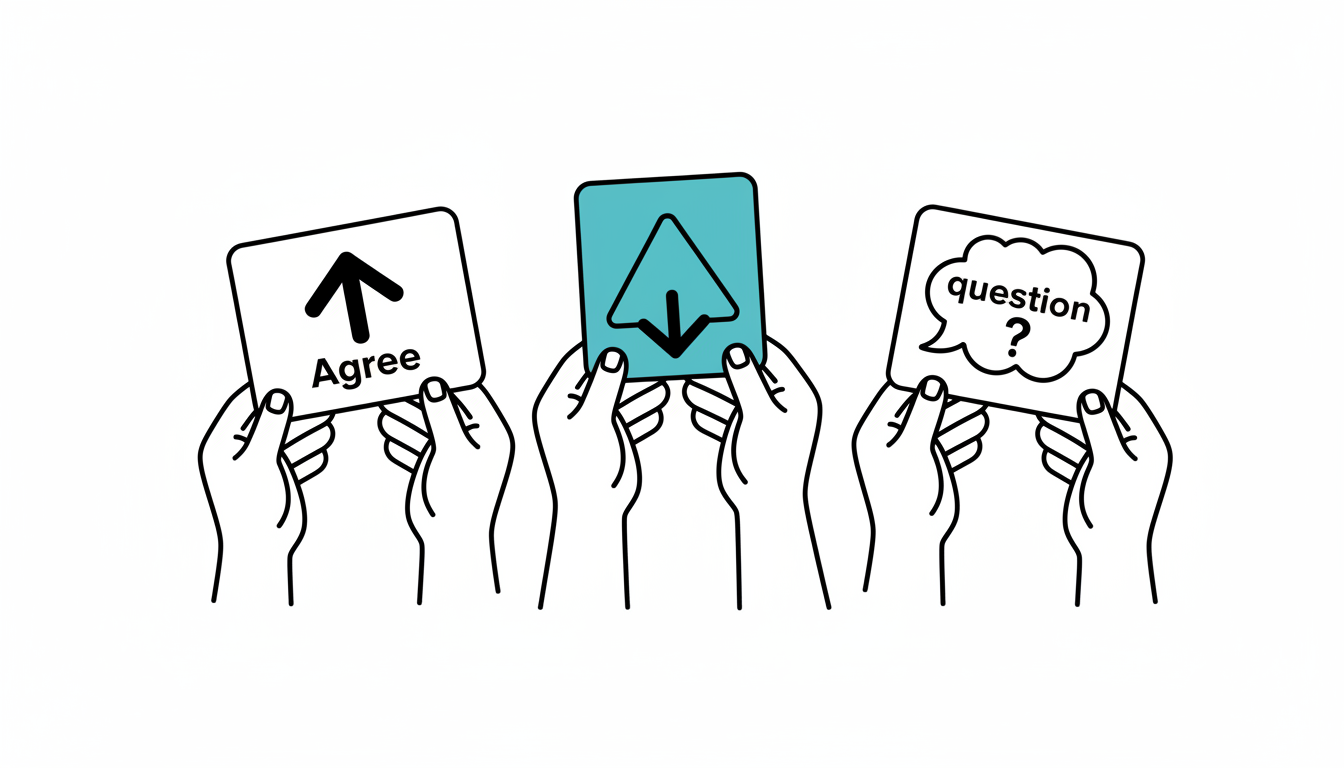
Enable silent, visual participation where students hold up cards ("I agree," "I disagree," "I have a question") to show their thinking during instruction, ensuring all voices are heard without verbal interruption.
How It Works
- Distribute card sets (before class) - Each student gets 3-4 cards with different responses
- Pause and check (during lesson) - "Hold up your card: Do you agree with this statement?"
- Scan and respond (15 sec) - Note patterns; address confusion or questions
What to Say
Opening: "You each have three cards: 'I agree,' 'I disagree,' and 'I have a question.' When I pause, hold up the card that shows your thinking." During: [After explaining concept] "Hold up: Do you agree photosynthesis creates energy?" [Scans cards] "I see questions—let's clarify..." Closing: "Cards let me see everyone's thinking without anyone shouting out. Keep them on your desk."
Why It Works
Provides silent participation pathway for shy students, gives teacher instant visual data on class understanding, and maintains flow without constant verbal interruptions.
Teacher Tip
Laminated index cards work well. Simple set: Green="I understand," Yellow="I'm unsure," Red="I'm confused," Blue="I have a question."
Variations
Card options: Agree/disagree, understand/confused, true/false, A/B/C/D choices • Ages: K-5: 2-3 simple cards; 6-12: standard sets; College: discipline-specific response cards
Online
Digital version: Students change Zoom/Teams reaction emoji or status to show response.
Troubleshooting
Students don't hold up cards: "Everyone must participate—I'm checking for all cards up."
Extension
Add "Explain" card—when held up, teacher calls on that student to elaborate their thinking.
Related: No-Tech Polling, Traffic Light Self-Assessment