
Free Association
At a Glance
- Time: 1-2 minutes
- Prep: None
- Group: Whole class
- Setting: Any
- Subjects: Universal
- Energy: Medium
Purpose
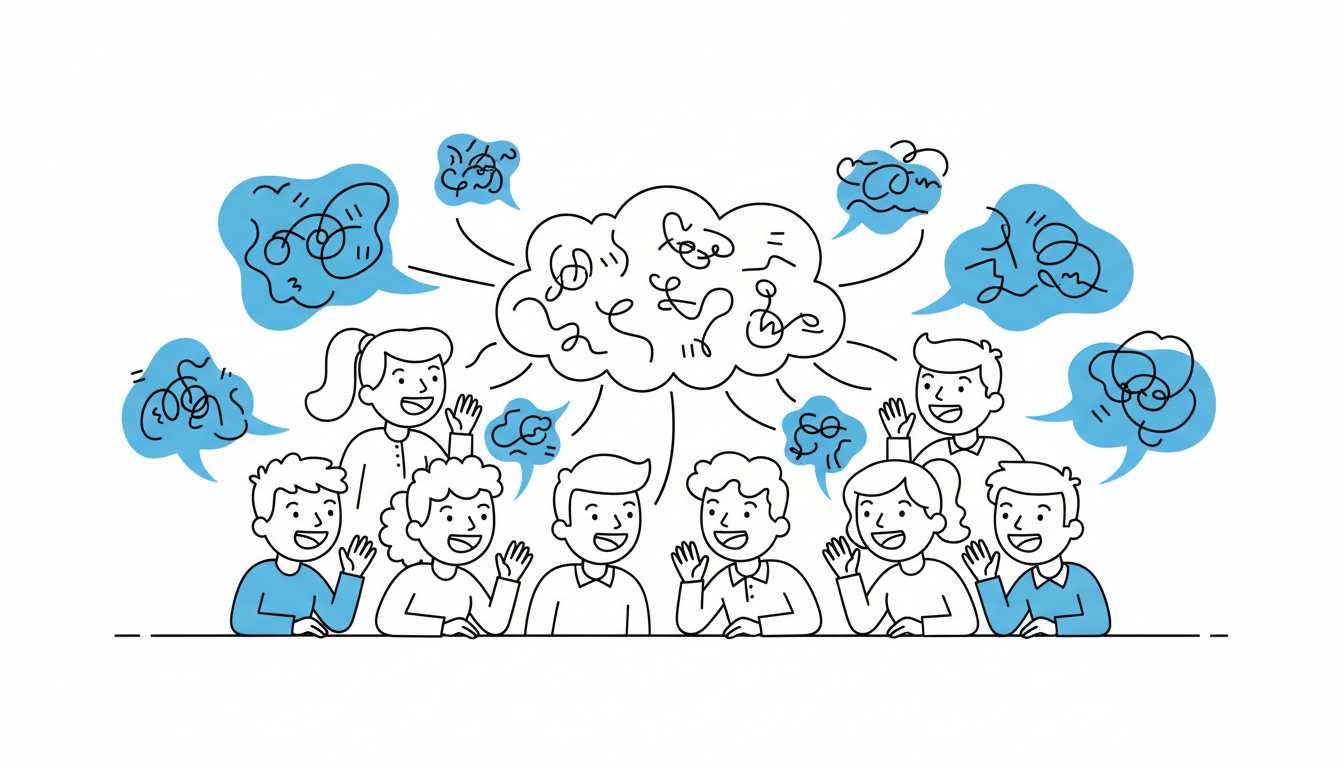
Rapidly activate prior knowledge through spontaneous word association. Teacher says a topic word; students immediately shout out whatever comes to mind. This unfiltered brainstorm reveals the breadth of students' associative knowledge and creates an energized, inclusive start to learning.
How It Works
- EXPLAIN (15 seconds) - "I'll say a word. You shout out the first thing that comes to mind!"
- SAY TOPIC WORD (5 seconds) - Teacher says the topic/keyword
- RAPID RESPONSES (60-90 seconds) - Students call out associations; teacher may record some on board
- ACKNOWLEDGE (15 seconds) - "Great! All of these connect to our topic. Let's dive in."
What to Say
"Quick activity! When I say a word, shout out the FIRST thing that pops into your head. Don't think too hard—just say it! Ready? The word is: OCEAN!"
(Students shout: "Fish!" "Waves!" "Salt!" "Blue!" "Beach!" "Sharks!" etc.)
"Awesome! Your brains already have tons of knowledge about oceans. Today we'll organize and expand that knowledge."
Example Topics:
- Gravity → "Fall!" "Apple!" "Heavy!" "Space!"
- Photosynthesis → "Plants!" "Green!" "Sun!" "Oxygen!"
- Democracy → "Voting!" "Freedom!" "President!" "Rights!"
Why It Works
Free association taps into implicit knowledge—the web of connections students have built over time. The rapid pace prevents self-censorship, allowing authentic retrieval. Hearing others' associations expands each student's network ("Oh, I didn't think of that!"). The energy and spontaneity make it engaging and memorable. This activity explicitly demonstrates that everyone brings knowledge to the table—even students who think they "don't know anything" about a topic.
Research Citation: Free association activates semantic networks and primes related concepts for learning (Collins & Loftus, 1975).
Teacher Tip
Don't worry about recording every response! The goal is activation, not comprehensive documentation. But do write down 5-8 interesting ones—this shows you're listening and validates student contributions.
Variations
Response Formats
Shouting: Everyone calls out simultaneously (high energy) Popcorn: Students raise hands; teacher calls on them rapidly Written: Students write on sticky notes or paper; post on board Paired: Partners say associations to each other for 30 seconds
Follow-Up Activities
Categorize: After brainstorming, group responses: "Which of these are living things? Which are processes?" Expand: Pick one association: "Someone said 'waves.' Tell me more about waves and oceans." Challenge: "Can you think of an association no one else has said yet?"
Content Examples
- Math - Algebra: "Equation!" → "Math," "X," "Solve," "Balance," "Unknown"
- Science - Cells: "Cell!" → "Small," "Microscope," "DNA," "Life," "Divide"
- Literature - Poetry: "Poetry!" → "Rhyme," "Feelings," "Short," "Metaphor," "Song"
- History - Renaissance: "Renaissance!" → "Art," "Italy," "Leonardo," "Rebirth"
For Different Settings
- Large Class: Simultaneous shouting (loud but energizing)
- Small Class: Popcorn style, everyone contributes
- Online: Rapid typing in chat; teacher reads aloud
- Quiet Class: Think-write-pair-share version
For Different Ages
- Elementary (K-5): Short, simple keywords; celebrate all responses
- Middle/High School (6-12): Can handle abstract concepts
- College/Adult: Discipline-specific terminology
Online Adaptation
Good for Online (with modifications):
- Students type rapidly in chat (less spontaneous but works)
- Or use reaction emojis to show associations (limited but quick)
- Verbal free association possible if small class and everyone unmutes briefly
- Not ideal for large online classes—use Think-Pair-Share instead
Troubleshooting
Challenge: Only a few students shout; others are silent. Solution: Normalize: "Everyone shout! There are no wrong answers!" Or use written version for quieter students.
Challenge: Students shout inappropriate or silly responses. Solution: Redirect: "Let's keep it related to the topic and school-appropriate. Try again!"
Challenge: Same students dominate; others don't participate. Solution: "Everyone must shout at least one thing! If you can't think of anything, say the topic word again or say 'I don't know.'"
Challenge: Students repeat what others said. Solution: "Try to think of something NEW! What else connects to this word?"
Challenge: Activity drags; energy drops. Solution: Stop after 60 seconds. Move on. The goal is quick activation, not exhaustive brainstorming.
Extension Ideas
- Visual Web: Draw the topic word in the center; add student associations as branches
- Group and Label: After associations, students categorize them into themes
- Prioritize: "Which 3 associations are most important for understanding this topic?"
- Add Context: Pick one association and have students explain the connection: "Why did you say 'sharks' when I said 'ocean'?"
- Compare Classes: Do this with multiple classes; compare what different groups said
Related Activities: Word Splash, One Word Storm, Brainstorm Web