
Speed Networking
At a Glance
- Time: 4-5 minutes
- Prep: Minimal (optional timer or bell)
- Group: Pairs rotating through multiple partners
- Setting: Any classroom with space for two rows facing each other
- Subjects: Universal - excellent for concept review
- Energy: Medium-High
Purpose
Maximize peer-to-peer teaching and content review through rapid rotation where students teach a concept to a new partner every 60 seconds, creating multiple opportunities for practice, refinement of explanations, and exposure to different perspectives while maintaining high energy through constant movement and fresh interactions.
How It Works
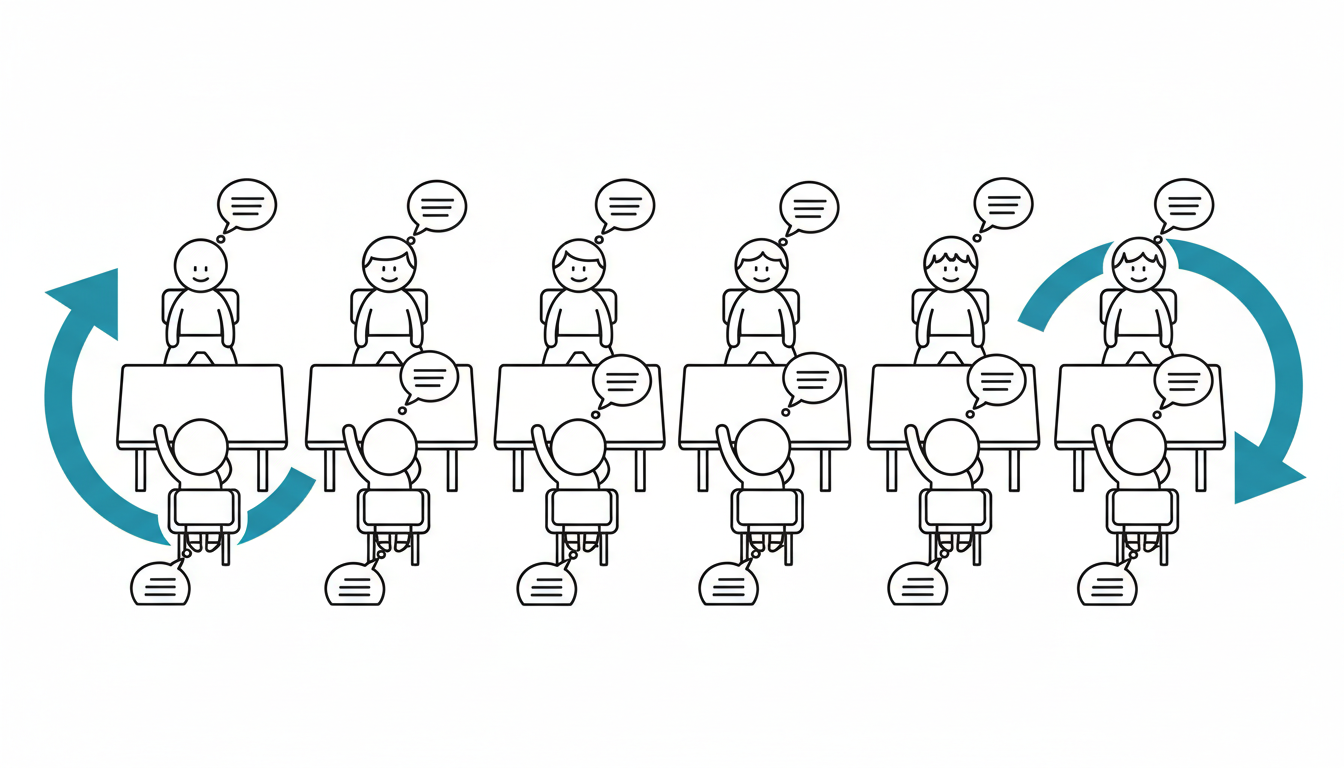
- Form two rows (30 sec) - Students form two parallel lines facing each other; designate one row as "stationary" and one as "rotating"
- Assign teaching focus (20 sec) - All students responsible for explaining same concept, or assign different concepts to different students
- First round (60 sec) - Partners teach their concept to each other simultaneously (30 sec each); timer rings
- Rotate (10 sec) - Rotating row shifts one position (person on end moves to beginning); everyone has new partner
- Subsequent rounds (60 sec each) - Repeat teaching with new partner; complete 3-4 rotations total
- Quick debrief (30 sec) - "How did your explanation improve each time? What did you learn from your partners?"
What to Say
Opening: "Line up in two rows facing a partner. In 60 seconds, you'll explain [today's key concept] to your partner. After 30 seconds, I'll signal to switch so your partner explains to you. Then the row by the window will rotate one person to the right, and you'll have a new partner. Ready?"
During: "Go! Teach your concept... [30 seconds] SWITCH! Now your partner teaches... [30 seconds] TIME! Rotating row, shift one person down. New partners, go!"
Between rounds: "Notice how you're getting better at explaining this each time. Borrow good ideas from the people who taught you!"
Closing: "Final rotation! Give your partner your absolute best, clearest explanation... Time! Return to seats. By teaching 4 different people, you just learned this concept 4 times deeper."
Why It Works
The "protégé effect" demonstrates that teaching material to others significantly strengthens the teacher's own understanding and retention (Chase et al., 2009). Multiple iterations with different partners provides distributed practice, immediate feedback through partners' comprehension (or confusion), and motivation to refine explanations. The physical rotation maintains alertness and prevents the conversation fatigue that sets in during extended single-partner discussions. Each new partner brings fresh questions or perspectives that deepen understanding.
Research Citation: Learning by teaching (Chase et al., 2009)
Teacher Tip
Use specific, focused prompts rather than vague "explain what we learned." Instead: "Explain the three causes of the Civil War" or "Teach how to solve this type of equation" or "Describe the water cycle in 30 seconds." The tighter the focus, the more efficiently students can teach and iterate. Also, consider letting students bring one note card as a reference—the goal is explaining, not memorization.
Variations
For Different Subjects
- Math/Science: Teach problem-solving strategy for specific equation type, explain scientific process (photosynthesis steps), or describe cause-and-effect relationships
- Humanities: Summarize a text, argue a thesis, explain character motivation, or connect historical events
- Universal: Any core concept that benefits from verbal explanation and can be taught in 30-60 seconds
For Different Settings
- Large Class (30+): Perfect activity for large groups; two rows of 15 each creates 15 simultaneous conversations
- Small Group (6-12): Form one small circle; all students teach to the person on their right, then rotate clockwise
For Different Ages
- Elementary (K-5): Longer teaching time (60 seconds each side); fewer rotations (2-3 partners total); provide sentence stems: "First... then... finally..."
- Middle/High School (6-12): Standard approach with 30-60 second explanations; 4-5 partners
- College/Adult: Shorten to 20-30 seconds per explanation for highly focused teaching; add challenge of teaching to non-expert audience
Online Adaptation
Tools Needed: Video platform with breakout rooms + clear timer visible to all
Setup: Prepare multiple breakout room assignments with pairs pre-arranged
Instructions:
- Assign initial pairs to breakout rooms
- Set automatic breakout room timer for 60 seconds (or manually close rooms)
- After each round, return to main room and immediately assign new pairs to different rooms
- Complete 3-4 rotations with different partners
- Final debrief in main room
Pro Tip: Use Zoom's "recreate breakout rooms" feature to automatically shuffle pairs, or prepare partner rotation schedule in advance and share in chat.
Troubleshooting
Challenge: Some students finish explaining in 10 seconds; lots of awkward silence Solution: Provide follow-up questions: "After you teach, your partner must ask you 2 clarifying questions. Then you answer. Use the full time."
Challenge: Rotating row gets confused about which direction to move Solution: Place visual marker (colored tape, sign) at the end of the stationary row: "Rotating row, everyone moves toward the red sign. Person at the red sign moves to the other end."
Challenge: Students just chat socially instead of teaching concept Solution: Accountability check: "Next round, I'll randomly call on someone to share what their partner just taught them. Listen carefully!"
Extension Ideas
- Deepen: "Expert upgrade" - after each rotation, students must add one new detail or example they learned from their previous partner
- Connect: Assign different concepts to each student; everyone teaches their unique concept, so students learn multiple things through rotation
- Follow-up: Writing prompt: "Explain the concept in writing as clearly as you explained it to your fourth partner"
Related Activities: Concentric Circles, Think-Pair-Share, Human Scavenger Hunt