
Self-Explanation
At a Glance
- Time: 3-4 minutes
- Prep: None
- Group: Individual or pairs
- Setting: Any classroom
- Subjects: Universal
- Energy: Low
Purpose
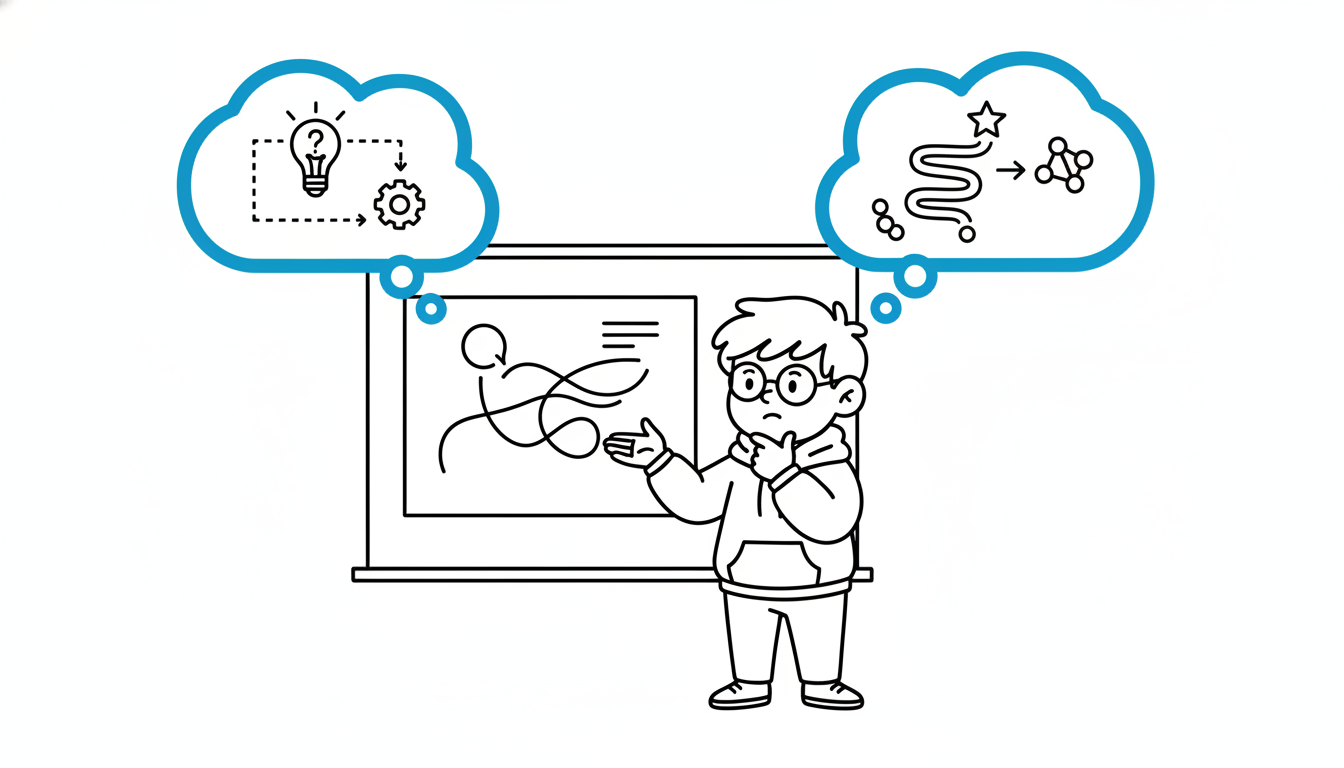
Deepen comprehension and reveal gaps in understanding by having students explain concepts, processes, or solutions to themselves (or a partner) in their own words, forcing active cognitive processing that surfaces misunderstandings and strengthens memory through elaborative encoding, while developing the metacognitive skill of monitoring one's own understanding by noticing where explanations break down.
How It Works
- Identify target concept (15 sec) - Teacher names concept, process, or problem from today's lesson
- Self-explanation prompt (15 sec) - "Explain this to yourself as if teaching someone who's never heard of it. Use your own words."
- Individual explanation (2-3 min) - Students write or speak their explanation (can be aloud to themselves, written, or to a partner)
- Reflection (30 sec) - "Where did your explanation feel shaky? What part was hard to explain? That's where you need more study."
What to Say
Opening: "We just learned about [concept]. Now I want you to explain it—not to me, to yourself. Pretend you're teaching it to a friend who missed class. Use your own words, not mine. Explain it out loud or write it. Go."
During: "If you get stuck—if you can't explain a part—that's valuable information. Notice where you stumble. That's what you don't fully understand yet. Mark it. Ask about it."
Closing: "Where did your explanation break down? Where did you hesitate or realize you weren't sure? Those gaps are your study priorities. You can't explain what you don't understand."
Why It Works
Self-explanation is one of the most powerful learning strategies (Chi et al., 1989). When students actively generate explanations rather than passively reviewing material, they engage in deeper cognitive processing that strengthens memory and reveals gaps. The act of explanation forces students to create causal connections, identify underlying principles, and translate abstract ideas into concrete language—all of which deepen comprehension. Critically, self-explanation serves as a metacognitive tool: students discover what they DON'T understand when they can't coherently explain it, making their learning needs explicit.
Research Citation: Self-explanation effect (Chi et al., 1989)
Teacher Tip
The "break down" moment is the learning gold. When a student can't finish an explanation, that's not failure—it's diagnostic precision. Encourage students to notice and NAME the sticking point: "I can explain X, but I don't get Y." That specificity guides effective studying.
Variations
For Different Subjects
- Math/Science: "Explain how to solve this problem step-by-step, including WHY each step works"
- Humanities: "Explain the author's argument or the historical cause-and-effect in your own words"
- Universal: "Explain how [new concept] is similar to and different from [related concept we already learned]"
For Different Settings
- Large Class (30+): Individual written self-explanations; collect to assess understanding
- Small Group (5-15): Pair-explain: each student explains to a partner, who asks clarifying questions
For Different Ages
- Elementary (K-5): "Teach this to your stuffed animal" or "Draw and label a picture showing how it works"
- Middle/High School (6-12): Standard self-explanation in writing or aloud
- College/Adult: Record video self-explanation as study tool; watch back to identify gaps
Online Adaptation
Tools Needed: Breakout rooms, screen recording tool (Loom, Flip), or chat
Setup: Prepare self-explanation prompt
Instructions:
- Pose prompt: "Explain [concept] in your own words as if teaching someone"
- Option A - Written: Students type explanation in chat or shared doc
- Option B - Verbal: Breakout pairs take turns explaining to each other
- Option C - Recorded: Students record 60-second video self-explanation using Flip/Loom
- Debrief: "Where was your explanation hardest? What do you still need to clarify?"
Pro Tip: Use Flip (formerly Flipgrid) for video self-explanations—students can watch their own explanation and self-assess clarity.
Troubleshooting
Challenge: Students just repeat textbook or teacher's words verbatim Solution: Emphasize: "Don't use the words from the textbook or my lecture. Use YOUR OWN WORDS. Pretend you're explaining to a younger sibling or grandparent. Make it your language."
Challenge: Students claim they CAN explain it, but their explanation is vague or circular Solution: Add specificity test: "Now explain it to someone who's never heard of it. Define every technical term you use. If you use a word they wouldn't know, you have to explain that word too."
Challenge: Student successfully explains it but didn't actually understand deeply—they memorized surface-level explanation Solution: Follow up with "Why?" questions: "You explained WHAT happens. Now explain WHY it works that way." Deep understanding requires causal reasoning.
Extension Ideas
- Deepen: "Explanation Chain"—start by explaining concept to self, then explain it to a peer, then revise explanation based on peer's questions
- Connect: "Explanation Evolution"—record self-explanation at start of unit and again at end; compare to see growth in sophistication
- Follow-up: Peer explanation exchange—students submit written self-explanations, then read and give feedback on a classmate's explanation
Related Activities: Peer Teaching Pairs, Think-Ink-Pair-Share, Muddiest Point