
Buzz Groups
At a Glance
- Time: 2-3 minutes
- Prep: None
- Group: Small groups (2-4 students)
- Setting: Any classroom context
- Subjects: Universal - works in any discipline
- Energy: Medium to High
Purpose
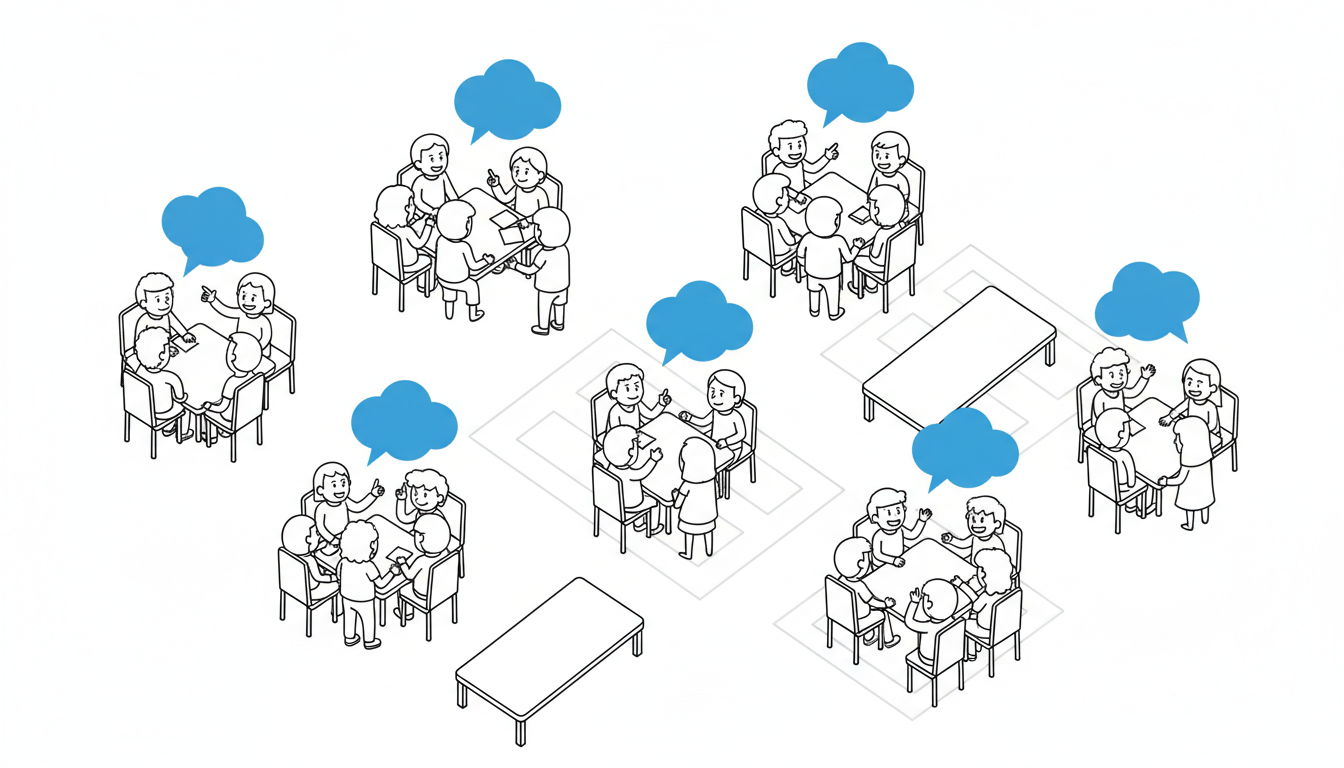
Buzz Groups create instant energy and engagement by having students turn to those seated nearby for brief, spontaneous discussions. Use this activity when you need to break up lecture segments, activate prior knowledge quickly, or generate multiple perspectives on a question without formal group formation. The name comes from the literal "buzz" of conversation that fills the room—a sound that signals active learning in progress.
How It Works
Step-by-step instructions:
-
POSE A FOCUSED QUESTION (10 seconds) - Present a specific question or prompt that can be discussed in 2-3 minutes. Keep it concrete and bounded.
-
FORM SPONTANEOUS GROUPS (15 seconds) - Students simply turn to the 2-3 people sitting closest to them. No formal group formation needed—proximity creates the groups.
-
BUZZ (90-120 seconds) - Groups discuss the question. You'll hear an energetic hum of conversation throughout the room.
-
SIGNAL ATTENTION (5 seconds) - Use a consistent attention signal (chime, raised hand, countdown) to bring the class back together.
-
BRIEF HARVEST (Optional, 30-60 seconds) - Quickly call on 2-3 groups to share one insight from their discussion.
What to Say
Opening: "Quick buzz group! Turn to the 2 or 3 people near you and discuss this question: [POSE QUESTION]. You have 90 seconds—go!"
During: [Usually no verbal guidance needed—let the buzz happen. Walk around and listen to sample conversations for formative assessment purposes.]
Signaling Return: "Three... two... one... attention back up here, please." [Or use your established attention signal]
Closing: "I heard some great thinking. Let me hear from one group—what's one idea that came up?" [Take 1-2 responses, then move on]
Why It Works
Buzz Groups work because they minimize barriers to participation:
Low Cognitive Load: The informal, spontaneous nature means students don't need to learn a complex protocol. They can focus their cognitive energy on the content, not the procedure.
Social Comfort: Talking to people you're already sitting near feels less risky than forming new groups or speaking to the whole class.
Energy Injection: The physical act of turning, the shift in voice level, and the buzz of multiple conversations creates a physiological arousal that combats passive listening fatigue.
Efficiency: No time wasted on logistics. Students are discussing within 15 seconds of hearing the prompt.
Research Citation: The buzz group technique is rooted in the "active learning" research base showing that breaking up lecture every 10-15 minutes with brief active processing significantly improves retention (Bligh, 2000; Middendorf & Kalish, 1996).
Teacher Tip
The power of Buzz Groups lies in their spontaneity and efficiency. Don't overthink it. The minute you start assigning specific groups or giving elaborate instructions, you've lost the "buzz." Keep it simple: pose a question, say "buzz," and let proximity create the groups. Embrace the slight chaos—it's productive noise, not disorder.
Variations
For Different Subjects
-
Math/Science: "Buzz group: How would you set up this problem? What's the first step?" (Great for activating problem-solving strategies)
-
Humanities: "What's one word that describes the mood of this scene/passage/image? Why?" (Quick entry into literary or artistic analysis)
-
Social Science: "What's one factor that might have influenced this historical decision?" (Generating multiple causal hypotheses)
For Different Settings
-
Large Lecture Hall (50+): Buzz Groups work brilliantly here. Students can turn around to talk to the row behind them, or side-to-side within their row.
-
Small Seminar (8-12): Form one or two buzz groups maximum. In a small class, you might skip this and just do whole-group discussion.
-
Lab Setting: Students can buzz right at their lab stations—no need to move.
For Different Ages
-
Elementary (K-5): Keep discussions to 60 seconds. Model what "buzz" looks and sounds like first: "Everyone uses their conversation voice, not their playground voice."
-
Middle/High School (6-12): Standard 90-120 seconds works well. Can handle more abstract questions.
-
College/Adult: Can extend to 2-3 minutes for more complex topics without losing focus.
Online Adaptation
Tools Needed: Video conferencing platform with breakout rooms (Zoom, Google Meet, Microsoft Teams)
Setup: Pre-configure the breakout room settings to auto-assign participants and auto-return after a set time.
Instructions:
- Pose your question clearly, displaying it in the chat or on screen
- Say "I'm sending you into buzz groups for 90 seconds"
- Launch pre-configured breakout rooms (3-4 people per room)
- Set timer for 90 seconds with auto-return enabled
- When everyone returns, proceed with your lesson
Pro Tip: In virtual settings, Buzz Groups are actually easier than in person because the platform handles all the logistics. Just click one button and students are instantly in small-group conversations.
Troubleshooting
Challenge: The room gets very loud and some students can't hear their group members.
Solution: This is actually a good sign—it means everyone is engaged! If volume becomes an issue, teach students the "SLANT forward" technique: Sit up, Lean toward your group members, Ask and answer questions, Nod, Track the speaker. Physical proximity naturally helps with hearing.
Challenge: One or two students are left out because they're sitting alone or on the edge.
Solution: Before starting, do a quick scan and say, "If you're not near anyone, scoot your chair to join the closest group." Or during your circulation, gently direct isolated students to nearby groups.
Challenge: Groups finish in 30 seconds and then sit silently.
Solution: Your question might be too simple. Buzz Group questions should require discussion, not just a one-word answer. Try "How...?" or "Why...?" questions rather than "What...?" questions.
Extension Ideas
-
Deepen: Use progressive Buzz Groups: first buzz about X, then buzz about how X relates to Y, then buzz about implications.
-
Connect: Combine with written reflection: "After your buzz group, jot down one new idea you heard that you hadn't considered."
-
Follow-up: "Find a NEW group of people and buzz about the same question again. See if different groups came up with different ideas."
Related Activities: Think-Pair-Share, Turn and Talk, Rotating Trios