
Before-After Thinking
At a Glance
- Time: 3-4 minutes
- Prep: None (best if done at start and end of unit)
- Group: Individual writing
- Setting: Any classroom
- Subjects: Universal
- Energy: Low
Purpose
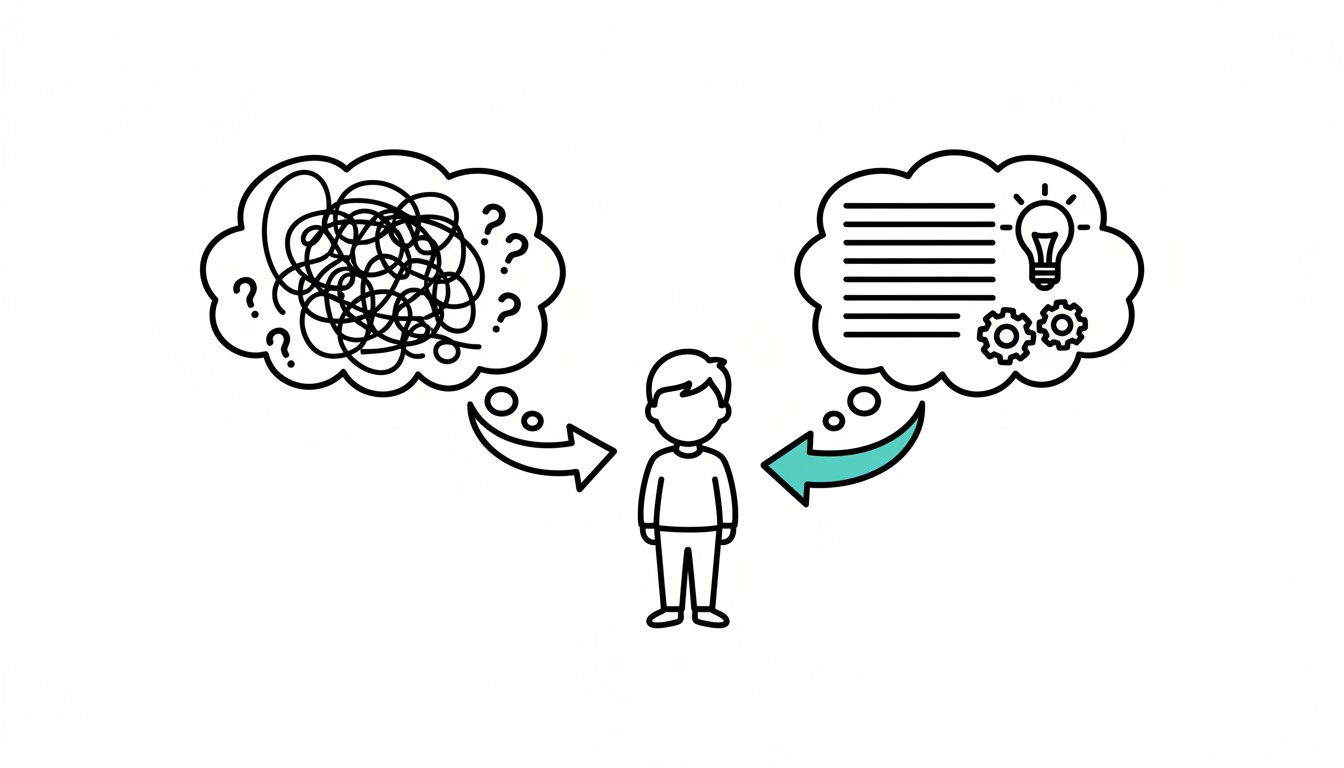
Make conceptual change visible and celebrate intellectual growth by having students explicitly compare their thinking before and after instruction, documenting initial beliefs or understandings alongside revised understandings, which both reinforces new learning through metacognitive reflection and builds growth mindset by providing concrete evidence that thinking evolves through learning, contradicting fixed-mindset beliefs that "you either get it or you don't."
How It Works
- Baseline capture (at unit start, 90 sec) - Before teaching new concept: "What do you currently think about X? Write your best answer based on what you know NOW."
- Instruction (happens over days/weeks)
- Comparison prompt (at unit end, 2 min) - "Look at what you wrote at the start. How has your thinking changed? What did you think THEN vs. what you know NOW?"
- Metacognitive reflection (60 sec) - "What caused your thinking to change? Which experiences or explanations shifted your understanding?"
What to Say
At unit START: "We're starting a new unit on [topic]. Before I teach you anything, write down: What do you CURRENTLY think about [key question or concept]? This isn't graded. I'm not looking for the 'right' answer—I want YOUR thinking as it is RIGHT NOW. This is your baseline."
Save these initial responses—students will return to them later
At unit END: "Pull out what you wrote at the start of the unit. Read it. Now write your answer to the SAME question based on what you know now. Compare: How did your thinking change? What did you believe before that you don't believe anymore? What NEW understanding do you have?"
Metacognitive reflection: "Thinking isn't static. You just saw your own mind change. What CAUSED that change? Was it an experiment? A discussion? An example? Identifying what shifts your thinking helps you learn more effectively."
Closing: "This comparison shows you're not the same learner you were [X weeks] ago. Your brain has reorganized itself around new understanding. That's what learning looks like."
Why It Works
Conceptual change theory (Posner et al., 1982) emphasizes that learning often requires replacing or restructuring prior beliefs, not just adding new information. However, students rarely recognize this transformation because they forget their initial misconceptions—current understanding feels like what they "always knew." Before-After Thinking makes conceptual change explicit by preserving the initial thinking state and forcing comparison. This serves multiple functions: it consolidates new learning through elaborative reflection, builds growth mindset by documenting intellectual progress, and helps students identify which instructional experiences were most transformative (valuable metacognitive data).
Research Citation: Conceptual change theory (Posner et al., 1982)
Teacher Tip
Choose questions that will likely reveal misconceptions or naive theories in the "before" phase—questions where students have intuitive but incorrect ideas. The bigger the contrast between before-after, the more powerful the reflection. For example, in science: "Why do we have seasons?" (common misconception: distance from sun). In literature: "What makes a strong thesis?" (common misconception: stating a fact).
Variations
For Different Subjects
- Math/Science: "How would you solve this problem? Explain your reasoning" (before instruction) vs. same problem after instruction
- Humanities: "What do you think X means/symbolizes?" (before reading) vs. "What does X mean?" (after reading and discussion)
- Universal: "What do you think causes X?" or "How does X work?" before instruction vs. after
For Different Settings
- Large Class (30+): Collect initial responses, return them at unit end for comparison
- Small Group (5-15): Share before-after comparisons aloud as whole class—powerful to hear everyone's intellectual journey
For Different Ages
- Elementary (K-5): Use drawing + writing: "Draw what you think X is before we learn about it" then "Draw X after we learned"
- Middle/High School (6-12): Standard written before-after with metacognitive reflection
- College/Adult: Add disciplinary component: "How does your new understanding align with how experts in the field think about this?"
Online Adaptation
Tools Needed: Google Doc, Padlet, or form with two sections (Before/After)
Setup: Create template with Before section at top, space for After section below
Instructions:
- Beginning of unit: Students access shared template and write "Before" response
- Save/lock that response so it can't be edited
- End of unit: Students scroll down, read their Before response, write After response below it
- Final prompt: "How did your thinking change and why?"
- Optional: Gallery view of selected before-after examples (anonymous or voluntary)
Pro Tip: Use Google Doc's "Suggesting" mode for Before response, then switch to "Editing" for After—visually distinct.
Troubleshooting
Challenge: Students don't remember writing the "Before" response and claim they "always knew" the correct answer Solution: This IS the problem the activity solves! Show them their own written words from weeks ago. "Here's what you wrote. You didn't always know this—your thinking evolved."
Challenge: Students are embarrassed by naive Before responses Solution: Normalize and celebrate: "EVERYONE has misconceptions before learning. That's what makes you human, not stupid. The fact that you NOW know better proves you learned."
Challenge: Before responses are blank or say "I don't know" Solution: Push for theories: "You DO have ideas, even if uncertain. Make your best guess. Explain using what you know from everyday life. Wrong answers are fine—that's the point."
Extension Ideas
- Deepen: "Before-During-After"—add a midpoint check: capture thinking at start, middle, and end of unit to see incremental evolution
- Connect: Gallery walk of before-after examples: read classmates' transformations to see diverse pathways of conceptual change
- Follow-up: End-of-year reflection: "Look back at ALL your before-after comparisons this year. What's the biggest way your thinking changed in this subject?"
Related Activities: I Used to Think, Now I Know, Progress Tracking, 3-2-1 Bridge