
Notice and Wonder
At a Glance
- Time: 2-3 minutes
- Prep: Something to observe (image, data, object, problem)
- Group: Whole class or pairs
- Setting: Any
- Subjects: Universal (especially strong for Math)
- Energy: Low
Purpose
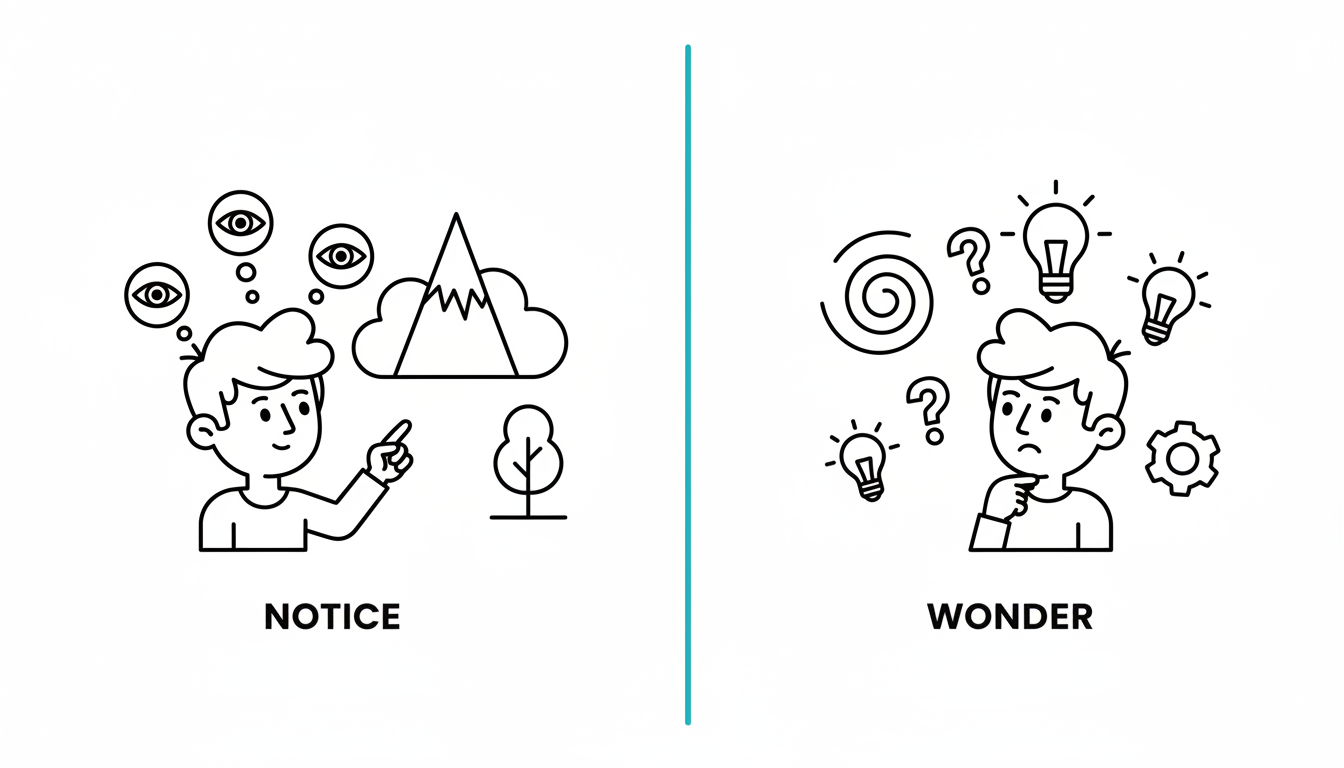
Activate observation skills and curiosity using the simple but powerful prompts: "What do you notice?" and "What do you wonder?" This low-floor, high-ceiling approach values all observations and questions, making it accessible while promoting deep inquiry.
How It Works
- DISPLAY (10 seconds) - Show an image, data set, object, or problem
- NOTICE (60-90 seconds) - "What do you notice?" Students observe and share observations
- WONDER (60-90 seconds) - "What do you wonder?" Students generate questions
- RECORD (optional) - Teacher writes notices and wonders on board
- TRANSITION - "Great observations and questions! Today's lesson will help us explore these."
What to Say
"I'm going to show you something. First, just notice. What do you notice? Don't analyze yet—just observe. You have 30 seconds of silent noticing."
(Show stimulus)
"Now, turn to a partner. Share: What did you notice? You have 60 seconds."
(After sharing) "Let's hear some notices. What did people observe?"
(Record 4-6 observations)
"Now: What do you WONDER? What questions does this raise? What are you curious about?"
(Record 4-6 wonders)
"Excellent noticing and wondering! Today's lesson will help us answer some of these wonders."
Why It Works
The two-step structure is beautifully simple yet cognitively rich. "Notice" activates observation and descriptive thinking. "Wonder" generates curiosity and sets purpose for learning. All students can contribute something they notice or wonder, making participation equitable. The approach explicitly teaches that learning begins with careful observation and asking questions—the foundation of inquiry.
Research Citation: Notice and Wonder routines improve mathematical thinking and inquiry skills (NCTM, 2014).
Teacher Tip
Accept ALL notices and wonders without judgment! Even "silly" observations or questions are valuable. The goal is to activate thinking and create curiosity, not to filter for "correct" observations. You can address accuracy during instruction.
Variations
What to Display
Math: Graph, data table, number pattern, word problem, equation Science: Phenomenon (video of reaction), specimen, diagram History: Historical photo, primary source document, map Literature: Excerpt, quote, book cover Art: Painting, sculpture photo General: Any complex stimulus related to the topic
Response Formats
Verbal: Students call out notices and wonders; teacher records Written: Students write in notebooks before sharing Think-Pair-Share: Individual think, pair discuss, whole-class share Sticky Notes: Students write on sticky notes; post on board
Content Examples
Math - Graph:
- Notice: "The line goes up." "There are numbers on both axes." "It crosses at (0,0)."
- Wonder: "Why does it go up?" "What do the axes represent?" "What would happen if we extended the line?"
Science - Plant Growth Data:
- Notice: "Some plants grew taller." "The data is in a table." "There are 5 plants."
- Wonder: "Why did some grow more?" "What were the conditions?" "Would this work with other plants?"
History - Historical Photo:
- Notice: "People are dressed formally." "It's black and white." "There's a crowd."
- Wonder: "When was this taken?" "What event is this?" "What happened next?"
For Different Settings
- Large Class: Whole-class sharing; teacher facilitates
- Small Class: Everyone shares notices and wonders
- Online: Chat or verbal sharing; digital whiteboard for recording
- Pairs: Partners notice and wonder together before class share
For Different Ages
- Elementary (K-5): Use concrete, visual stimuli; celebrate all contributions
- Middle/High School (6-12): Can handle abstract or complex stimuli
- College/Adult: Discipline-specific, sophisticated observations and questions
Online Adaptation
Excellent for Online:
- Screen share the stimulus clearly
- Students type notices in chat, then wonders
- Or use breakout rooms for pair discussion
- Use digital whiteboard to record responses
- Works seamlessly virtually
Troubleshooting
Challenge: Students jump to wonders before noticing. Solution: "Hold your wonders! We're just noticing right now—what do you SEE, not what you're curious about yet."
Challenge: Notices are too general ("I see colors"). Solution: "Be more specific! What colors? Where? What else do you notice about them?"
Challenge: No one has wonders/questions. Solution: Prompt: "What would you ask an expert about this? What confuses you? What would you want to know more about?"
Challenge: Students don't understand the difference between notice and wonder. Solution: Model: "A notice is an observation: 'I see a triangle.' A wonder is a question: 'I wonder why it's a triangle?'"
Challenge: Too many responses; activity drags. Solution: Set limits: "Let's hear 5 notices and 5 wonders, then move on."
Extension Ideas
- Answer the Wonders: During the lesson, explicitly address the wonders students raised
- Add More Wonders: After learning, return to the stimulus—what NEW wonders do you have?
- Notice-Wonder-Learn: Add a third column at lesson's end: "What did we LEARN?"
- Student-Generated: Students bring their own stimuli for the class to notice and wonder about
- Gallery Walk: Multiple stimuli around room; students notice and wonder at each station
Related Activities: See-Think-Wonder, Image Prompt, Think-Pair-Share