
Four Corners Assessment
At a Glance
- Time: 2-3 minutes
- Prep: Minimal (corner signs)
- Group: Whole class
- Setting: Classroom with space
- Subjects: Universal
- Energy: Medium-High
Purpose
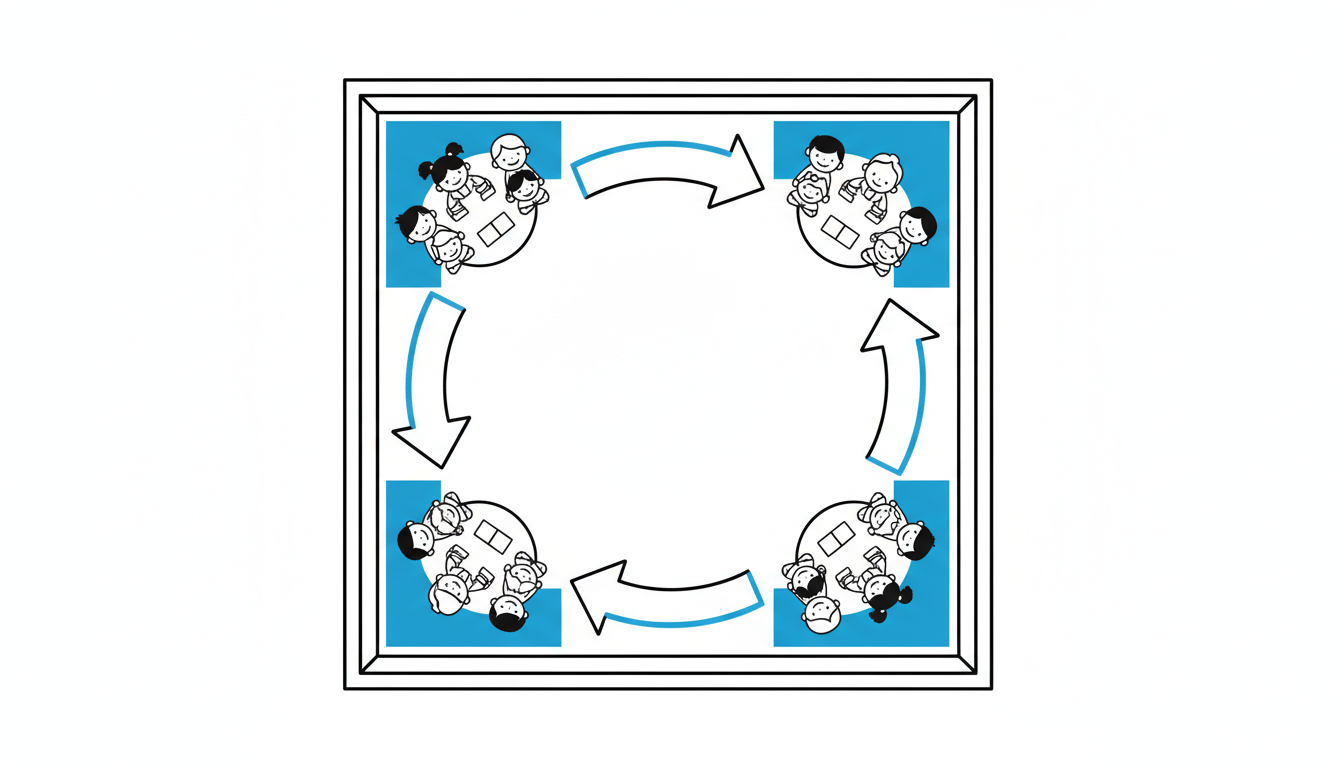
Transform comprehension checking into physical movement by assigning each corner of the room to different answer choices or positions, having students move to their chosen corner, instantly revealing distribution of understanding through physical grouping.
How It Works
- Pose question with 4 options (30 sec) - "Which answer is correct? A, B, C, or D? Each corner represents one option."
- Students move (30 sec-1 min) - Students walk to corner matching their answer choice
- Assess and discuss (1 min) - Teacher notes distribution; optionally has corners defend their choice
What to Say
Opening: "Four Corners check! Corner 1: Mitosis creates 2 cells. Corner 2: Mitosis creates 4 cells. Corner 3: Mitosis creates identical cells. Corner 4: Mitosis creates different cells. Move to your answer—go!"
During: [Observes movement] "Corners 1 and 3 have most students... Corner 2 is empty—good! Corner 3, why did you choose that answer?"
Closing: "Corner 3 is correct! Corner 1 folks, you were ALMOST there—you caught part of the answer but missed the 'identical' aspect. Let's clarify..."
Why It Works
Movement increases engagement and blood flow to brain. Physical grouping makes thinking visible—students see how their understanding compares to peers. Kinesthetic learners especially benefit from body-based responding.
Research Connection: Movement enhances cognitive processing and memory formation (Donnelly et al., 2016; Mavilidi et al., 2015).
Teacher Tip
After movement, before revealing answer: "Find one person from a different corner. Each explain why you chose your corner." Peer teaching often resolves misconceptions before teacher explanation.
Variations
Options: Agree/Disagree/Unsure/Pass (4 corners), Cause 1/2/3/4 (historical events), Character perspectives (literature), Difficulty levels (self-assessment) • Movement: Walk, hop, skip for added engagement • Ages: K-5: Use pictures in corners; 6-12: Text-based options; College: Complex scenarios
Online
Annotate shared screen with 4 quadrants labeled A/B/C/D. Students click/drag name into chosen quadrant. Or breakout rooms labeled by choice.
Troubleshooting
Students follow friends: "Everyone close your eyes, point to your corner choice, THEN open eyes and walk there."
Extension
Debate corners: Once in corners, give groups 1 minute to prepare defense of their answer, then each corner presents reasoning to class.
Related: Confidence Corners, Human Barometer