
Anticipation Guide
At a Glance
- Time: 2-3 minutes
- Prep: Prepare 4-6 true/false statements
- Group: Individual then whole class
- Setting: Any
- Subjects: Universal
- Energy: Low
Purpose
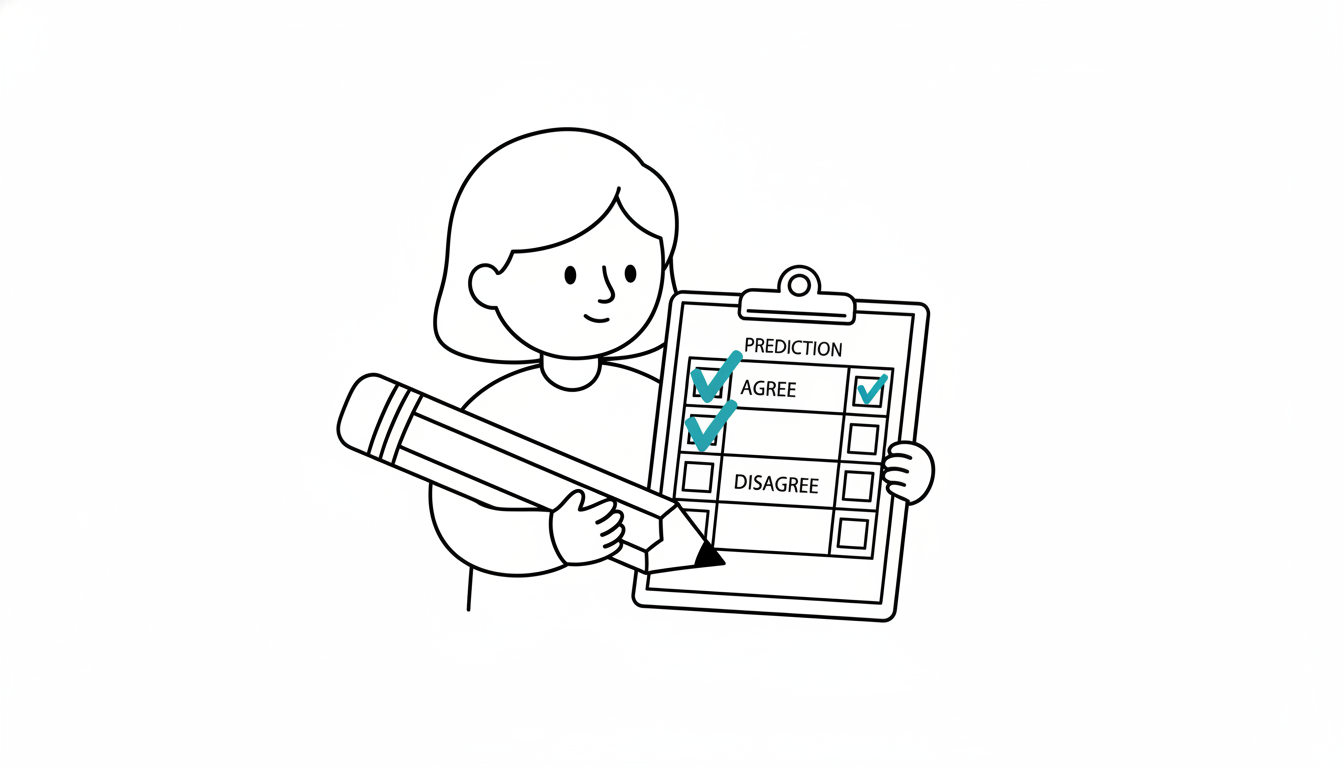
Activate prior knowledge and reveal misconceptions by asking students to agree/disagree with statements before instruction. This creates cognitive dissonance ("Wait, I thought I knew this!") which increases engagement and retention. Students become invested in discovering whether their predictions were correct.
How It Works
- PRESENT STATEMENTS (30 seconds) - Display 4-6 statements about the topic (mix true and false)
- INDIVIDUAL RESPONSE (60-90 seconds) - Students mark Agree or Disagree for each
- QUICK POLL (optional, 30 seconds) - Tally class responses; note disagreements
- TEACH - Proceed with lesson
- REVISIT (end of lesson, 60 seconds) - Return to guide; discuss what changed
What to Say
"Before we learn about [topic], I want to see what you already think you know. I'm going to show you 4 statements. For each one, decide: Do you AGREE or DISAGREE? Don't worry about being right—I want to know what you currently think. You have 90 seconds. Mark your answers."
(Show statements; students respond individually)
"Okay, let's see how we did. Who agreed with statement 1? Who disagreed?"
(Quick show of hands; note split opinions)
"Interesting! We have some disagreement. Let's find out who's right. As we learn today, pay attention—we'll revisit these statements at the end."
Why It Works
Predicting activates curiosity and creates stakes—students want to know if they were right. When predictions are wrong, the surprise creates a "memorable moment" that aids retention. The guide makes misconceptions visible so you can address them explicitly. Revisiting the guide at lesson's end provides closure and allows students to see their learning growth. This structure teaches that learning involves testing and revising beliefs.
Research Citation: Anticipation guides improve comprehension and engagement by creating purpose for reading/learning (Herber, 1978).
Teacher Tip
Mix obviously true, obviously false, and ambiguous statements. The ambiguous ones spark the best discussions! Also, avoid making all false statements "trick questions"—include some truths to reward prior knowledge.
Variations
Sample Statement Sets
Science - Photosynthesis:
- Plants get energy from the sun. (True)
- Plants breathe in oxygen like humans. (False - they take in CO2)
- All plants need soil to grow. (False - hydroponics)
- Photosynthesis happens in the leaves. (Mostly true)
History - American Revolution:
- The Revolutionary War was about taxes. (Partially true)
- All colonists wanted independence from Britain. (False)
- The war lasted about 8 years. (True)
- George Washington never lost a battle. (False)
Math - Fractions:
- A fraction represents part of a whole. (True)
- The bigger the denominator, the bigger the fraction. (False)
- You can add fractions only if denominators match. (True for direct addition)
Response Formats
- Agree/Disagree: Simple binary choice
- True/False: Same as above, different wording
- Scale: 1-5 (Strongly Disagree to Strongly Agree)
- Confidence: Mark A/D and also how confident (H/M/L)
For Different Settings
- Large Class: Students write on paper; quick hand-raise poll
- Small Class: Go statement by statement with discussion
- Online: Use polling feature or Google Form
- Pairs: Partners discuss before marking individual responses
For Different Ages
- Elementary (K-5): 3-4 simple statements; read aloud
- Middle/High School (6-12): 5-6 statements; can include nuance
- College/Adult: Complex statements requiring prior knowledge application
Online Adaptation
Excellent for Online:
- Display statements via screen share
- Use Zoom/Teams polling for instant results
- Google Form for individual responses
- Mentimeter for live voting and visualization
- Works seamlessly online
Troubleshooting
Challenge: Students just guess randomly. Solution: Emphasize: "Use what you already know or have heard. It's okay if you're not sure—that's why we're learning!"
Challenge: All students agree on everything; no disagreement. Solution: Your statements may be too obvious. Add more nuanced/tricky ones.
Challenge: Students are frustrated when they're wrong. Solution: Normalize: "If you got some wrong, that's perfect! That means you learned something new today. Misconceptions are learning opportunities!"
Challenge: Running out of time. Solution: Do the "Before" quickly (2 min), then save "After" for an exit ticket or tomorrow's review.
Challenge: Statements are ambiguous; students debate meaning. Solution: Great! Let the debate happen briefly. "Hold that thought—let's see what we learn."
Extension Ideas
- Before/After Comparison: Students use different colored pens for before vs. after responses
- Written Justification: Students write WHY they agree/disagree
- Debate: Assign sides; students defend A or D before learning
- Create Your Own: After learning, students write statements for a quiz or next class
- Track Growth: Keep guides in portfolios; reflect on misconceptions at year's end
Related Activities: KWL Chart, Predict-Observe-Explain, Four Corners