
Speed Meeting
At a Glance
- Time: 4-5 minutes
- Prep: None
- Group: Pairs (rotating)
- Setting: Space to move and rotate
- Subjects: Universal
- Energy: Medium
Purpose
Maximize the number of peer connections in minimal time. Use this during the first weeks of school, before collaborative projects, or when you want to build a cohesive class community quickly. Students practice introducing themselves, active listening, and making quick connections with multiple classmates. The rotation format ensures everyone interacts with many people.
How It Works
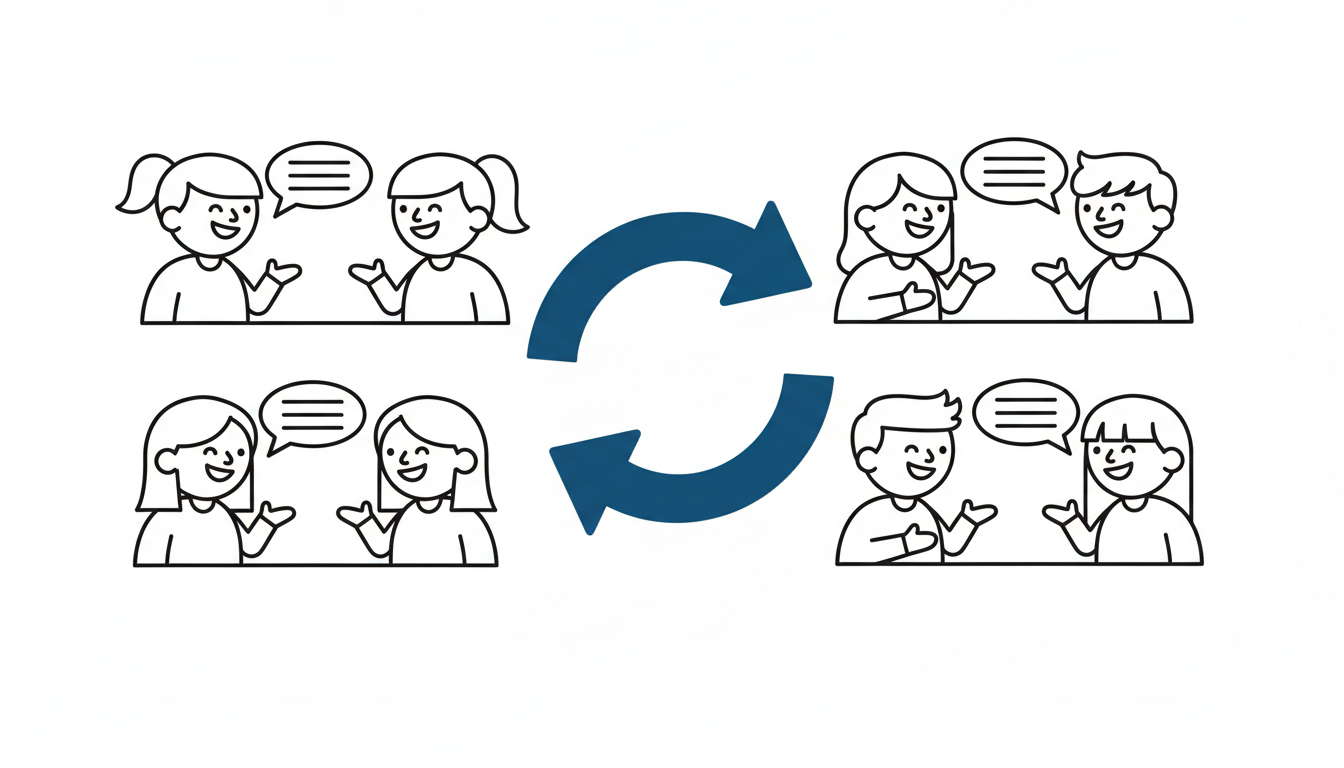
- ARRANGE (30 seconds) - Students form two lines facing each other (or circles: inner circle facing out, outer circle facing in)
- EXPLAIN (30 seconds) - "You'll have 45 seconds to introduce yourselves and answer a question. When I say 'switch,' one line moves down."
- ROUND 1 (45 seconds) - Give a prompt, students talk in pairs
- ROTATE (15 seconds) - One line shifts down; everyone has a new partner
- REPEAT (2-3 minutes) - Complete 3-4 rounds with different prompts
What to Say
"Form two lines facing each other. Make sure you're looking at a partner. If we have an odd number, one group can be a trio.
We're doing speed meetings! You'll have 45 seconds to introduce yourself and answer a question. When I say 'Switch!', this line (point to one line) will shift down one person. You'll meet someone new. We'll do 4 quick rounds.
First question: What's your name and what's one thing you did this summer? Go!"
(After 45 seconds) "Switch! This line moves down one spot. New partner, new conversation."
(Continue for 3-4 rounds with different prompts)
Why It Works
The time constraint creates energy and focus—students know they have limited time, so they jump right in. Meeting multiple people quickly builds a web of connections across the classroom. The structure removes the awkwardness of "who should I talk to?"—it's decided for you. Rotating prevents the activity from dragging and keeps energy high. Research shows that brief, repeated social interactions build familiarity and comfort more effectively than single long interactions.
Research Citation: Repeated brief exposures increase interpersonal attraction and comfort (Zajonc, 1968 - Mere Exposure Effect).
Teacher Tip
Participate! Jump into the line and rotate through. Students love getting 45 seconds with you, and it builds relationship. Plus, you model active listening and authentic engagement.
Variations
Sample Prompts
- Round 1: "Name and one hobby or interest"
- Round 2: "Name and one place you'd love to visit"
- Round 3: "Name and one superpower you wish you had"
- Round 4: "Name and one thing you're looking forward to this year"
Content-Connected Prompts
- Math: "What's your relationship with math? Love it, fear it, somewhere in between?"
- Science: "What's one science question you've always wondered about?"
- English: "What's the last book you read for fun?"
- History: "If you could time-travel to any era, when and why?"
For Different Settings
- Large Class: Two long lines or multiple smaller groups of lines
- Small Class: One small circle (4-6 people) rotating
- Online: Breakout rooms with random assignments that change every minute
- Limited Space: Students seated, rotate seats within rows
For Different Ages
- Elementary (K-5): Use simple prompts: "Favorite color? Favorite animal? Number of siblings?"
- Middle/High School (6-12): Can handle more abstract prompts: "Biggest goal this year?"
- College/Adult: Professional prompts: "What's your major and why did you choose it?"
Online Adaptation
Excellent for Online:
- Use Zoom/Teams breakout room auto-assignment
- Set breakout rooms to auto-close and shuffle after 1 minute
- Students meet 4-5 different people in 4-5 minutes
- Works beautifully in virtual settings
Troubleshooting
Challenge: Odd number of students leaves one person out each round. Solution: Make one group a trio, or teacher participates to even numbers, or assign one student as "observer/timekeeper" who rotates in after first round.
Challenge: Conversations end after 15 seconds; awkward silence. Solution: Give follow-up prompts: "Now ask each other: Why? Tell me more about that. What else?"
Challenge: Students don't rotate fast enough; time is wasted. Solution: Have a clear signal ("Switch! Move now! 5 seconds!") and practice the rotation once before starting.
Challenge: Students talk to the same person twice (rotation error). Solution: Assign numbers: "You're Partner 1, 2, 3, etc. Only Partner 1 moves." Or mark starting spots with tape.
Extension Ideas
- Deeper Follow-Up: "Did you meet anyone with similar interests? Seek them out for a future group project."
- Metacognitive Debrief: "How did it feel to meet so many people so quickly? Was it easier or harder than meeting one person for a long time?"
- Create Connection Map: Students draw a map showing everyone they talked to and one fact about each
- Memory Challenge: "Can you name all 4 people you met? What's one thing you learned about each?"
- Revisit Throughout Year: Periodically do speed meetings with different prompts to maintain connections
Related Activities: Two Truths and a Lie, Birthday Lineup, Find Someone Who