
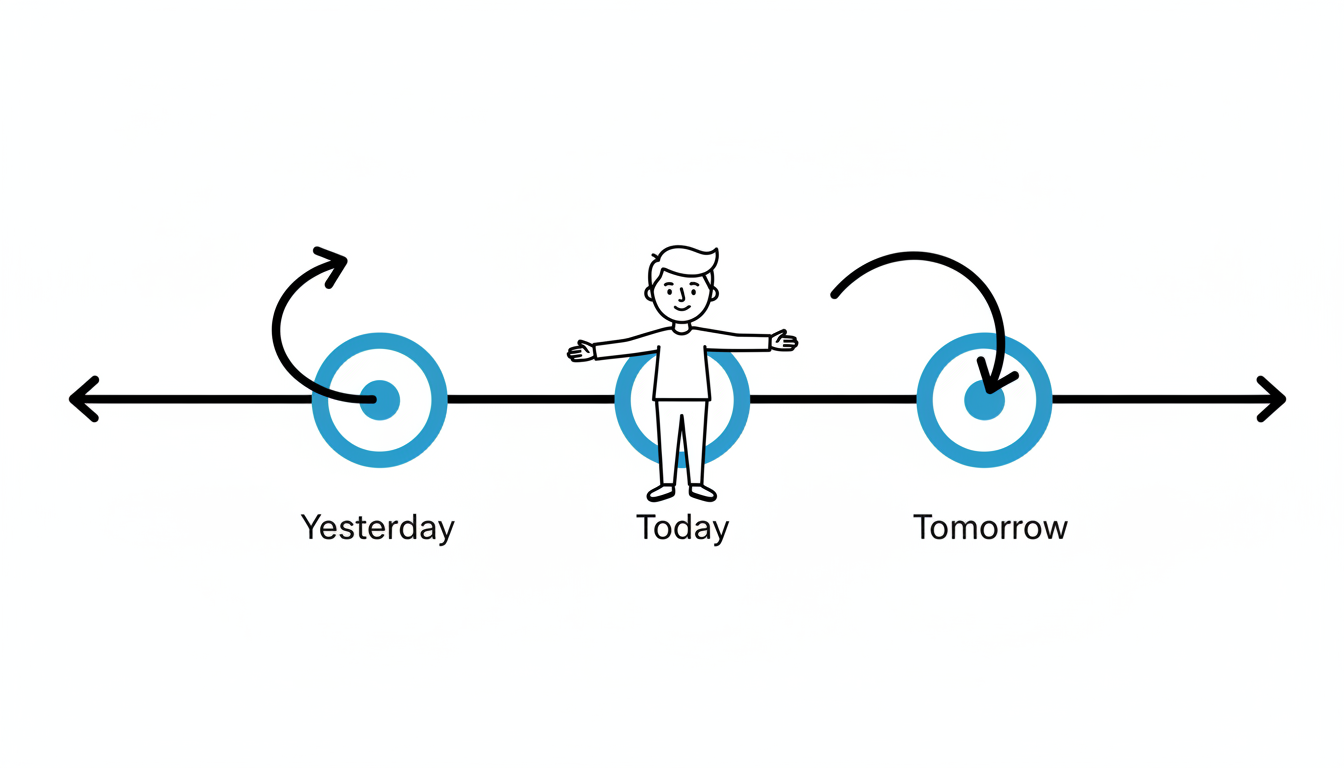
Yesterday-Today-Tomorrow
At a Glance
- Time: 3-4 minutes
- Prep: None
- Group: Individual or whole class
- Setting: Any
- Subjects: Universal
- Energy: Low
Purpose
Activate prior knowledge by explicitly connecting past learning (yesterday), current lesson (today), and future application (tomorrow). This temporal framework helps students see learning as a connected journey, not isolated lessons.
How It Works
- YESTERDAY (60 seconds) - "What did we learn yesterday/recently that connects to today's topic?"
- TODAY (30 seconds) - "Today we're learning about [topic]. How might it build on yesterday?"
- TOMORROW (60 seconds) - "Where might we use this knowledge tomorrow/in the future?"
- SHARE (optional, 60 seconds) - Students share their connections
What to Say
"Let's connect our learning across time. Think about three time frames:
YESTERDAY: What did we learn recently that might connect to today's topic? Take 30 seconds to think or write one thing."
(Pause)
TODAY: Today we're learning about [topic]. How do you think it will build on what we learned yesterday/before?"
(Brief responses)
TOMORROW: Where might we use this knowledge in the future? In next week's lessons? In real life? Think about it."
(Share a few responses)
"Great! You're seeing that learning connects across time. Today's lesson is a bridge from yesterday to tomorrow."
Why It Works
Making connections explicit improves retention and transfer. Students see that knowledge builds cumulatively rather than existing in isolated chunks. The "tomorrow" prompt creates purpose and relevance. The temporal framework aids memory by creating a narrative structure. This explicitly teaches that learning is an ongoing, connected process.
Research Citation: Connecting new information to prior learning and future application improves retention (Bransford et al., 2000).
Teacher Tip
Be flexible with "yesterday"—it can mean the last lesson, last week, or even last year if relevant. The goal is activating ANY relevant prior learning, not just the most recent lesson. Also, "tomorrow" can be metaphorical—future lessons, real-world application, or long-term goals.
Variations
Time Frame Variations
Literal: Yesterday's actual lesson → Today → Tomorrow's actual lesson Unit-Based: Beginning of unit → Middle → End of unit Year-Based: Last year → This year → Next year Life-Based: Before this class → During this class → After graduating
Question Prompts
Yesterday:
- "What do we already know that will help us today?"
- "What concept/skill from before connects to this?"
- "What did we learn that sets us up for today?"
Today:
- "What are we learning right now?"
- "How does today build on yesterday?"
- "What's the new concept we're adding?"
Tomorrow:
- "How will we use this tomorrow?"
- "Where will this show up in the future?"
- "Why does this matter beyond today?"
Content Examples
Math - Fractions:
- Yesterday: "We learned about numerators and denominators."
- Today: "We're learning to add fractions."
- Tomorrow: "We'll use this when cooking, measuring, and doing more complex math."
Science - Ecosystems:
- Yesterday: "We studied food chains."
- Today: "We're learning about food webs—more complex connections."
- Tomorrow: "We'll understand how ecosystems can collapse when one species disappears."
History - Civil Rights:
- Yesterday: "We learned about segregation laws."
- Today: "We're studying the Montgomery Bus Boycott."
- Tomorrow: "We'll see how this event sparked larger movements."
For Different Settings
- Large Class: Individual reflection, then share a few
- Small Class: Everyone shares their yesterday-today-tomorrow connections
- Online: Type in chat or speak in turn
- Written: Students create three-column chart in notebooks
For Different Ages
- Elementary (K-5): Use concrete examples; may need help recalling "yesterday"
- Middle/High School (6-12): Can handle abstract connections across longer time spans
- College/Adult: Can connect across courses, semesters, or career applications
Online Adaptation
Excellent for Online:
- Display the three prompts on screen
- Students type responses in chat (Yesterday/Today/Tomorrow format)
- Or do as a think-pair-share in breakout rooms
- Works well virtually
Troubleshooting
Challenge: Students can't remember what they learned yesterday. Solution: Give hints or show a visual from yesterday's lesson. Or expand: "What have we learned RECENTLY that connects?"
Challenge: Students say "Nothing connects to today." Solution: Probe: "Are you sure? Think about skills, not just topics. Did we practice anything yesterday that we'll use today?"
Challenge: Students struggle with "tomorrow" prediction. Solution: Provide examples: "We might use this when... / This will help us understand... / In real life, this matters because..."
Challenge: Connections are too vague ("It's all related"). Solution: "Be specific! WHAT from yesterday? HOW does it connect?"
Challenge: Running out of time. Solution: Do just yesterday and today (skip tomorrow). Or do it as a quick think-pair-share without whole-class discussion.
Extension Ideas
- Visual Timeline: Draw a timeline showing yesterday → today → tomorrow with key concepts
- Written Reflection: Students write a paragraph connecting all three time frames
- End-of-Lesson Revisit: At lesson's end, return to "tomorrow" predictions—were they accurate?
- Weekly Version: Monday (what we'll learn this week), Wednesday (what we're learning), Friday (how we'll use it)
- Create Analogies: "Yesterday is like the foundation, today is like building the walls, tomorrow is like moving in."
Related Activities: KWL Chart, 3-2-1 Bridge, Think-Pair-Share