
Take and Pass
At a Glance
- Time: 4-5 minutes
- Prep: None
- Group: Small groups (3-5)
- Setting: Any
- Subjects: Universal
- Energy: Medium
Purpose
Build collaborative understanding through written conversation where students pass papers around their group, reading and adding to previous responses, creating layered multi-perspective thinking.
How It Works
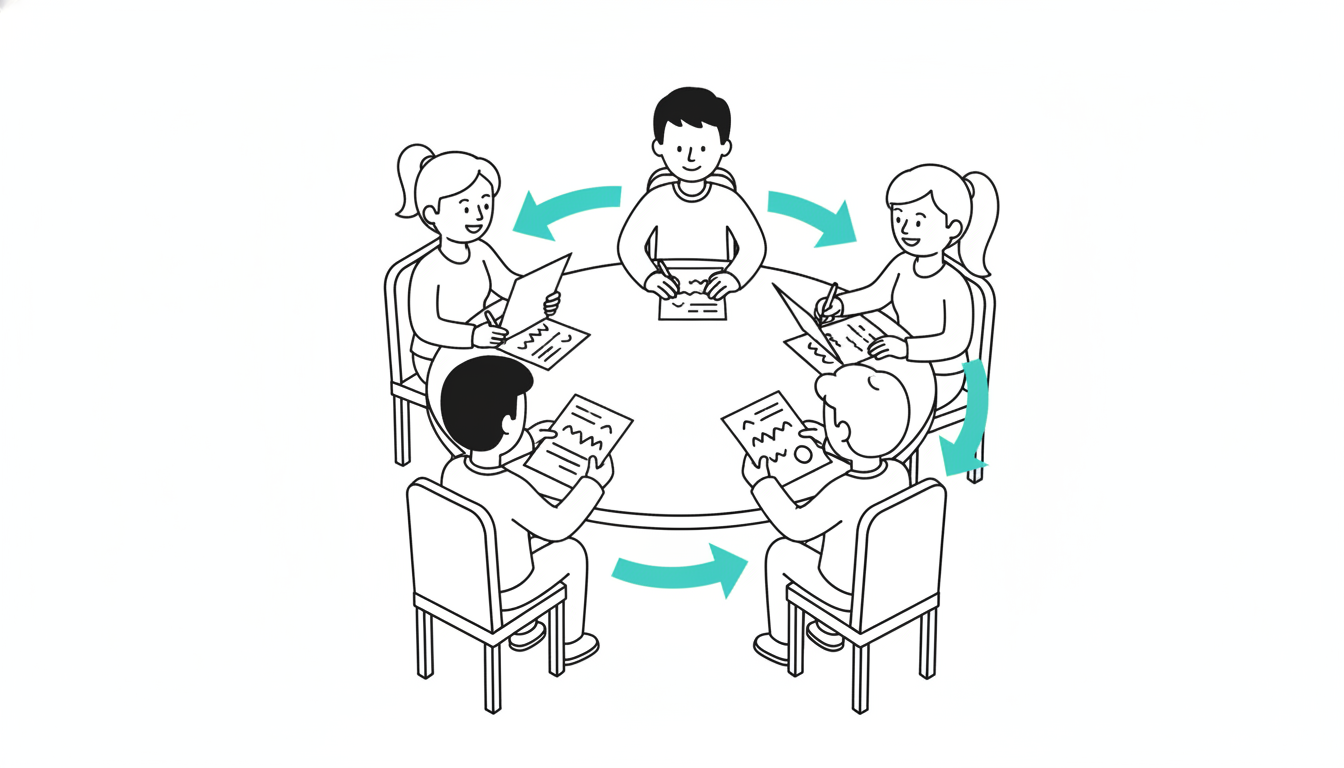
- Start writing (1 min) - Each student writes response to prompt on their paper
- Pass and add (2-3 min) - On signal, pass right; read previous response; add your thoughts
- Continue rounds (until papers return) - Pass 3-4 times until original paper returns to owner
What to Say
Opening: "Write your answer to 'Why is photosynthesis important?' on your paper—90 seconds. When I say 'pass,' pass your paper right, read what's there, add your thoughts—no repeating what's written. Pass again on my signal." During: "Read... then add something NEW... Build on previous ideas... What's missing?... Pass!" Closing: "Read all the responses on your original paper. Notice how many perspectives deepened the thinking? That's collaborative intelligence."
Why It Works
Written format gives thinking time (unlike verbal discussions where fast talkers dominate). Students must read and respond to peers' ideas, building genuinely collaborative understanding. Creates written record of evolving thought.
Teacher Tip
Use prompts that benefit from multiple perspectives: "Why is this important?" "What are different applications?" "What might go wrong?" Avoid yes/no questions.
Variations
Group size: 3 students (3 passes) to 5 students (5 passes) • Rounds: 2-5 depending on time • Format: Physical papers or shared digital doc • Ages: K-5: sentence starters; 6-12: open prompts; College: complex analysis
Online
Shared Google Doc per group. Students take turns editing in sequence (turn on suggestion mode to see evolution).
Troubleshooting
Students repeat previous ideas: "Read carefully first. Only add what's NOT already there."
Extension
After return, highlight the BEST addition someone made to your paper. Discuss what made it valuable.
Related: Think-Pair-Share, Brainwriting