
Classroom Scavenger Hunt
At a Glance
- Time: 4-5 minutes
- Prep: Minimal (prepared list of 5-7 items to find)
- Group: Individuals or pairs
- Setting: Classroom (can extend to school building)
- Subjects: Universal - adaptable to any content
- Energy: High
Purpose
Activate observational skills and connect abstract concepts to concrete examples by challenging students to find real-world instances of academic concepts within their immediate environment, transforming the classroom itself into a learning lab while providing energizing movement and practical application of knowledge.
How It Works
- Distribute hunt list (30 sec) - Give each student/pair a list: "Find 5 examples of [concept] in our classroom"
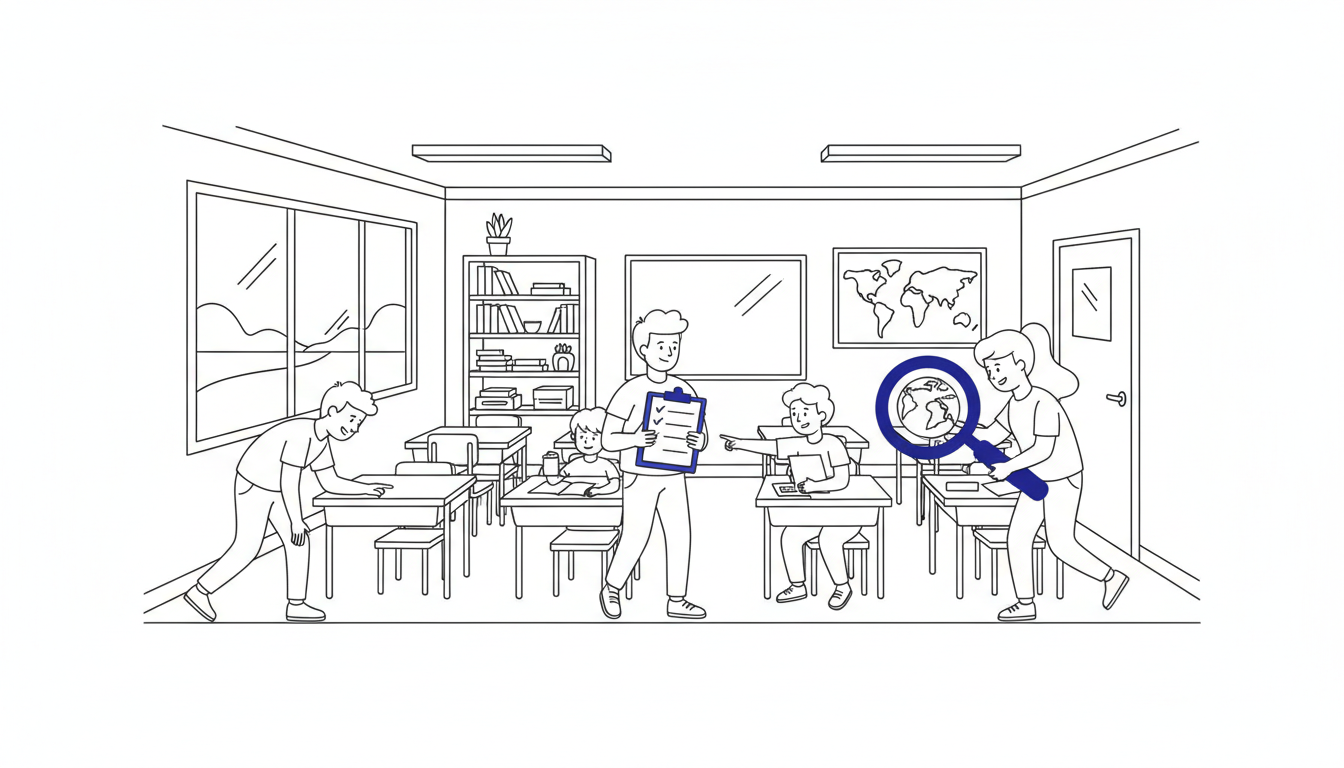
- Hunt begins (3-4 min) - Students move around classroom (and nearby hallway if permitted) identifying and documenting examples; can photograph, sketch, or list locations
- Quick share-out (30-60 sec) - "Show us one interesting example you found and explain why it fits"
- Connect to lesson (30 sec) - "Now that you've seen [concept] all around you, let's apply this to today's task"
What to Say
Opening: "You have 4 minutes to find 5 examples of [angles/persuasive text/simple machines/metaphors/living things] in our classroom or visible through the windows. Move quickly, document what you find, and be ready to share your best discovery."
During: "Look high and low! Check walls, objects, even the architecture of the room. Think creatively about what counts as an example."
Share-out: "Who found something unexpected? Show us and explain how it connects to our concept."
Closing: "Notice how [concept] is literally everywhere once you start looking. Let's use that observational skill in our work today."
Why It Works
Scavenger hunts transform passive learning into active discovery, engaging the reticular activating system—the brain's attention filter—to notice examples of concepts students might otherwise overlook (Medina, 2008). The physical movement increases blood flow and oxygen to the brain while the search-and-discover pattern activates dopamine reward pathways, creating positive associations with the learning content. Finding real-world applications demonstrates relevance and strengthens the transfer of knowledge beyond classroom walls.
Research Citation: Brain rules for learning (Medina, 2008)
Teacher Tip
Make your list progressively challenging. Start with concrete, visible examples (Find 5 right angles; Find 3 examples of symmetry) before moving to abstract applications (Find 5 examples of persuasion in posted materials; Find 3 instances of irony in classroom objects). The thrill of the hunt works best when items are findable but require genuine observation and thought.
Variations
For Different Subjects
- Math/Science: Find geometric shapes, examples of levers/pulleys/inclined planes, evidence of chemical reactions, measurements, patterns, prime numbers
- Humanities: Find persuasive text in posted materials, examples of literary devices in visible book titles, historical artifacts, symbols representing themes
- Universal: Find evidence of a concept (cooperation, diversity, growth, creativity) represented in classroom displays or objects
For Different Settings
- Large Class (30+): Pairs instead of individuals to reduce crowding; assign different concepts to different groups so they're not all searching for the same things
- Small Group (5-15): Can expand hunt beyond classroom into hallway, library, or outside if available; individuals rather than pairs
For Different Ages
- Elementary (K-5): Very concrete items (Find something red; Find 5 circles; Find examples of the letter B); provide picture cards for non-readers
- Middle/High School (6-12): Abstract applications requiring interpretation (Find examples of theme; Find evidence of ecosystem; Find geometric proofs in architecture)
- College/Adult: Highly conceptual (Find examples of theoretical frameworks; Find evidence of design principles; Find instances of cognitive biases)
Online Adaptation
Tools Needed: Video platform with camera access; students use smartphone/tablet cameras
Setup: Students remain in video call while using device camera to search their environment
Instructions:
- Assign concept to find in students' homes: "Find 5 examples of symmetry in your house"
- Students have 3 minutes to move around their space and photograph examples
- Return to video call; share screen to show photos
- Alternative: Use Google Slides where each student adds photos to their assigned slide
Pro Tip: The home environment version creates wonderful opportunities for family engagement—students often recruit family members to help find examples, extending learning beyond the screen.
Troubleshooting
Challenge: Students can't find enough examples; become frustrated Solution: Provide hints or categories: "Check the walls for text. Look at classroom tools and supplies. Think about the room's structure. Look outside the windows."
Challenge: Students find same obvious examples; no variety Solution: Add rule: "Each team must find different examples. If another team found yours first, you need a new one."
Challenge: Activity becomes chaotic with students rushing around Solution: Establish traffic rules: "Walk, don't run. If you arrive at a spot at the same time as another group, take turns examining it. Stay within classroom boundaries."
Extension Ideas
- Deepen: "Justify your choices" - after finding examples, students must write brief explanations of why each item qualifies
- Connect: Create a classroom map showing where all examples were found; notice patterns (Why are most examples of [concept] near the front/back/window?)
- Follow-up: Students photograph their favorite example and create an annotated explanation for a class gallery or digital display
Related Activities: Human Scavenger Hunt, Gallery Walk, Symbol Hunt