
Reverse Engineering
At a Glance
- Time: 3-4 minutes
- Prep: None
- Group: Pairs or small groups
- Setting: Any classroom
- Subjects: Universal
- Energy: Medium
Purpose
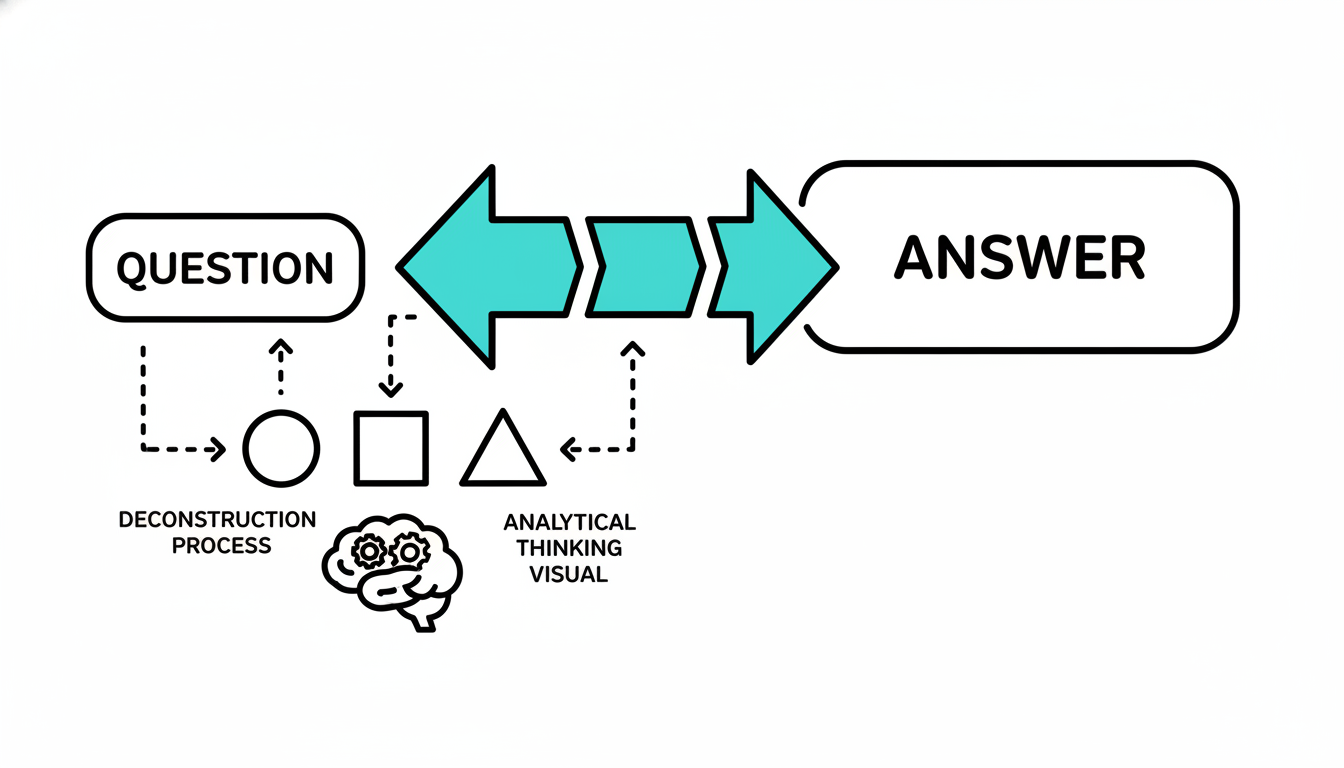
Develop analytical and deductive reasoning by starting with an answer/solution and working backward to identify the question/problem that led to it. Use this to deepen understanding of problem-solving processes, practice backwards reasoning, or check understanding.
How It Works
Step-by-step instructions:
-
Provide the answer (30 seconds) - Give students a solution, answer, or endpoint: "The answer is 42," "The solution is photosynthesis," "The outcome was the Treaty of Versailles"
-
Work backwards (2-3 minutes) - Students must figure out: What was the question? What was the problem? What steps led to this solution? What conditions made this outcome possible/necessary?
-
Share reasoning (1 minute) - Groups share their backwards-engineered questions/problems. Compare: Did everyone identify the same question? Different valid questions for the same answer?
What to Say
Opening: "The answer is '12.' What was the question? Work backwards—what mathematical problem has 12 as the answer? Come up with at least 3 different questions. For example: 6+6=?, 3×4=?, 144÷12=? Your turn—reverse engineer the problem from the answer. Go!"
During: "Don't just find one question—find multiple possibilities... Think about different operations, different contexts... Work systematically backwards... What information would you need to arrive at this answer?"
Closing: "How many different questions did you find? [Students share.] We got 6+6, 3×4, 20-8, the number of months, inches in a foot—same answer, completely different questions! Working backwards helps you see that answers don't exist in isolation—they're always answers TO something. This backwards thinking is exactly what detectives, scientists, and engineers do when troubleshooting."
Why It Works
Reverse engineering requires deconstructing solutions to understand their underlying logic—a higher-order cognitive skill. It forces students to consider multiple pathways to the same destination, revealing that problems can be solved in various ways. Working backwards is a powerful problem-solving strategy that helps when forward approaches are stuck. This activity builds metacognition about problem-solving processes themselves, not just solutions. It also reveals whether students truly understand concepts or are just following procedures mechanically.
Research Connection: Backwards reasoning and means-ends analysis are fundamental problem-solving strategies that improve with practice (Newell & Simon, 1972; Polya, 1945).
Teacher Tip
Use this as a formative assessment tool. If students can reverse-engineer a solution, they truly understand the process. If they can only move forward (given problem → find answer) but not backward (given answer → identify problem), understanding is shallow. The struggle reveals gaps.
Variations
For Different Subjects
- Math: "The answer is 45. What are 10 different problems?"
- Science: "The outcome is rust. What process caused it? What conditions were necessary?"
- History: "The result was WWI. Work backwards through the chain of causes"
- Literature: "The ending is tragic. Trace backwards—what decisions led here?"
For Different Settings
- Large Class (30+): Individual brainstorming, then small groups compare and compile comprehensive lists
- Small Group (5-15): Whole-class collaborative reverse engineering on the board
For Different Ages
- Elementary (K-5): Use concrete answers: "The answer is 'a sandwich.' What questions could lead to this answer?"
- Middle/High School (6-12): Standard format with content-specific answers
- College/Adult: Complex multi-step reverse engineering: "This is the conclusion of a research study. Reverse-engineer the hypothesis, methodology, and reasoning"
Online Adaptation
Tools Needed: Chat or shared document
Setup: Display the "answer" clearly on screen
Instructions:
- Present the answer/solution
- Breakout rooms for reverse engineering (2-3 minutes)
- Groups type their backwards-engineered questions/problems in chat
- Poll or vote: Which question is most likely? Most creative?
- Discuss multiple valid pathways to same answer
Pro Tip: Use a shared doc where all groups add their questions simultaneously—shows the diversity of pathways in real-time
Troubleshooting
Challenge: Students find one obvious question and stop Solution: "You found ONE path backwards. Now find a completely different path. What if this answer came from a different subject? A different type of problem? Push for variety!"
Challenge: Backwards reasoning feels too hard—students want to work forwards Solution: "Exactly! Backwards is harder because it's less familiar. But that difficulty is building new neural pathways. Start with the answer and ask: What would I need to know to get here?"
Extension Ideas
- Deepen: After reverse engineering, have students solve their own backwards-engineered problems to verify they work
- Connect: Link to real-world applications: "Medical diagnosis is reverse engineering—start with symptoms (the answer) and work backwards to the disease (the question)"
- Follow-up: "Create a 'mystery answer' challenge for classmates: provide an unusual answer and see if they can reverse-engineer plausible questions"
Related Activities: Logic Puzzles, Chain Reactions, Reverse Brainstorming