
Connection Web
At a Glance
- Time: 3-4 minutes
- Prep: None
- Group: Individual reflection then pair sharing
- Setting: Any classroom
- Subjects: Universal
- Energy: Low
Purpose
Develop students' ability to see interdisciplinary connections and transfer knowledge across domains by challenging them to link today's learning to three other subject areas, building schema integration and demonstrating that knowledge is not compartmentalized but interconnected across academic and real-world contexts.
How It Works
- Pose the challenge (15 sec) - "Think about what we learned today. In the next 2 minutes, identify THREE connections between today's content and OTHER subjects or areas of your life."
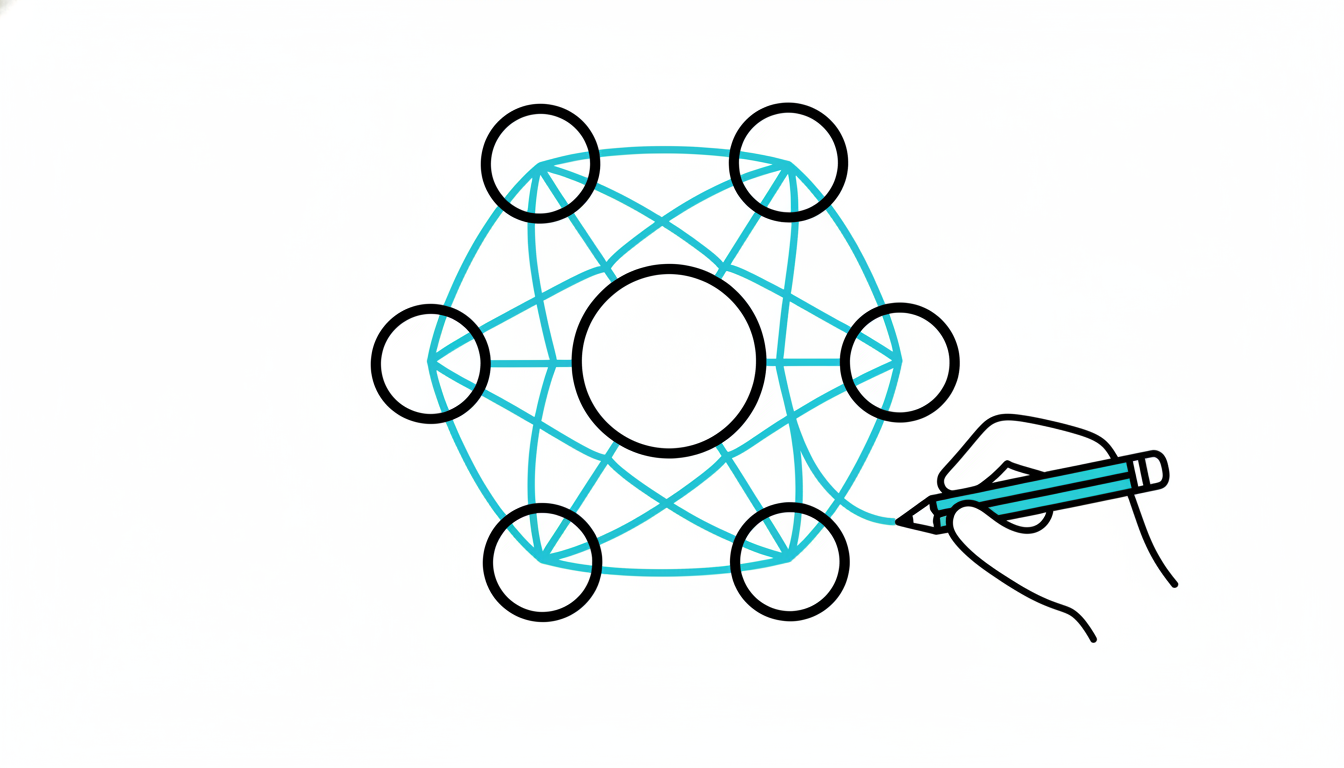
- Individual web-building (2 min) - Students write down today's topic in center of paper, draw three arrows to three different subject areas, write brief explanation of each connection
- Pair comparison (90 sec) - Partners share their webs and discuss whose connections surprised them
What to Say
Opening: "We just learned about [today's concept]. But learning doesn't stay in neat boxes labeled 'Math Class' or 'History Class.' Everything connects. Your challenge: In 2 minutes, find THREE connections between what we learned today and other subjects—or even connections to your life outside school. Draw it like a web with today's topic in the center."
During: "Think broadly. How does this relate to science? To art? To current events? To a book you're reading? To something you do after school?"
Closing: "Share your web with your partner. Did they make a connection you didn't think of? That's the power of networked thinking—seeing how everything links together."
Why It Works
Schema theory in cognitive science emphasizes that learning involves integrating new information into existing knowledge networks (Piaget, 1952). Isolated facts are easily forgotten; connected knowledge becomes durable. Asking students to explicitly find interdisciplinary connections forces them to activate multiple schemas simultaneously, strengthening retrieval pathways and demonstrating transfer potential. This also combats the "inert knowledge problem"—students who learn material but never apply it beyond the test.
Research Citation: Schema theory and transfer of learning (Bransford et al., 2000)
Teacher Tip
Don't pre-judge which connections are "valid." Sometimes students make surprising, creative links that reveal deep thinking. If a connection seems far-fetched, ask them to explain their reasoning rather than dismissing it. Often what looks random is actually metaphorically or structurally meaningful.
Variations
For Different Subjects
- Math/Science: "Connect this formula/concept to: (1) a natural phenomenon, (2) a technology, (3) a daily life application"
- Humanities: "Connect this historical event/literary theme to: (1) current events, (2) another time period, (3) your personal experience"
- Universal: "Connect to: (1) another class you're taking, (2) something you do outside school, (3) a current news story"
For Different Settings
- Large Class (30+): Gallery walk—students post their webs on walls, circulate to view others' connections, add sticky notes with additional links
- Small Group (5-15): Create one collaborative web as a class on board with everyone contributing connections
For Different Ages
- Elementary (K-5): Start with two connections instead of three; provide category prompts ("Connect to another school subject" and "Connect to home/family")
- Middle/High School (6-12): Standard three connections; require brief written explanations for each
- College/Adult: Five connections including at least two to professional fields or real-world applications
Online Adaptation
Tools Needed: Digital mind-mapping tool (Mind Meister, Coggle, Google Jamboard) or drawing tool
Setup: Each student has access to simple drawing/mapping interface
Instructions:
- Share template with center circle labeled with today's topic
- Students draw/type three branches showing connections to other subjects
- Submit to shared board or share screen in breakout rooms
- Gallery view of everyone's webs; identify most creative connections
Pro Tip: Use Padlet's "web" layout where each post automatically connects to central concept; students add their connection points.
Troubleshooting
Challenge: Students can only think of surface-level connections ("Both use numbers") Solution: Push for depth: "Yes, but HOW do they use numbers differently or similarly? What's the underlying principle that's the same?"
Challenge: Students struggle to find three connections Solution: Provide thinking stems: "This reminds me of ___ because...", "This is similar to ___ in the way that...", "I could use this when..."
Challenge: All students make the same obvious connections Solution: After first few shares, challenge: "Who found a connection no one else has mentioned yet?" Reward novelty.
Extension Ideas
- Deepen: "Connection Chain"—see how many links in a row students can make from today's topic through multiple subjects before returning to today's topic
- Connect: At end of unit, create a master connection web showing how all topics from the unit link to each other and to other domains
- Follow-up: Assign "Connection Detective" homework where students find and photograph real-world examples of today's concept outside school
Related Activities: Future Application, Transfer Challenge, Interdisciplinary Synthesis