
Prior Knowledge Walk
At a Glance
- Time: 3-4 minutes
- Prep: Minimal (post chart paper around room)
- Group: Individual then whole class
- Setting: Any classroom
- Subjects: Universal
- Energy: Medium-high
Purpose
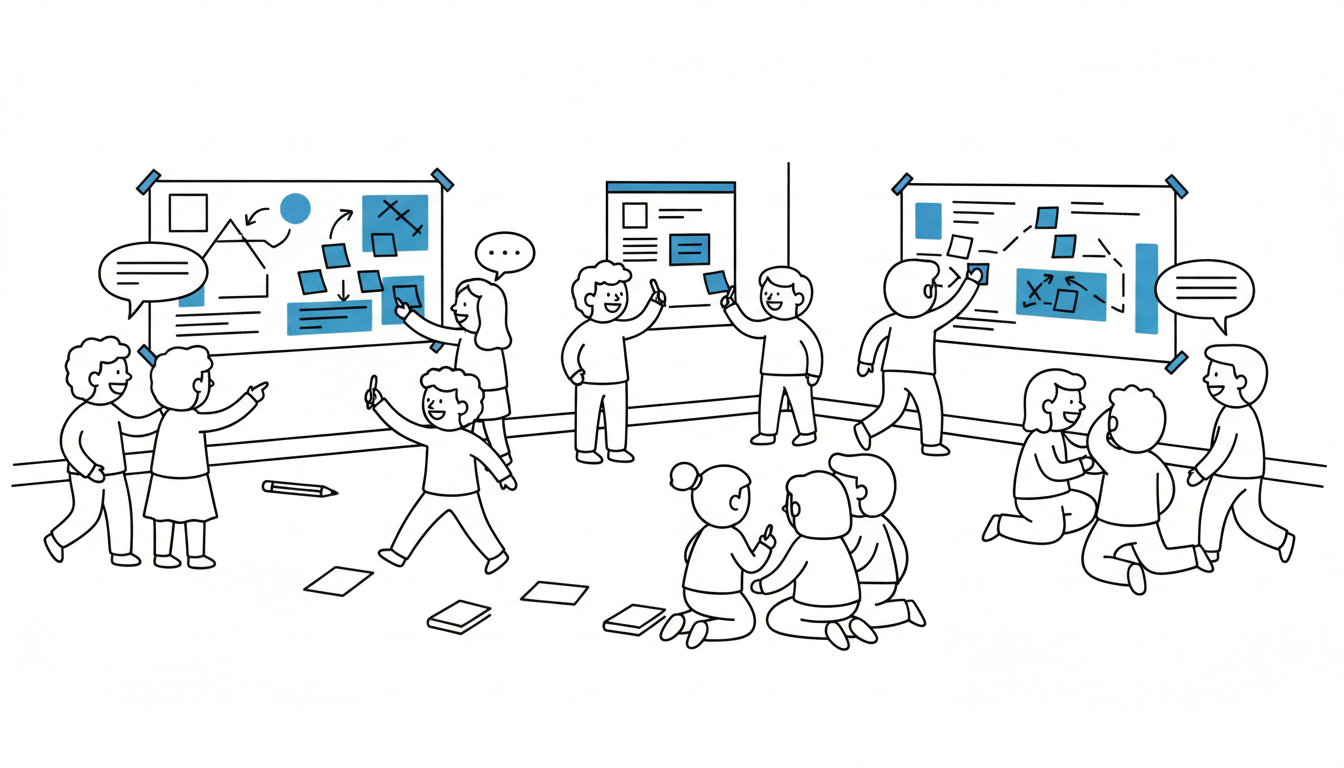
Prior Knowledge Walk combines movement with reflection, allowing students to physically activate what they know by writing on posted charts around the room. The kinesthetic element enhances memory retrieval and engagement.
How It Works
Step-by-step instructions:
- SET UP STATIONS (before class) - Post 3-5 chart papers with topic prompts around room
- STUDENTS WALK AND WRITE (2.5 minutes) - Students circulate, adding knowledge to each chart
- GALLERY OBSERVATION (1 minute) - Quick scan to notice patterns and gaps
What to Say
Opening: "You'll see chart paper posted around the room with different prompts. Grab a marker and walk around, adding what you know to each chart. Write words, draw pictures, add questions—anything related."
During: "Keep moving! Try to add something to every station. Build on what others wrote."
Closing: "Return to your seats. Let's look at what we collectively know about [topic]. I'm noticing we have strong understanding of [X] but questions about [Y]..."
Why It Works
Movement increases blood flow to the brain, enhancing cognition. The public nature of writing on shared charts activates social learning while reducing individual performance pressure—everyone contributes to collective knowledge building.
Research Citation: Jensen, 2005 (Teaching with the Brain in Mind)
Teacher Tip
Use different colored markers for each student or pair so you can later identify who needs support in which areas.
Variations
For Different Subjects
- Math/Science: Station prompts: "Formulas I know," "Real-world applications," "Questions I have"
- Humanities: "Key people," "Important events," "Themes," "Vocabulary"
- Universal: "What I know," "What I wonder," "What I learned before"
For Different Settings
- Large Class (30+): Use more stations (5-7) to prevent crowding
- Small Group (5-15): Fewer stations (2-3) with deeper prompt questions
For Different Ages
- Elementary (K-5): Use pictures/drawings; prompts with visual cues
- Middle/High School (6-12): Standard format with written responses
- College/Adult: Add "Evidence" station requiring citations or sources
Online Adaptation
Tools Needed: Google Slides or Padlet (one per station)
Setup: Create virtual "stations" as different slides/boards
Instructions:
- Share links to 3-5 virtual stations
- Students add sticky notes/comments to each
- Review together after 3 minutes
Pro Tip: Use Miro or Mural for real-time collaborative virtual gallery walk.
Troubleshooting
Challenge: Traffic jam at popular stations Solution: "Start at different stations—you don't have to go in order!"
Challenge: Some students write very little Solution: "Add at least 3 items total across all stations"—gives clear minimum
Extension Ideas
- Deepen: Assign groups to synthesize one station's responses into categories
- Connect: Take photos of charts and return to them throughout unit
- Follow-up: End of unit—add to charts in different color showing new learning
Related Activities: Brainstorm Web, Concept Sort, Anchor Chart