
Air Writing
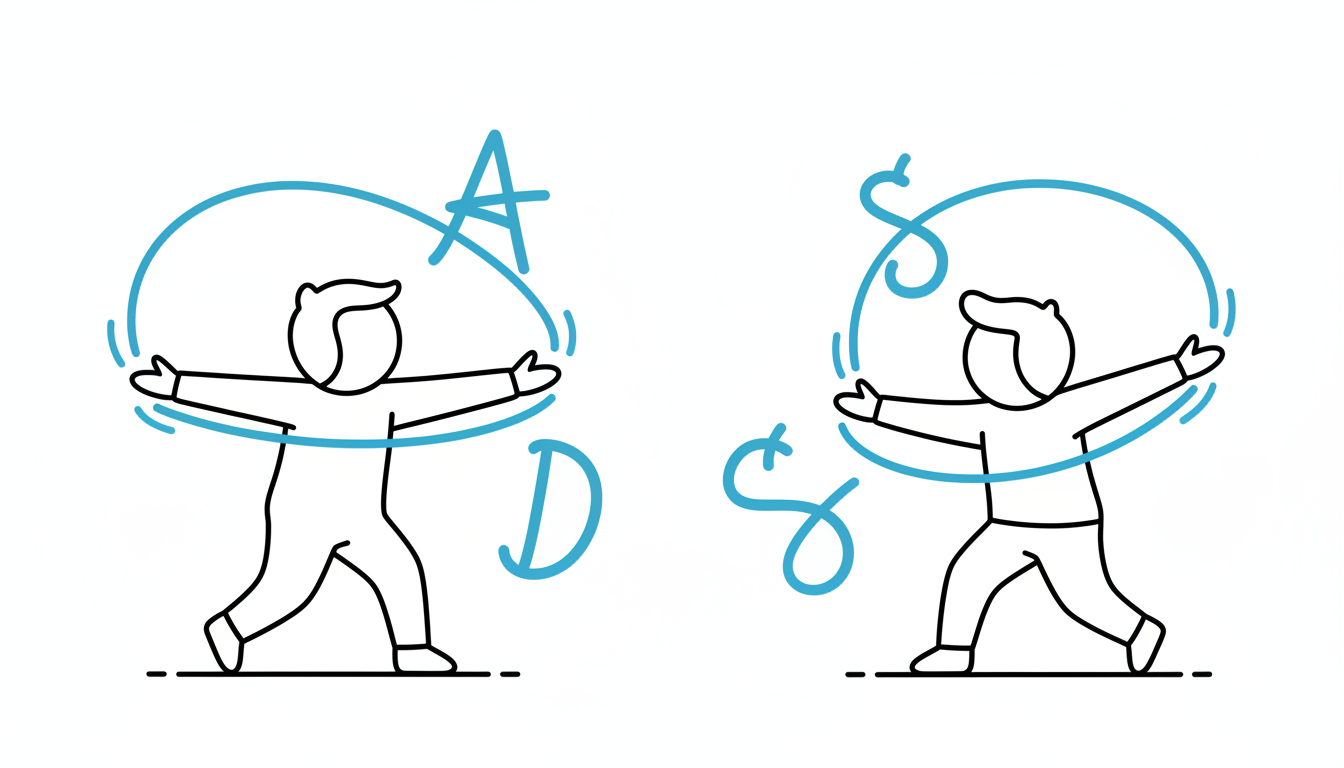
At a Glance
- Time: 60-90 seconds
- Prep: None
- Group: Whole class (individual participation)
- Setting: Any (works in-person or online, seated or standing)
- Subjects: Universal (especially vocabulary, spelling, math formulas, chemical equations)
- Energy: Medium-High
Purpose
Combine kinesthetic movement with visual-motor learning to reinforce spelling, vocabulary, formulas, or key concepts. Use this to activate embodied cognition—writing in the air with large arm movements creates stronger memory traces than passive viewing or small handwriting.
How It Works
Step-by-step instructions:
- ANNOUNCE (10 seconds) - "Stand up! We're going to write our key concept in the air using GIANT arm movements. The word is 'PHOTOSYNTHESIS.'"
- DEMONSTRATE (15 seconds) - Stand and write the first 2-3 letters in the air with exaggerated, large movements
- WRITE (60 seconds) - Students write the entire word/concept in the air with you, using full arm extension
- REPEAT (15 seconds, optional) - Write it one more time faster or with your non-dominant hand
- TRANSITION (5 seconds) - "Sit down. Your brain just encoded that word through movement. Let's define it."
What to Say
Opening: "Stand up! Our key term today is 'MITOCHONDRIA.' We're going to write it in the air—but not with tiny finger movements. I want BIG letters, giant arm movements, like you're writing on a billboard. Watch me: M-I-T-O... Now, your turn! Write it with me in the air: M..."
During: Call out each letter as you write it: "M... I... T... O... C... H... O... N... D... R... I... A!" Encourage big movements: "Bigger! Use your whole arm!"
Closing: "One more time, faster! Ready? M-I-T-O-C-H-O-N-D-R-I-A! Perfect. Your brain just created a motor memory of that word. Sit down. Now let's learn what it means."
Why It Works
Air writing leverages embodied cognition—the brain's tendency to encode information more deeply when it's paired with physical movement. Large motor movements engage more of the motor cortex than fine motor skills (typing or small handwriting), creating stronger neural pathways. The visual-spatial processing of "seeing" the word in the air combines with kinesthetic processing, creating multi-sensory memory traces. This is especially effective for visual and kinesthetic learners who struggle with auditory-only instruction.
Research Citation: Embodied cognition research shows that motor actions enhance memory encoding, particularly for vocabulary and spatial concepts (Barsalou, 2008; Macedonia & Klimesch, 2014).
Teacher Tip
Emphasize BIGNESS. The larger the movement, the stronger the memory trace. Say, "Write it like you're painting the side of a building!" Students will laugh, but the exaggeration actually improves encoding. Don't let them do tiny finger movements—that defeats the purpose.
Variations
For Different Subjects
- Spelling/Vocabulary: Write key terms, difficult spelling words, or vocabulary in target language
- Math: Write formulas in the air (e.g., "a² + b² = c²"), symbols (π, ∞, ÷)
- Science: Chemical formulas (H₂O, CO₂), scientific notation, key terms (MITOSIS)
- History: Important names (ABRAHAM LINCOLN), dates (1776), locations
- Universal: Write the day's learning objective, essential question, or main idea
For Different Settings
- Large Class (30+): Everyone does it at once. No problem!
- Small Class (5-15): Can have students write individually while others watch, then all do it together
- Seated: Works just as well seated as standing—just use arm/shoulder movement
- Limited Space: Perfect for tight spaces—doesn't require students to move around the room
For Different Ages
- Elementary (K-5): Use short words and make it playful. "Write your name in the sky!" Add sound effects.
- Middle/High School (6-12): Use content vocabulary, formulas, or key terms. Frame it as "motor memory encoding."
- College/Adult: Works well if you explain the neuroscience first. Adults appreciate understanding why it helps them learn.
Online Adaptation
Tools Needed: Zoom, Teams, any video platform
Setup: Students turn cameras on. Can be seated or standing.
Instructions:
- "I want everyone where I can see your upper body and arms on camera."
- "We're writing 'DEMOCRACY' in the air with giant letters. Follow me: D..."
- Write together, calling out letters.
- (Optional) Have students write it on their own while you watch.
Pro Tip: This works PERFECTLY online because everyone can see each other's air writing. It's actually more visible on camera than in a large classroom. Use gallery view for maximum engagement.
Troubleshooting
Challenge: Students make tiny finger movements instead of big arm movements. Solution: Exaggerate your demonstration. Stand up, extend your arm fully, write HUGE letters. Say, "No tiny writing! Imagine you're painting the ceiling of the Sistine Chapel! BIG!"
Challenge: Students can't spell the word so they can't write it. Solution: That's fine! You lead. Call out each letter slowly as you write it, and they follow. "M... I... T... O..." It's a guided practice. The motor act still helps encoding even if they're just copying you.
Challenge: It feels silly or childish to students. Solution: Reframe it. Say, "This might feel silly, but it's based on neuroscience. Your brain remembers things better when you move. Pro athletes visualize movements—we're adding actual movement to learning. Try it for 30 seconds. If it doesn't help you remember, I'll never make you do it again." (It will help, and they'll be fine with it.)
Extension Ideas
- Deepen: After air writing, ask students to close their eyes and "see" the word in their minds. This visualization reinforces the visual-spatial memory.
- Connect: Connect to content: "We just air-wrote 'EVAPORATION.' Now let's trace the evaporation cycle—use your arm to show water rising into the air..."
- Follow-up: Challenge them: "Tonight, air-write all your spelling words. Tomorrow, we'll test if it helped."
Related Activities: Body Letters, Invisible Jump Rope, Robot Walk