
Turn and Talk
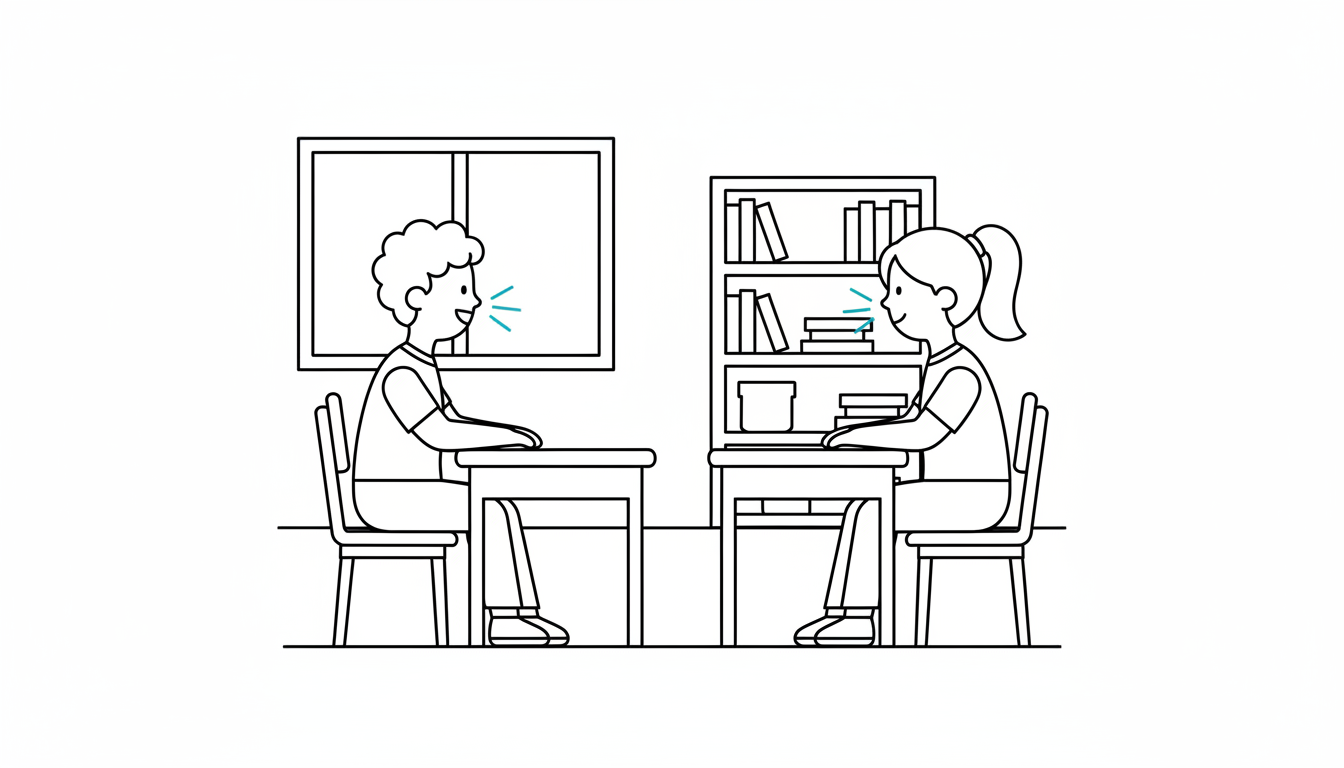
At a Glance
- Time: 1-2 minutes
- Prep: None
- Group: Pairs (whoever is sitting nearby)
- Setting: Any classroom context
- Subjects: Universal - works in any discipline
- Energy: Low to Medium
Purpose
Turn and Talk is the simplest, most flexible collaborative learning technique in your toolkit. Use it dozens of times throughout a lesson whenever you want students to process what you've just taught, articulate their thinking, or check their comprehension. It's so quick and seamless that it becomes an invisible routine—students don't even realize they're actively learning, they're just... talking.
How It Works
Step-by-step instructions:
-
PRESENT KEY CONTENT (Variable) - Teach a concept, share information, or demonstrate a skill.
-
PAUSE AND PROMPT (5 seconds) - Stop and say: "Turn and talk to the person next to you..." followed by a specific prompt.
-
STUDENTS TURN (5 seconds) - Students physically turn toward a neighbor.
-
TALK TIME (60 seconds) - Partners briefly discuss the prompt. No formal structure—just conversation.
-
RESUME TEACHING (Immediate) - Call attention back and continue with your lesson. Often no sharing-out is necessary.
What to Say
The Formula: "Turn and talk to the person next to you about [SPECIFIC PROMPT]."
Example Prompts:
For Comprehension Check: "Turn and talk: Summarize what I just explained in your own words."
For Connection-Making: "Turn and talk: How does this concept relate to what we learned yesterday?"
For Application: "Turn and talk: Give an example of where you might see this in real life."
For Clarification: "Turn and talk: What's one question you still have about this?"
For Prediction: "Turn and talk: What do you think will happen next?"
Bringing Attention Back: Often you don't need formal sharing. Just say: "Alright, bring your attention back" and continue teaching. The processing has already happened.
Why It Works
Turn and Talk is deceptively powerful despite its simplicity:
Cognitive Processing: Speaking about an idea (even for 30 seconds) forces the brain to organize thoughts, which strengthens neural pathways and moves information from working memory into long-term memory.
Engagement Reset: After 10-15 minutes of listening, attention naturally wanes. A 60-second Turn and Talk breaks that pattern and refocuses students on the content.
Formative Assessment: As you circulate during Turn and Talk, you hear real-time evidence of understanding—or misunderstanding—which lets you adjust your teaching immediately.
No Barrier to Entry: Because it's informal and brief, even shy students will talk. There's no performance pressure, no raising hands in front of the class.
Metacognitive Awareness: Articulating understanding reveals gaps. Students often discover what they don't understand only when they try to explain it.
Research Citation: The "pause procedure" (stopping lectures for brief processing activities) has been shown to improve retention by 100-150% compared to straight lecture (Ruhl, Hughes, & Schloss, 1987).
Teacher Tip
The magic of Turn and Talk lies in its frequency and casualness. Don't save it for "important moments"—use it constantly. "Turn and talk: What's the definition of photosynthesis in your own words?" "Turn and talk: Why do you think the author chose this word?" The more routine it becomes, the less cognitive load it creates, and the more students can focus on content instead of procedure. Aim to use Turn and Talk 5-10 times per class period.
Variations
For Different Subjects
-
Math: "Turn and talk: Explain the steps you would take to solve this problem."
-
Science: "Turn and talk: What would happen if we changed this variable?"
-
Humanities: "Turn and talk: What is this author's main argument?"
-
Arts: "Turn and talk: What emotions does this piece evoke? Why?"
For Different Settings
-
Large Lecture (50+): Turn and Talk works brilliantly here. Students can pair with someone in front/behind/beside them. The room gets loud—embrace it.
-
Small Seminar (8-12): Still useful, but you might occasionally do whole-group discussion instead since sharing out takes less time with fewer people.
-
Lab/Studio: Students can Turn and Talk right at their workstations without moving.
For Different Ages
-
Elementary (K-5): Keep prompts concrete and discussions to 30-45 seconds. "Tell your partner what you just learned."
-
Middle/High School (6-12): Standard 60-second format works perfectly.
-
College/Adult: Can extend to 90 seconds for more complex conceptual discussions.
Online Adaptation
Tools Needed: Video conferencing with breakout rooms (Zoom, Google Meet, Teams)
Setup: Pre-configure 2-person breakout rooms set to auto-return after 60 seconds.
Instructions:
- Teach your content segment
- Say "Turn and talk time—I'm sending you into quick breakout rooms for 60 seconds"
- Launch the pre-configured breakout rooms
- Set timer for 60 seconds with auto-return
- When everyone returns, continue teaching
Pro Tip: In some virtual platforms, creating breakout rooms is slower than Turn and Talk in person. To preserve the "quick" nature, use the chat or annotation tools instead: "Drop in the chat: [PROMPT]." This lets everyone process simultaneously without breakout logistics.
Troubleshooting
Challenge: Students immediately turn to their phone or continue another conversation instead of engaging with your prompt.
Solution: Make your prompt more specific and cognitively demanding. Instead of "Turn and talk about the video," say "Turn and talk: Name three specific factors that caused the event we just watched."
Challenge: Turn and Talk feels rote; students go through the motions without genuine engagement.
Solution: Make sure you're using it purposefully, not just for the sake of using it. Ask yourself: "What mental processing do I want students to do right now?" Let that drive your prompt.
Challenge: Some students don't have a partner.
Solution: Before calling for Turn and Talk, scan the room. If you see someone sitting alone, direct them to join the pair nearby: "Marcus, turn and join the pair behind you" or quickly move a solo student yourself.
Extension Ideas
-
Deepen: Use sequential Turn and Talks to build complexity: "Turn and talk: Define the term." [Continue teaching.] "Turn and talk: Now apply that definition to this example."
-
Connect: Follow up with writing: "After your conversation, write one sentence capturing the key idea you discussed."
-
Follow-up: Occasionally have students share with the whole class after Turn and Talk: "Who heard something from their partner that clarified this concept?"
Related Activities: Think-Pair-Share, Buzz Groups, Quick Polling