
Philosophical Chairs
At a Glance
- Time: 5-8 minutes
- Prep: Minimal (prepare one debatable statement)
- Group: Whole class
- Setting: Classroom with moveable furniture
- Subjects: Humanities, Social Sciences, Ethics (any topic with multiple valid perspectives)
- Energy: High
Purpose
Engage students in structured academic debate where they must listen deeply, paraphrase opposing views, and remain open to changing their position based on evidence. Use this to explore controversial topics, practice respectful discourse, or demonstrate that complex issues rarely have simple answers.
How It Works
Step-by-step instructions:
-
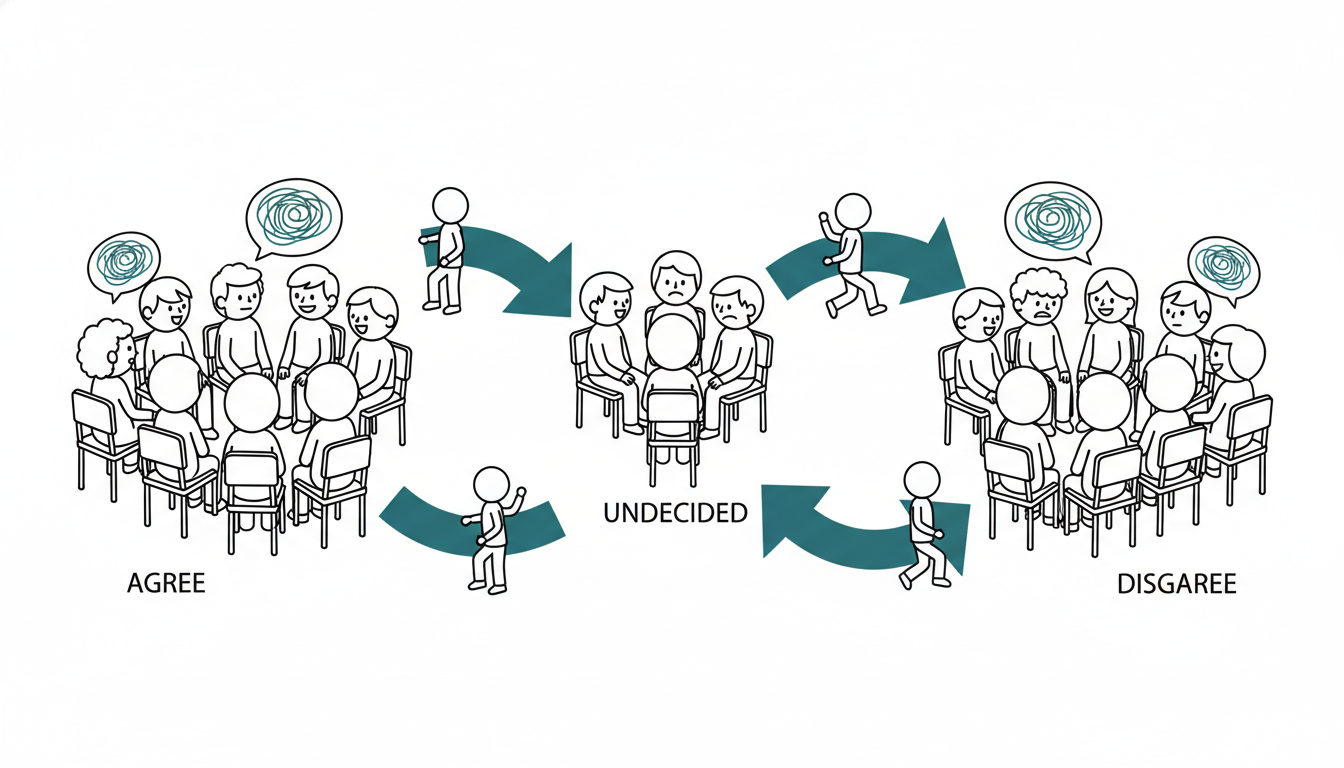
Set up and position (1 minute) - Present a debatable statement. Designate one side of the room for "Agree," the opposite for "Disagree," and the middle for "Undecided/Unsure." Students move to the section representing their position
-
Facilitate structured debate (4-6 minutes) - A moderator (teacher or student) calls on speakers alternately from each side. Before making their point, speakers must accurately paraphrase what the previous speaker said. Students can move to a different section if they're persuaded
-
Debrief (1 minute) - Reflect on the experience: Did anyone change positions? What evidence was most persuasive? What made this discussion different from typical debates?
What to Say
Opening: "Here's our statement: 'Schools should require community service for graduation.' If you agree, move to this side. Disagree, move there. Unsure, stay in the middle. Remember: you can change positions at any time if someone makes a compelling argument. Once you're positioned, who wants to start? Before you speak, paraphrase what the last person said."
During: "Before you respond, paraphrase their argument... Can you steel-man their position—state it even more strongly than they did?... Has anyone been persuaded to move?... Undecided folks, what would you need to hear to choose a side?"
Closing: "Notice how many people moved during the discussion? That's the sign of genuine intellectual engagement—being willing to revise your thinking. What was the strongest argument you heard, even if you didn't fully agree? How did the paraphrasing rule change how you listened?"
Why It Works
The paraphrasing requirement forces deep listening—students can't just wait for their turn to talk while ignoring others. Physically moving to change positions makes intellectual flexibility visible and celebrated rather than seeing changing your mind as weakness. The structured format prevents the chaos of typical debates while maintaining high energy. The "undecided" middle zone honors complexity and gives students permission to not have all the answers immediately.
Research Connection: Structured debate activities improve critical thinking, perspective-taking, and argumentation skills when they emphasize listening and evidence-based reasoning over winning (Muir & van der Linden, 2009; Bellon, 2000).
Teacher Tip
Choose statements that are genuinely debatable—not clearly right or wrong. "Homework should be abolished" works; "Bullying is bad" doesn't because there's no legitimate opposing view. The goal is complexity, not controversy. Statements with research on both sides ("Year-round schooling improves learning outcomes") work beautifully.
Variations
For Different Subjects
- Humanities: "The protagonist made the right choice... Capital punishment is ethical... This historical figure was a hero, not a villain"
- Science: "We should prioritize space exploration over ocean exploration... Genetic modification of humans should be allowed... Climate change is primarily caused by human activity"
- Math: "Math is more discovered than invented... Calculators should be allowed on all math tests"
For Different Settings
- Large Class (30+): Standard format—room becomes visibly polarized, making positions and movement clear
- Small Group (5-15): Use "corners" instead—three spots (agree, disagree, unsure) in a smaller space. Still works effectively with fewer people
For Different Ages
- Elementary (K-5): Use simpler, age-appropriate topics: "Recess should be longer... Students should choose their own seats... Homework should be optional." Shorten to 3-4 minutes
- Middle/High School (6-12): Standard format with complex, nuanced topics
- College/Adult: Add academic rigor: cite research, distinguish between empirical and value claims, identify assumptions
Online Adaptation
Tools Needed: Video conferencing with reactions/hand-raising features, or collaborative whiteboard
Setup: Create three breakout rooms labeled "Agree," "Disagree," "Undecided"
Instructions:
- Present statement in main room
- Students move to appropriate breakout room
- Use a speaking order in main room with a moderator tracking who's next
- Students who change positions use reactions to signal, then "move" next round
- Alternative: Use Padlet with three columns—students move their names between columns as they're persuaded
Pro Tip: Use polling feature first to quickly visualize initial distribution, then transition to verbal debate
Troubleshooting
Challenge: Students repeat arguments already made without adding new insights Solution: "We've heard that reason—can someone add a new perspective or piece of evidence?... Devil's advocates: who can strengthen the opposite argument?"
Challenge: Debate becomes heated or personal Solution: Pause and reset: "Remember: we're debating ideas, not attacking people. Restate your point focusing on evidence and reasoning, not emotion. What does the research say?"
Extension Ideas
- Deepen: After concluding, have students write a brief reflection: "The strongest argument against my original position was... I changed my mind (or didn't) because..."
- Connect: Link to real-world discourse: "How was this different from political debates you've seen? What made this more productive? How could public discourse improve if people had to paraphrase before responding?"
- Follow-up: Research assignment: "Find empirical evidence that supports OR challenges your final position. Write a paragraph explaining how this evidence shapes your thinking."
Related Activities: Forced Debate, Four Corners, Devil's Advocate