
Word Splash
At a Glance
- Time: 2-3 minutes
- Prep: List of 6-10 key vocabulary words
- Group: Whole class or pairs
- Setting: Any
- Subjects: Universal
- Energy: Low
Purpose
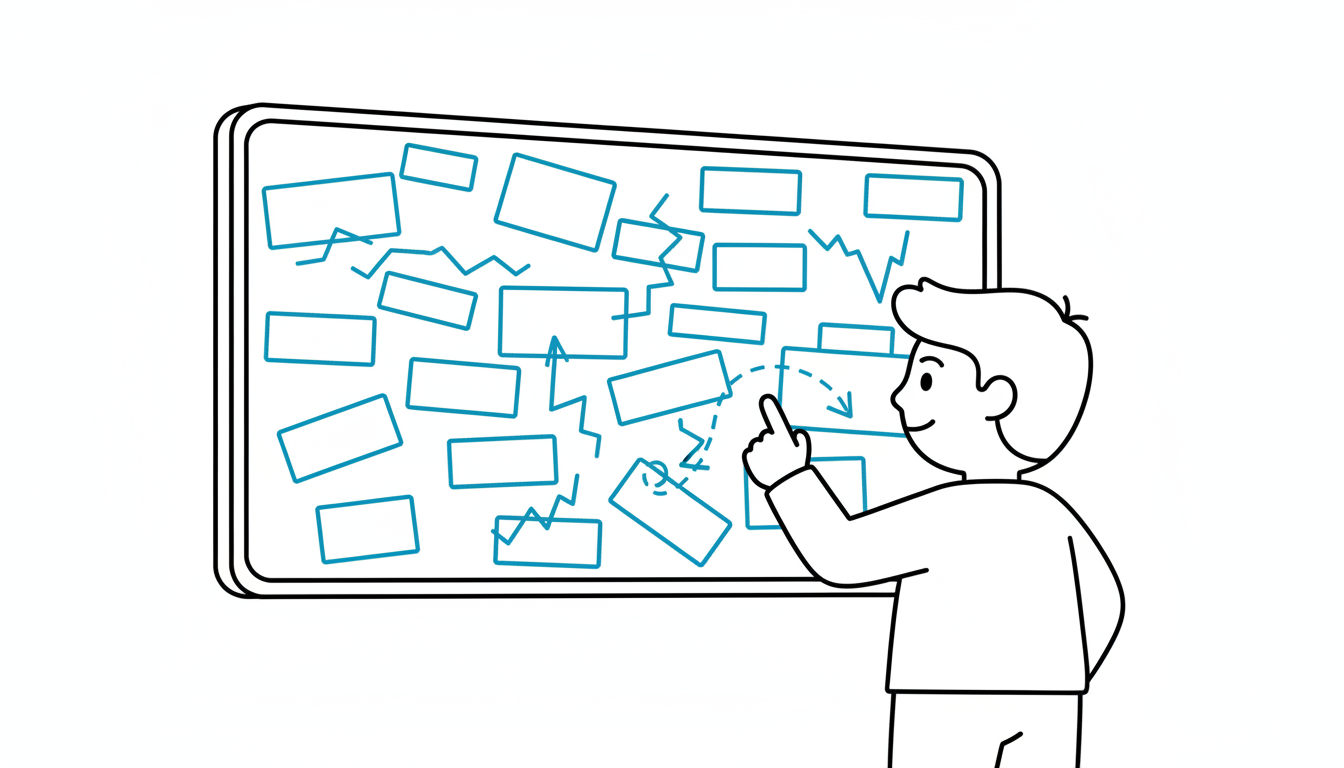
Activate prior knowledge by displaying key vocabulary words "splashed" across a board or screen before teaching. Students make connections, predictions, and associations with the words, which primes their brains to organize new information around familiar anchors.
How It Works
- DISPLAY WORDS (20 seconds) - Show 6-10 key vocabulary words arranged randomly (splashed) on board/screen
- OBSERVE (30 seconds) - Students silently read and think about the words
- MAKE CONNECTIONS (90 seconds) - Students share: What do these words make you think of? How might they connect? What do you predict we'll learn?
- OPTIONAL: Students write sentences or draw connections between words
- TEACH - Proceed with lesson; refer back to the word splash
What to Say
"Look at these words splashed across the board. These are key vocabulary words from today's lesson. Take 30 seconds to read them silently and think: What do you notice? What do these words make you think of? Do any of them connect?"
(After 30 seconds) "Turn to a partner. Talk about: What do you already know about any of these words? How might they relate to each other? What do you predict we'll learn today? Go!"
(After 90 seconds) "Let's hear some predictions. What stood out to you?"
Why It Works
Seeing key vocabulary before instruction activates semantic networks in the brain. Students begin forming hypotheses about relationships between concepts. Familiar words serve as cognitive anchors; unfamiliar words create curiosity. The visual "splash" format (random arrangement) encourages students to construct their own connections rather than receiving them passively. This primes working memory to categorize and organize information as it's presented during instruction.
Research Citation: Pre-teaching vocabulary improves comprehension and content retention (Marzano, 2004).
Teacher Tip
Choose words that represent the BIG ideas of the lesson, not just vocabulary for vocabulary's sake. Mix familiar words (anchors) with new words (curiosity). The randomarrangement invites students to impose order—a powerful learning act.
Variations
Word Selection Strategies
Mix Familiarity Levels:
- 3-4 words students likely know
- 2-3 words students have heard but may not fully understand
- 1-2 completely new words
Content Examples:
Science - Ecosystems:
- Producer, Consumer, Decomposer, Energy, Food Chain, Habitat, Predator, Prey
Math - Algebra:
- Variable, Equation, Solve, Unknown, Balance, Expression, Simplify
Literature - Short Story:
- Character, Conflict, Resolution, Theme, Setting, Plot, Climax
History - Civil War:
- Union, Confederacy, Slavery, Lincoln, Secession, Emancipation
Activity Variations
Word Splash + Prediction: "Use 3 of these words in a sentence predicting what we'll learn." Word Splash + Categorize: "Sort these words into 2-3 groups. What's your rationale?" Word Splash + Draw: "Draw a picture or diagram showing how these words connect." Word Splash + Story: "Create a story using at least 5 of these words."
For Different Settings
- Large Class: Display on board; whole-class or pair discussion
- Small Class: Everyone shares their connections
- Online: Display via screen share; chat or breakout rooms
- Individual: Students write connections in notebooks
For Different Ages
- Elementary (K-5): 4-6 words; include images next to words
- Middle/High School (6-12): 8-10 words; abstract vocabulary
- College/Adult: 10-12 discipline-specific terms
Online Adaptation
Excellent for Online:
- Display word splash on shared screen
- Use annotation tools for students to draw connections
- Collaborative digital whiteboard (Jamboard, Miro)
- Students type predictions in chat
- Works perfectly in virtual settings
Troubleshooting
Challenge: Students don't know any of the words. Solution: Prompt: "Even if you don't know the exact definition, what does the word SOUND like? What's your best guess?"
Challenge: Students make incorrect connections. Solution: Perfect! Write them down. Say: "Interesting theory! Let's test that as we learn." Address misconceptions during instruction.
Challenge: Students quickly say "I don't see any connections." Solution: Scaffold: "Look for patterns. Do any words share letters or roots? Do any describe similar things?"
Challenge: Activity drags; energy drops. Solution: Set a timer. "You have 60 seconds—go!" Time pressure creates focus.
Extension Ideas
- Draw Connections: Students draw lines/arrows showing relationships; label with "how" they connect
- Word Splash Revisit: At lesson's end, return to the splash. "Now how would you connect these words?"
- Create Definitions: Students write definitions for unknown words before learning, then revise after
- Word Wall: Keep the word splash visible throughout the unit; add new words as needed
- Student-Created: Students create word splashes for other topics as a review tool
Related Activities: Think-Pair-Share, Vocab Predictions, Concept Sort