
What-How-Why Reflection
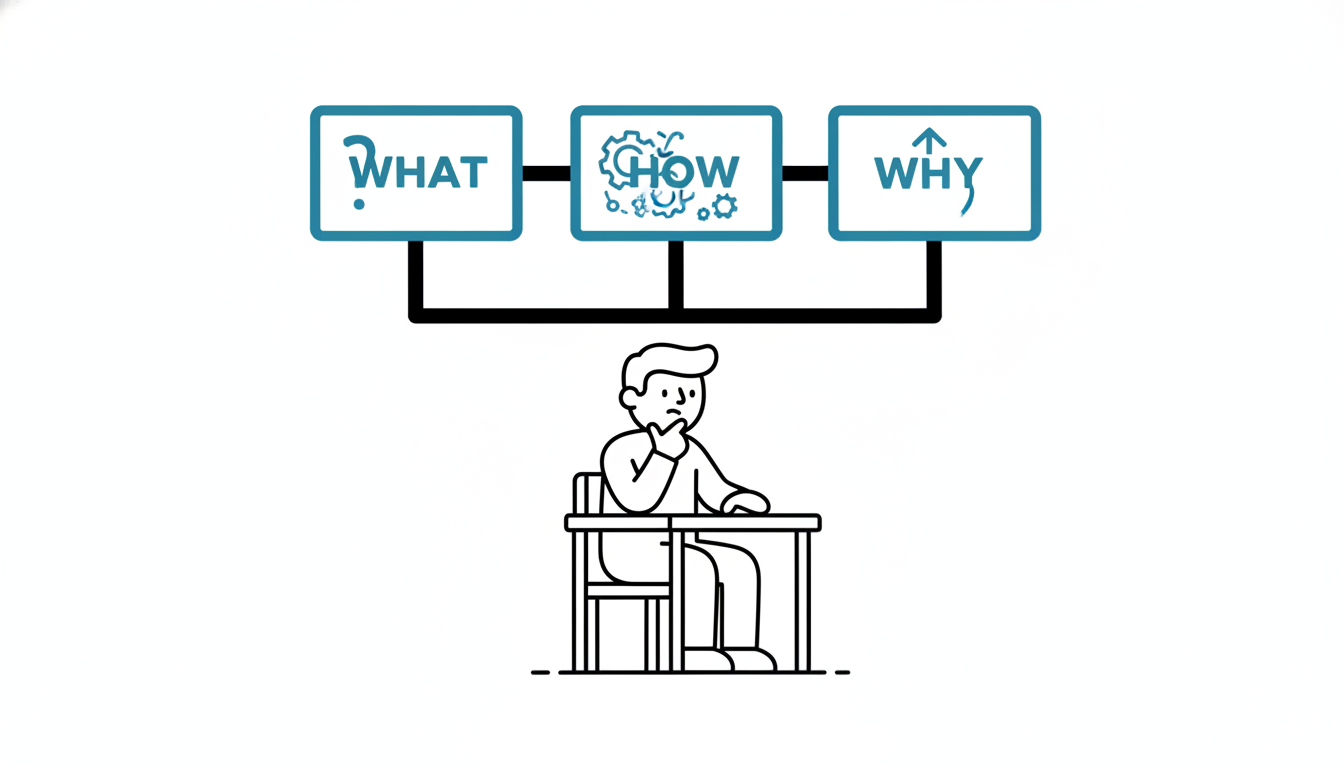
At a Glance
- Time: 3-4 minutes
- Prep: None
- Group: Individual writing
- Setting: Any classroom
- Subjects: Universal
- Energy: Low
Purpose
Move students beyond surface-level recall to deeper understanding by structuring reflection through three ascending levels of cognitive depth—What (factual content), How (process and method), Why (rationale and significance)—ensuring that students not only know the material but understand the procedures and underlying reasons, which enables transfer and application in new contexts.
How It Works
- Introduce framework (15 sec) - Write on board: "WHAT did we learn? HOW did we learn it? WHY does it matter?"
- Individual reflection (3 min) - Students write responses to all three questions in their notes
- Optional pair-share (60 sec) - Partners compare responses, especially focusing on "Why"
- Teacher highlights (30 sec) - Sample responses that show deep understanding of significance
What to Say
Opening: "Three questions before you go. Write your answers: WHAT did we learn today—what was the content, the skill, the concept? HOW did we learn it—what method or process did we use? And WHY does it matter—why is this worth knowing? Three minutes."
Prompts on board:
WHAT: What did we learn? (content/skill/concept)
HOW: How did we learn it? (method/process/activity)
WHY: Why does it matter? (significance/application/importance)
During writing: "WHAT is usually easiest—you can name the topic. HOW makes you think about the learning process itself. WHY is hardest but most important—it's about significance, not just 'because it's on the test.' Why should you care? Why does this knowledge exist?"
Closing: "Your WHAT tells me you were present. Your HOW tells me you're aware of your own learning. Your WHY tells me you understand deeply. All three matter."
Why It Works
Bloom's Taxonomy and depth-of-knowledge frameworks consistently show that memorizing facts (What) is cognitively simpler than understanding procedures (How) or analyzing significance (Why). By structuring reflection through these three levels, students are pushed toward deeper processing (Marzano & Kendall, 2007). The "Why" question in particular promotes transfer—students who can articulate why something matters are more likely to apply it in new contexts. This framework also metacognitively reveals students' depth of understanding: superficial learners struggle with "Why" while deep learners articulate rich connections and implications.
Research Citation: Depth of knowledge frameworks (Marzano & Kendall, 2007)
Teacher Tip
Most students can answer "What" easily and "How" with some thought, but "Why" is where you'll see true understanding (or its absence). If student responses to "Why" are vague ("because it's important"), probe deeper: "Important for what? To whom? In what contexts?" Push beyond generic answers.
Variations
For Different Subjects
- Math/Science: What concept/formula did we learn? How did we derive or apply it? Why does this principle exist/matter?
- Humanities: What was the main idea/event? How did the author/historical actors achieve this? Why is this significant historically/thematically?
- Universal: What skill did we practice? How did we practice it? Why will this skill be useful?
For Different Settings
- Large Class (30+): Individual written reflection; collect to assess depth of understanding
- Small Group (5-15): After individual writing, discuss "Why" responses as a class to deepen collective understanding
For Different Ages
- Elementary (K-5): Simplify to "What did we learn? Why is it cool/important?" (skip "How" for younger students)
- Middle/High School (6-12): Standard three-part reflection
- College/Adult: Add fourth layer: "Where/When will you use this?" (application context)
Online Adaptation
Tools Needed: Shared document (Google Doc template) or form (Google Forms)
Setup: Create What-How-Why template with three text boxes
Instructions:
- Share template link in chat 5 minutes before end of session
- Students fill in all three sections
- Option A: Shared doc where everyone can see others' responses (promotes learning from peers)
- Option B: Form submission (private, teacher reviews for patterns)
- Next class, address common gaps in "Why" responses to deepen understanding
Pro Tip: Use Padlet with three columns (What/How/Why)—creates visual representation of class thinking across all three levels.
Troubleshooting
Challenge: Students write vague "Why" responses ("because it's important") Solution: Require specificity: "Important for WHAT? Give a real example of when you'd use this or why someone should care. Make it concrete, not generic."
Challenge: "How" responses just repeat "What" in different words Solution: Clarify "How" means method: "HOW did you learn it? Did we read, discuss, experiment, solve problems, watch demo? Describe the PROCESS, not the content."
Challenge: Students spend too much time on "What" and rush through "How" and "Why" Solution: Time each section: "1 minute on What, 1 minute on How, 1.5 minutes on Why. The Why deserves the most thought."
Extension Ideas
- Deepen: Add "So What?"—after answering What/How/Why, add final question: "So what will I DO with this knowledge?"
- Connect: Compare What-How-Why across multiple lessons: "What patterns do you notice in HOW we learn in this class? Which methods work best for you?"
- Follow-up: Return to "Why" at unit's end: "Reread your 'Why' from week 1. Do you have a deeper answer now? Revise it."
Related Activities: 3-2-1 Reflection, Future Application, Connection Web