
Human Scavenger Hunt
At a Glance
- Time: 5 minutes
- Prep: Minimal (prepared list of characteristics or tasks)
- Group: Whole class
- Setting: Any classroom with space to move
- Subjects: Universal - adaptable to any content area
- Energy: Medium-High
Purpose
Transform content review into purposeful social movement by challenging students to find classmates who meet specific criteria related to the lesson content, encouraging knowledge sharing and community building while activating prior knowledge or reviewing key concepts.
How It Works
- Distribute hunt lists (30 sec) - Give each student a handout with 5-8 prompts like "Find someone who can explain photosynthesis" or "Find someone who read Chapter 3"
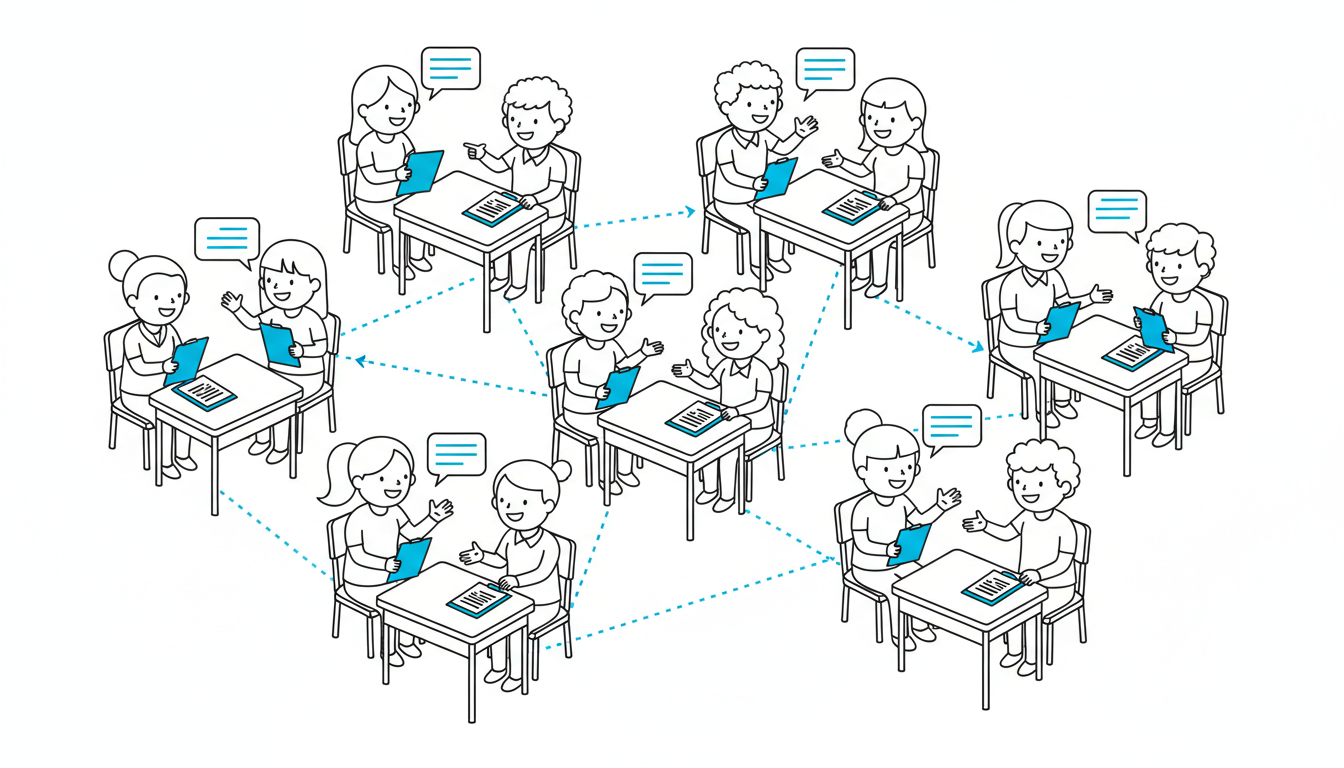
- Hunt begins (3-4 min) - Students move around the room, talk to classmates, and collect names/signatures when they find someone who meets each criterion
- Quick debrief (30 sec) - "Who found someone for all items? What interesting things did you learn about your classmates?"
What to Say
Opening: "You have 4 minutes to find classmates who fit each description on your list. When you find someone, have them sign next to that item. You can't use the same person for more than two items. Ready? Go!"
During: "Keep moving! If you're stuck on an item, ask someone to help you find the right person."
Closing: "Time! Return to your seats. Hands up if you completed the entire hunt. What surprised you about what your classmates know?"
Why It Works
This activity combines purposeful conversation with physical movement, helping students find common ground while sharing academic knowledge in a low-pressure social context. The hunt structure creates natural opportunities for peer teaching and builds classroom community while reviewing content.
Research Foundation: Social constructivism and cooperative learning principles show that peer-to-peer knowledge sharing in informal contexts enhances retention and creates positive classroom culture (Vygotsky's Zone of Proximal Development).
Teacher Tip
Create hunt lists that progressively increase in difficulty or specificity. Start with easier items ("Find someone who finished the homework") and end with challenging ones ("Find someone who can explain why the protagonist made that choice"). This ensures all students can participate successfully while providing challenge for advanced learners.
Variations
For Different Subjects
- Math/Science: "Find someone who can solve this equation" or "Find someone who knows three parts of a cell"
- Humanities: "Find someone who can name the main character's motivation" or "Find someone who lived through a historical event we're studying"
- Universal: "Find someone who has the same favorite [concept/character/theory] as you"
For Different Settings
- Large Class (30+): Reduce list to 5 items; allow students to use the same person twice
- Small Group (5-15): Increase complexity of criteria; require brief explanations, not just signatures
For Different Ages
- Elementary (K-5): Use visual cards with pictures; simpler criteria like "Find someone who can count to 10 in Spanish"
- Middle/High School (6-12): Content-specific academic criteria; can include skill demonstrations
- College/Adult: Complex conceptual understanding; require brief peer teaching moments
Online Adaptation
Tools Needed: Zoom breakout rooms + shared Google Doc or Padlet
Setup: Create digital hunt list with 5-6 items; prepare multiple breakout rooms
Instructions:
- Share hunt list in chat; students copy into their notes
- Send students into random breakout rooms (2-3 students, 1 minute each)
- Rotate through 3-4 room combinations in 4 minutes
- Students add names to their digital list when they find matches
- Return to main room for quick share-out
Pro Tip: Use Zoom's automatic breakout room timer to create urgency and keep pace brisk.
Troubleshooting
Challenge: Students cluster with friends instead of hunting broadly Solution: Add rule: "You must talk to at least 5 different people" or "You can't use someone you sat with today for any items"
Challenge: Some criteria are too difficult; no one can answer Solution: Include a "wild card" option: "If you can't find someone for this item, write down your own answer instead"
Extension Ideas
- Deepen: Add "expert level" items that require demonstration or extended explanation, not just a signature
- Connect: Use hunt results to form study groups or discussion pairs based on complementary knowledge
- Follow-up: Next day, randomly call on students who signed for specific items to share what they know with the whole class
Related Activities: Minefield, Speed Networking, Gallery Walk