
Circle of Voices
At a Glance
- Time: 6-10 minutes
- Prep: None
- Group: Small groups (4-6 students)
- Setting: Any classroom context
- Subjects: Universal - works in any discipline
- Energy: Low to Medium
Purpose
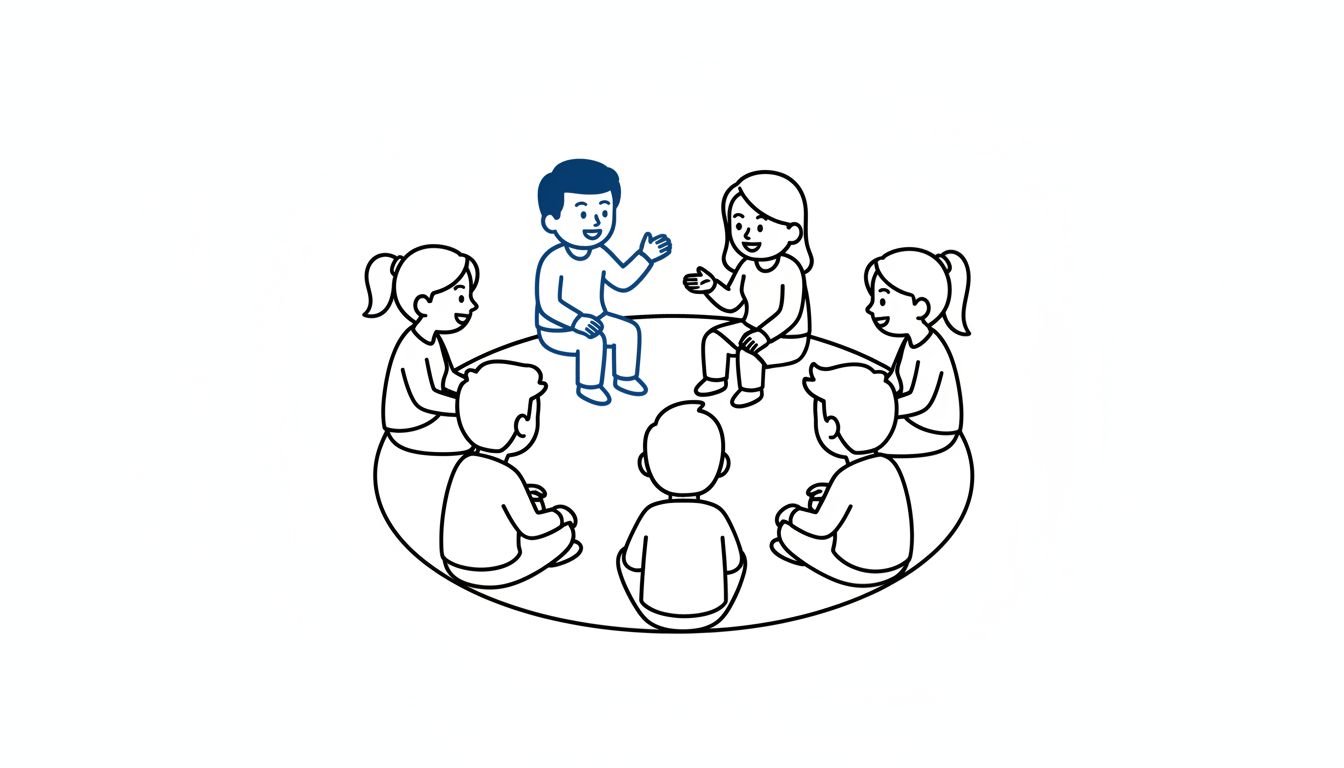
Circle of Voices ensures equitable participation by giving every student an uninterrupted turn to speak. Students sit in small circles and take turns sharing their thoughts on a question—no one can interrupt, respond, or comment until everyone has spoken once. Use this when you want to guarantee that quiet voices are heard, practice deep listening skills, or prevent dominant students from monopolizing discussion.
How It Works
Step-by-step instructions:
-
POSE A QUESTION (30 seconds) - Present a thoughtful question or prompt related to your content.
-
SILENT THINKING (1 minute) - Students think silently and may jot notes.
-
FORM CIRCLES (30 seconds) - Create groups of 4-6 students sitting in circles.
-
ROUND 1: UNINTERRUPTED SHARES (3-5 minutes) - Going around the circle, each person shares their thoughts for 30-60 seconds without interruption. No one responds or comments yet.
-
ROUND 2: OPEN DISCUSSION (Optional, 2-3 minutes) - After everyone has spoken once, open the floor for responses, questions, and back-and-forth discussion.
-
DEBRIEF (1 minute) - Briefly reflect on what it felt like to speak without interruption and to listen without responding.
What to Say
Setup: "We're doing Circle of Voices. This is a discussion protocol that guarantees everyone speaks and is heard. Here's the question: [POSE QUESTION]. Take 60 seconds to think silently about your response."
Forming Circles: "Form circles of five. Someone volunteer to go first, then we'll continue clockwise around the circle."
Round 1 Instructions: "Each person will share their thoughts for about 45 seconds without being interrupted. While someone else is talking, your job is to LISTEN—not to plan your response, not to mentally debate, just listen. After everyone has shared once, we'll open it up for discussion. Who's starting in your circle? Begin."
After Round 1: "Now that everyone has shared, you can respond to each other. Ask questions, build on ideas, or respectfully disagree. You have 2 minutes for open discussion."
Debrief: "What was it like to speak knowing no one would interrupt you? What was challenging about listening without responding?"
Why It Works
Circle of Voices addresses common discussion problems through structural design:
Guaranteed Equity: Every voice gets equal time and attention. Quiet students can't hide; dominant students can't monopolize.
Deep Listening: Knowing they cannot interrupt forces students to actually listen rather than waiting for their turn to speak.
Reduced Performance Anxiety: Students aren't "volunteering" or competing for airtime—everyone speaks, in turn, predictably. This lowers anxiety.
Idea Development: Hearing multiple perspectives before responding gives students more to think about, leading to richer contributions in Round 2.
Reflection Time: The structured turn-taking gives students time to formulate thoughts without the pressure of jumping into rapid-fire debate.
Research Citation: Research on cooperative learning structures shows that protocols ensuring equal participation lead to more equitable learning outcomes and higher satisfaction among all students (Cohen, 1994).
Teacher Tip
The hardest part of Circle of Voices is enforcing the "no interruptions" rule. Students instinctively want to respond immediately: "Oh, I disagree because..." Gently redirect: "Hold that thought. You'll get to respond after everyone shares. Right now, just listen." After students experience this structure once, they appreciate the space it creates for thoughtfulness.
Variations
For Different Subjects
-
Literature: "Share one quote from the text that resonated with you and explain why." Each student shares their quote uninterrupted.
-
Science: "Describe one observation from the lab or demonstration and what you think it means." Students share observations in sequence.
-
Math: "Explain one strategy you used to solve this problem." Students share different approaches.
-
Any Subject: "What's one question you still have after today's lesson?" Students share questions in the circle.
For Different Settings
-
Large Class (30+): Create 6-8 small circles. All work simultaneously. You can't monitor all circles, but the protocol is self-enforcing.
-
Small Class (8-12): One or two circles. In a class of 8, do one circle with the whole class.
-
Online: Works beautifully in breakout rooms. The structure actually makes virtual discussion feel less chaotic.
For Different Ages
-
Elementary (K-5): Shorten speaking time to 20-30 seconds per student. Use concrete prompts: "Share one thing you learned today."
-
Middle/High School (6-12): Standard 45-60 seconds per student works well.
-
College/Adult: Can extend to 90 seconds per person for complex topics.
Online Adaptation
Tools Needed: Video conferencing with breakout rooms
Setup: Assign students to breakout rooms of 4-6.
Instructions:
- Present question in main room
- Give 60 seconds silent thinking time
- Send students to breakout rooms
- In breakout rooms, students take turns sharing (use alphabetical order by first name to determine sequence)
- After everyone shares, open discussion
- Return to main room for debrief
Pro Tip: In virtual Circle of Voices, have students use the "raise hand" feature to indicate they're next in line, helping maintain the circle structure.
Troubleshooting
Challenge: A student speaks for 3+ minutes, far exceeding the time limit.
Solution: Set a visible timer for each person. When it goes off, gently intervene: "Thank you—we need to hear from everyone, so let's move to the next person." This keeps it equitable.
Challenge: A student says "I don't have anything to add" or "I agree with what was said."
Solution: Encourage elaboration: "Even if you agree, share why you agree or add an example. Everyone has something to contribute." Set the expectation upfront that passing is not an option.
Challenge: Students respond or debate immediately after someone shares, breaking the protocol.
Solution: Be firm in the first circle: "Remember, no responses yet. Right now we're just listening. You'll get your chance after everyone shares." Physical gesture—raise your hand in a "wait" motion—can help.
Extension Ideas
-
Deepen: Add a third round where students must build on or respond to something a specific person said: "Choose someone in your circle and build on their idea."
-
Connect: Use Circle of Voices for reflections at the end of units: "Share one concept from this unit that you now understand better and one you're still working on."
-
Follow-up: After the activity, have students write: "Something I heard in the circle that changed my thinking was..." This reinforces the value of listening.
Related Activities: Fishbowl Discussion, Concentric Circles, Socratic Seminar