
Gallery Walk
At a Glance
- Time: 10-15 minutes
- Prep: Moderate - create 4-6 stations with prompts/images/student work
- Group: Small groups of 3-5 students
- Setting: Requires space for movement and wall-mounted stations
- Subjects: Universal - especially effective for analysis and discussion
- Energy: High
Purpose
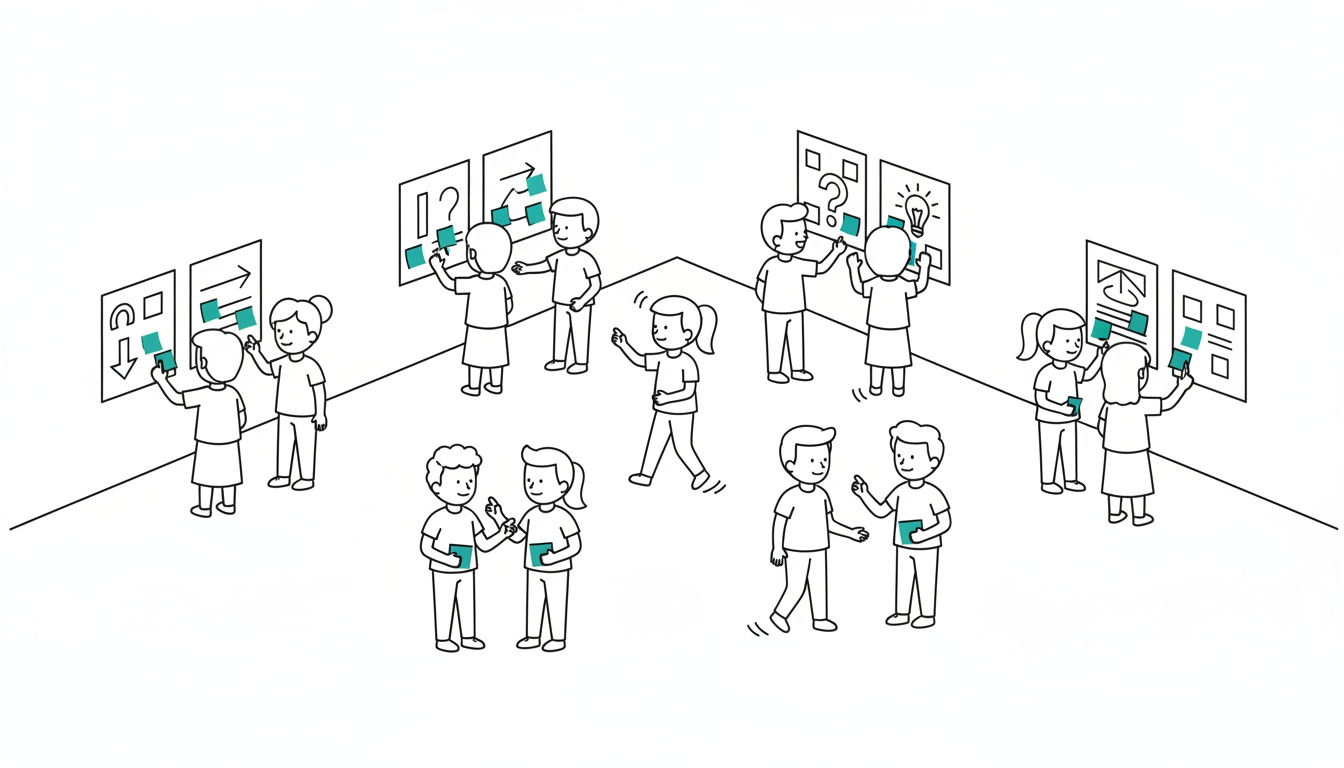
Gallery Walk transforms your classroom into an interactive museum where learning becomes visible and collaborative. Use it when you want students to encounter multiple ideas, perspectives, or examples simultaneously, respond critically, and build on each other's thinking. It's ideal for brainstorming, analyzing complex materials, peer feedback, or reviewing multiple concepts. The movement component resets attention and energizes the room.
How It Works
Step-by-step instructions:
-
SET UP STATIONS (Before class: 10 minutes) - Post 4-6 different prompts, images, questions, or pieces of student work at "stations" around the room. Each station should have chart paper or space for sticky notes.
-
FORM GROUPS (30 seconds) - Divide class into small groups (ideally the same number of groups as stations, but not required).
-
ASSIGN STARTING STATIONS (30 seconds) - Send each group to a different starting station.
-
FIRST ROTATION (2-3 minutes) - Groups discuss the prompt/image at their station and record their thoughts on the chart paper or sticky notes.
-
ROTATE (15 seconds) - Signal for groups to move clockwise to the next station.
-
SUBSEQUENT ROTATIONS (2-3 minutes each) - At each new station, groups first READ what previous groups wrote, then ADD their own ideas or responses. They can agree, disagree, ask questions, or build on previous thinking.
-
CONTINUE ROTATING - Repeat until groups have visited most or all stations.
-
GALLERY VIEWING (Optional: 2 minutes) - Groups do a final silent walk to view all stations without stopping.
-
DEBRIEF (2-3 minutes) - Gather the class and discuss patterns, surprises, or key insights from the gallery.
What to Say
Setup: "We're doing a Gallery Walk. I've posted [number] questions around the room. Each is a 'station' with chart paper. You'll move through the stations in groups, discuss what you see, and add your thoughts. Here's what makes this interesting: you'll see what other groups wrote before you, and you can respond to their ideas—agree, disagree, add on, or ask questions."
Starting: "Count off by [number of stations] to form groups. Ones, start at Station 1. Twos, start at Station 2..."
At First Station: "At your first station, read the prompt carefully. Discuss it in your group for 30 seconds, then someone be the scribe and write your group's response on the chart paper. You have 2 minutes starting... now."
For Rotations: "Rotate clockwise to the next station. Read what the previous groups wrote first. Then add something new—you can build on their ideas, offer a different perspective, or ask a question. You have 2 minutes. Go."
Debrief: "Take a moment to walk around silently and look at all the stations. Notice the range of ideas." [After viewing] "What patterns did you notice? What idea surprised you? Where did you see the most agreement? The most debate?"
Why It Works
Gallery Walk engages multiple learning modalities and cognitive processes:
Movement and Cognition: Physical movement increases blood flow to the brain and combats the attention fatigue that comes from sitting still. Kinesthetic learners especially benefit.
Visible Thinking: Ideas become externalized and visible on the chart paper. Students see thinking developing in real-time, which makes abstract discussion concrete.
Building Knowledge Collaboratively: No single student or group has the "right" answer. Knowledge is constructed socially as groups build on and react to each other's contributions.
Multiple Exposures: Students encounter each concept or prompt multiple times—once when they visit that station, and again when they read others' responses at subsequent stations.
Perspective-Taking: Seeing how different groups approached the same prompt reveals diverse ways of thinking, which deepens understanding.
Research Citation: Gallery Walk aligns with constructivist learning theory (Vygotsky) and research on cooperative learning structures that promote higher-order thinking through social interaction (Johnson & Johnson, 1999).
Teacher Tip
The debrief is where the magic happens—don't skip it or rush it. The Gallery Walk generates rich, multi-layered responses, but students need help synthesizing what they saw. Ask specific questions: "Where did you see disagreement between groups? Why might that be?" or "Which station generated the most variety in responses?" This meta-discussion about the thinking process is often more valuable than the content itself.
Variations
For Different Subjects
-
Literature/Arts: Post images, quotes, or passages at each station. Groups analyze and interpret. This works beautifully for visual art analysis or close reading.
-
Science: Post lab results, data sets, or diagrams at each station. Groups analyze findings and make inferences.
-
Math: Post different solution strategies for the same problem. Groups evaluate the validity of each approach.
-
Social Studies: Post primary sources at each station. Groups analyze perspective and bias.
For Different Settings
-
Large Class (30+): Create more stations (6-8) so groups are smaller (4-5 students) and students spend less time waiting.
-
Small Class (10-15): Create 3-4 stations and allow longer time at each station (3-4 minutes) for deeper discussion.
-
Limited Wall Space: Use tabletops instead of walls. Post prompts on table tents and spread materials across tables.
For Different Ages
-
Elementary (K-5): Use images or simple prompts. Have students draw responses instead of writing if that's developmentally appropriate.
-
Middle/High School (6-12): Standard format works well. Can handle complex texts and abstract prompts.
-
College/Adult: Can incorporate dense academic readings or sophisticated ethical dilemmas at each station.
Online Adaptation
Tools Needed: Digital collaboration platform (Google Slides, Jamboard, Padlet, Miro)
Setup: Create a virtual "gallery" with 4-6 slides/boards, each containing a different prompt or image.
Instructions:
- Assign breakout rooms (these are the "groups")
- Assign each breakout room a starting "station" (slide number)
- Groups spend 2-3 minutes adding their thoughts to their assigned slide using text boxes or sticky notes
- After each rotation, manually reassign breakout rooms to the next slide number
- Repeat rotations
- Bring everyone back to main room and screen-share the gallery for debrief
Pro Tip: In Padlet or Miro, students can work asynchronously—no need for breakout rooms. Just assign groups a starting column/section and have them work simultaneously, moving to the next section every 3 minutes.
Troubleshooting
Challenge: Groups finish too quickly and stand around waiting for rotation signal.
Solution: Provide extension prompts at each station: "If your group finishes early, discuss: What questions does this raise? What real-world example connects to this?"
Challenge: Later groups at a station find everything has already been said and just write "We agree."
Solution: Change the instructions for later rotations: "At this station, read all the previous responses and add something that's MISSING from the conversation" or "Identify the strongest and weakest idea from previous groups and explain why."
Challenge: Handwriting on chart paper becomes illegible or space runs out.
Solution: Use sticky notes instead of writing directly on chart paper. Give each group a different colored sticky note pack so you can track which group contributed which ideas. This also prevents space issues.
Extension Ideas
-
Deepen: After the Gallery Walk, assign students to return to one station as "experts." They synthesize all the responses at that station and present a summary to the class.
-
Connect: Use Gallery Walk as a pre-reading or pre-lab activity to activate prior knowledge, then revisit the same stations post-unit to see how thinking has evolved.
-
Follow-up: Create a written reflection: "Choose one station where you changed your thinking after reading other groups' responses. What caused that shift?"
Related Activities: Graffiti Wall, Jigsaw, World Cafe