
One-Sentence Summary
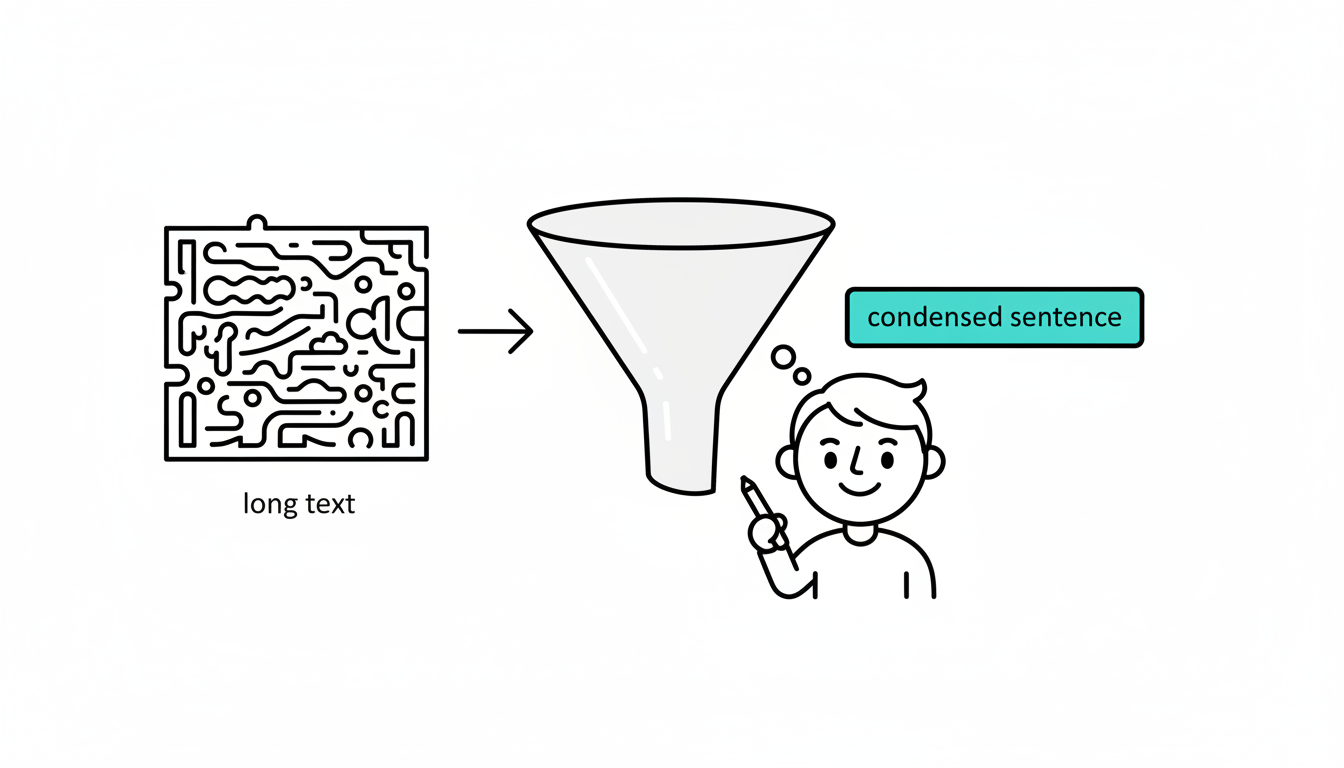
At a Glance
- Time: 2-3 minutes
- Prep: None
- Group: Individual
- Setting: Any
- Subjects: Universal
- Energy: Low-Medium
Purpose
Challenge students to synthesize complex ideas into a single summary sentence that answers who, what, where, when, why, and how—forcing prioritization and deep comprehension.
How It Works
- Present challenge (30 sec) - "Summarize today's lesson in ONE sentence that includes: who, what, where, when, why, and how"
- Compose sentences (2 min) - Students draft and refine their summary
- Share examples (1 min) - Read 2-3 aloud; discuss what makes them effective
What to Say
Opening: "The One-Sentence Summary challenge: Capture the entire photosynthesis process in a single sentence. Must include: who (what), what happens, where, when, why it matters, and how it works. Go!"
During: "Can you fit all six elements?... What's essential?... What can you cut?"
Closing: "Great example: 'Plants (who) convert sunlight to glucose (what) in chloroplasts (where) during daylight (when) to create energy for survival (why) through a chemical reaction splitting water molecules (how).' That's synthesis."
Why It Works
Summarizing in a single sentence requires aggressive prioritization, distinguishing essential from peripheral information. The constraint forces clarity and reveals whether students grasp core concepts or just surface details.
Research Connection: Summarization improves comprehension and retention (National Reading Panel, 2000; Graham & Hebert, 2011).
Teacher Tip
This is HARD. Model one first. Show how you decide what's essential, what gets cut, and how to combine ideas efficiently. Struggle is the point—it reveals thinking.
Variations
Difficulty: Remove constraints (just one sentence) or add more (include 3 vocabulary terms) • Format: Written, verbal to partner, tweet-length (280 characters) • Ages: K-5: simpler topics, fewer required elements; 6-12: standard challenge; College: discipline-specific sophisticated synthesis
Online
Students type in chat or shared doc. Display side-by-side for comparison and analysis.
Troubleshooting
Run-on sentences: "That's three sentences hiding behind semicolons. Make it truly ONE."
Extension
Peer edit: Exchange sentences and suggest improvements while keeping it to one sentence.
Related: 20 Words Challenge, Headline Creator