
Musical Chairs Plus
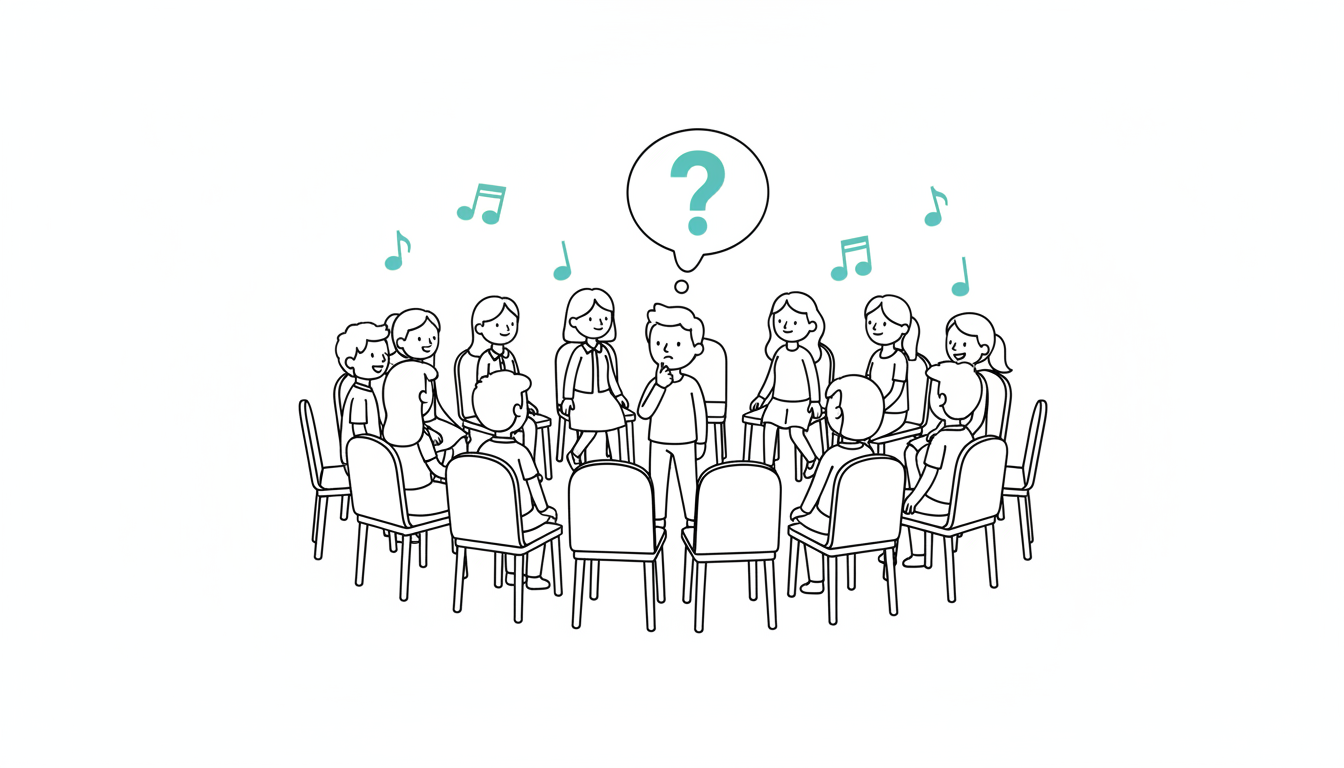
At a Glance
- Time: 4-5 minutes
- Prep: Minimal (music source, prepared review questions)
- Group: Whole class
- Setting: Classroom with chairs arranged in circle or rows
- Subjects: Universal - works for any content review
- Energy: High
Purpose
Transform traditional musical chairs into an academic review game where students must correctly answer content questions when music stops in order to remain in the game, combining the energizing movement of a classic game with low-stakes assessment and immediate feedback, while maintaining high engagement through friendly competition.
How It Works
- Setup (30 sec) - Arrange chairs in circle (one fewer than number of students); prepare list of review questions
- Start music (20 sec) - Students walk around chairs while music plays
- Music stops (30 sec) - Students quickly find and sit in a chair; one student remains standing
- Question challenge (30-45 sec) - Standing student answers a review question; if correct, they choose someone sitting to switch places with; if incorrect, they're out and one chair removed
- Continue rounds (2-3 min) - Repeat for 4-5 rounds until 2-3 students remain
- Brief celebration (15 sec) - Acknowledge finalists; everyone returns to seats
What to Say
Opening: "We're playing Musical Chairs with a twist! Walk around the chairs while music plays. When it stops, find a seat quickly. If you're left standing, you'll answer a review question. Get it right, and you can choose someone to trade places with. Get it wrong, and you're out but you'll be an audience judge. Let's go!"
When music stops: "Freeze! Everyone seated, stay down. [Student name], you're standing. Here's your question: [Review question]. Take 5 seconds to think."
After correct answer: "Correct! Choose someone sitting to switch places with. They'll walk for the next round."
After incorrect answer: "Not quite—the answer is [correct answer]. Thanks for playing! Join the audience judges and help me monitor the next rounds."
Closing: "Our finalists! Great work everyone. We reviewed [number] concepts in 5 minutes while moving and having fun."
Why It Works
Combining physical movement with cognitive challenge activates multiple brain systems simultaneously, improving both engagement and retention. The game format creates eustress (positive stress) that enhances alertness and memory formation (Vogel & Schwabe, 2016). The public accountability of answering when standing provides motivation to pay attention during review, while the low-stakes consequence (being "out" but staying to watch) maintains psychological safety. The random element (who will be standing) keeps all students mentally prepared to answer.
Research Citation: Stress and memory consolidation (Vogel & Schwabe, 2016)
Teacher Tip
Differentiate question difficulty based on who's standing. Scaffold support for struggling students with simpler questions or multiple choice options. Challenge advanced students with harder questions. This keeps the game equitable and maintains engagement for all ability levels. Also, limit the game to 4-5 rounds—the goal is energizing review, not elimination until one winner remains.
Variations
For Different Subjects
- Math/Science: Quick calculations, formula identification, definition recall, or process steps (Name one step in photosynthesis)
- Humanities: Character identification, historical dates, vocabulary definitions, or text details (Who said this quote?)
- Universal: Any factual recall or quick-answer questions appropriate for your unit
For Different Settings
- Large Class (30+): Run two simultaneous games in different classroom areas, or do "mega rounds" where multiple students are standing and all answer the same question
- Small Group (8-15): Standard format works perfectly; everyone gets multiple turns to answer
For Different Ages
- Elementary (K-5): Slower music, longer think time (10 seconds), simpler questions, optional "phone a friend" lifeline for incorrect answers
- Middle/High School (6-12): Standard format; faster pace; can add requirement that standing student must answer AND explain reasoning
- College/Adult: Very rapid pace with complex questions; can add "challenge" option where seated students can dispute answers
Online Adaptation
Tools Needed: Video platform with music sharing capability + polling/chat feature
Setup: All students on camera with video enabled
Instructions:
- Play music through screen share audio
- Students "walk" by standing up, moving in place, or waving arms on camera
- Stop music; use random generator to select one student (spinner wheel, random name picker)
- Selected student answers question via unmuting or chat
- Instead of removing from game, track "points" - correct answers earn points
- Play 4-5 rounds; highest points wins
Pro Tip: Use upbeat, instrumental music to avoid distractions. Consider theme-related music (historical period music, music from novel's era) to add thematic element.
Troubleshooting
Challenge: Students who are "out" lose interest and become disruptive Solution: Give eliminated students roles: "Question reader," "Answer validator," "Timer keeper." Active roles maintain engagement.
Challenge: Same students always manage to get seats; shy students always standing Solution: Reverse the game occasionally: "Person left standing gets to sit safely and skip answering. Person who gets the answer wrong has to walk the next round."
Challenge: Questions are too difficult; many students get eliminated quickly Solution: Add lifelines: "Poll the audience," "50/50" (eliminate two wrong answers), or "Collaborative answer" (person next to you can help).
Extension Ideas
- Deepen: "Steal" option - if standing student gets question wrong, any seated student can raise hand to answer and earn a token; most tokens wins
- Connect: Thematic music - use music from the era/culture being studied; discuss musical context during transitions
- Follow-up: Create a "question bank" from all questions asked during game; post for students to use as study guide
Related Activities: Four Corners, Vocabulary Fly Swatter, Ball Pass Review