
Turn and Tell
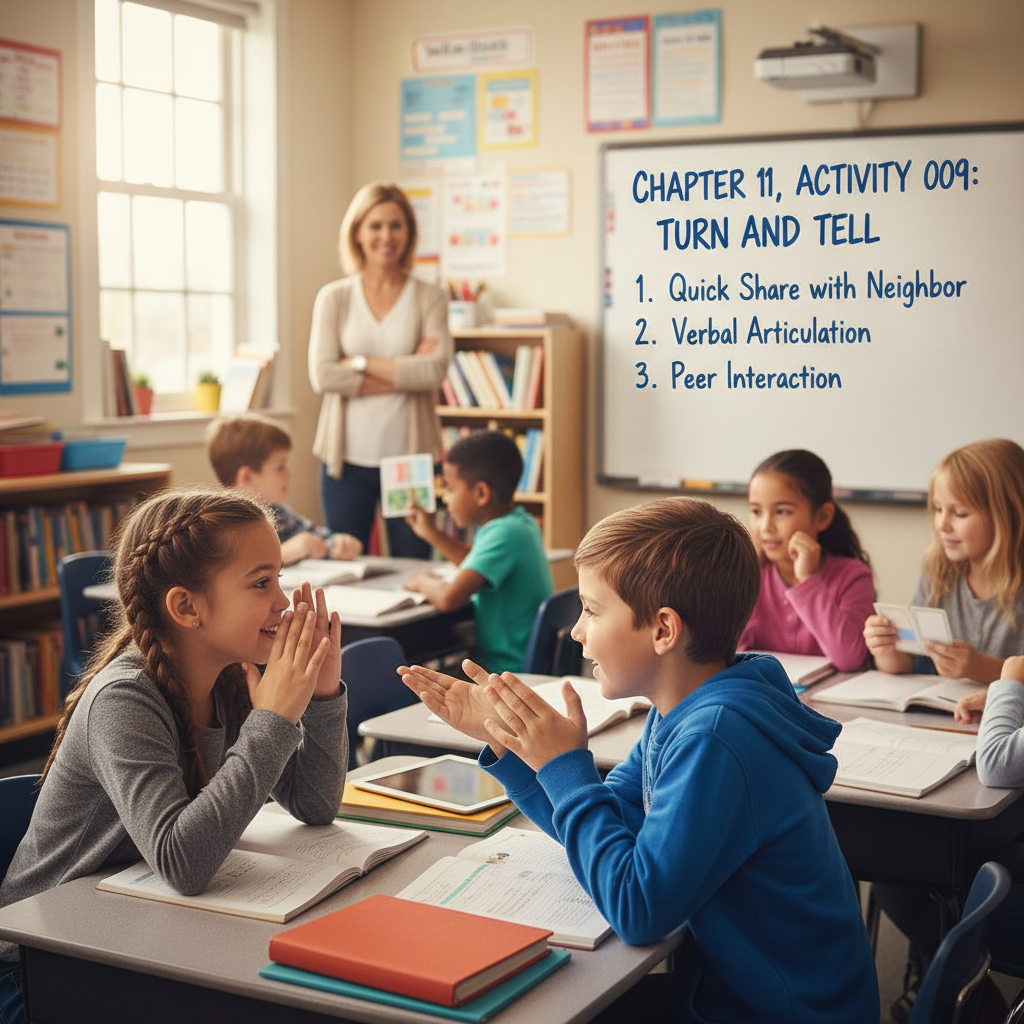
At a Glance
- Time: 1-2 minutes
- Prep: None
- Group: Pairs
- Setting: Any classroom
- Subjects: Universal
- Energy: Low-Medium
Purpose
Provide cognitive processing time and social interaction by having students quickly share thoughts with a neighbor, consolidating learning through verbal articulation while breaking up teacher talk with peer interaction, ensuring students actively process information rather than passively receiving it, and giving everyone a voice rather than calling on one student while others zone out.
How It Works
- Pose prompt (5 sec) - "Turn to your neighbor and tell them: [specific prompt]"
- Partner share (60-90 sec) - Students turn to person next to them and take turns sharing (30-45 sec each)
- Return attention (5-10 sec) - Signal to stop talking, eyes back on teacher
- Optional whole-class sampling (30 sec) - "What did your partner say that was interesting?"
What to Say
Opening: "Turn to your neighbor—the person next to you or behind you. Tell them: What's one thing that surprised you about what we just learned? You have 60 seconds total—30 seconds each. Go."
During: [Let them talk. Resist urge to interrupt. Watch time.]
Closing: "Eyes back on me. Who heard something interesting from their partner?" [Take 1-2 responses.] "Great. Let's keep going."
Why It Works
Verbal articulation forces cognitive processing—students can't fake understanding when they have to explain aloud (Chi et al., 1994). Turn-and-Tell also provides universal participation: in traditional whole-class discussion, one student talks while 29 sit silently. With Turn-and-Tell, all 30 students are simultaneously talking. This maximizes engagement and ensures everyone processes the content verbally. The social element also reengages attention through interaction after passive listening.
Research Citation: Learning through explaining (Chi et al., 1994)
Teacher Tip
Be specific with prompts. "Turn and tell your partner what you think" is too vague—students will say "I don't know" and sit in awkward silence. Instead: "Tell your partner: What's one example of [concept] from real life?" Concrete prompts yield actual conversation.
Variations
Different Prompts
- Comprehension: "Explain the main idea in your own words"
- Application: "Give an example of this concept"
- Connection: "How does this relate to [previous topic]?"
- Metacognitive: "What strategy helped you understand this?"
- Question: "What's one thing you're still confused about?"
Different Timing
- Quick (30-60 sec): Both partners share briefly
- Standard (1-2 min): Each partner gets full turn
- Extended (3-5 min): Deeper discussion with multiple exchanges
Different Ages
- Elementary (K-5): Simple prompts; teacher may assign partnerships
- Middle/High School (6-12): Standard Turn-and-Tell; students choose partners
- College/Adult: Can be formal "Think-Pair-Share" with written component first
Online Adaptation
Tools Needed: Breakout rooms
Setup: Pre-assign pairs or use automatic breakout room assignment
Instructions:
- "You're going into breakout rooms for 90 seconds"
- Post prompt on screen or in chat
- Send to breakout rooms (pairs)
- Auto-close rooms after time limit
- Return to main room: "What did you discuss?"
Pro Tip: Use Zoom's "Breakout Room" feature with 90-second auto-close timer—forces efficiency.
Troubleshooting
Challenge: Students don't have partners (odd number, absent student, isolated seating) Solution: Create one trio instead of leaving someone alone. Or teacher becomes partner for the solo student.
Challenge: Students go off-topic, chat about weekend plans instead of prompt Solution: Circulate during Turn-and-Tell. When you hear off-topic talk, redirect: "Remember, you're discussing [prompt]." Repeat prompt to refocus them.
Challenge: Partners finish in 15 seconds, sit in silence rest of time Solution: Give multi-part prompt: "First, tell your partner X. Then, tell them Y. Finally, ask them Z." Multiple steps sustain conversation.
Extension Ideas
- Deepen: "Turn-and-Tell, then whole-class share"—after pair discussion, call on students to share what their PARTNER said (listening accountability)
- Connect: Recurring partners: Assign permanent "Turn-and-Tell buddies" for semester—builds relationship depth
- Follow-up: "Turn-and-Tell + written reflection"—after verbal share, students write one sentence capturing their discussion
Related Activities: Think-Pair-Share, Turn-and-Talk, Brain Dump