
Call-and-Response Cues
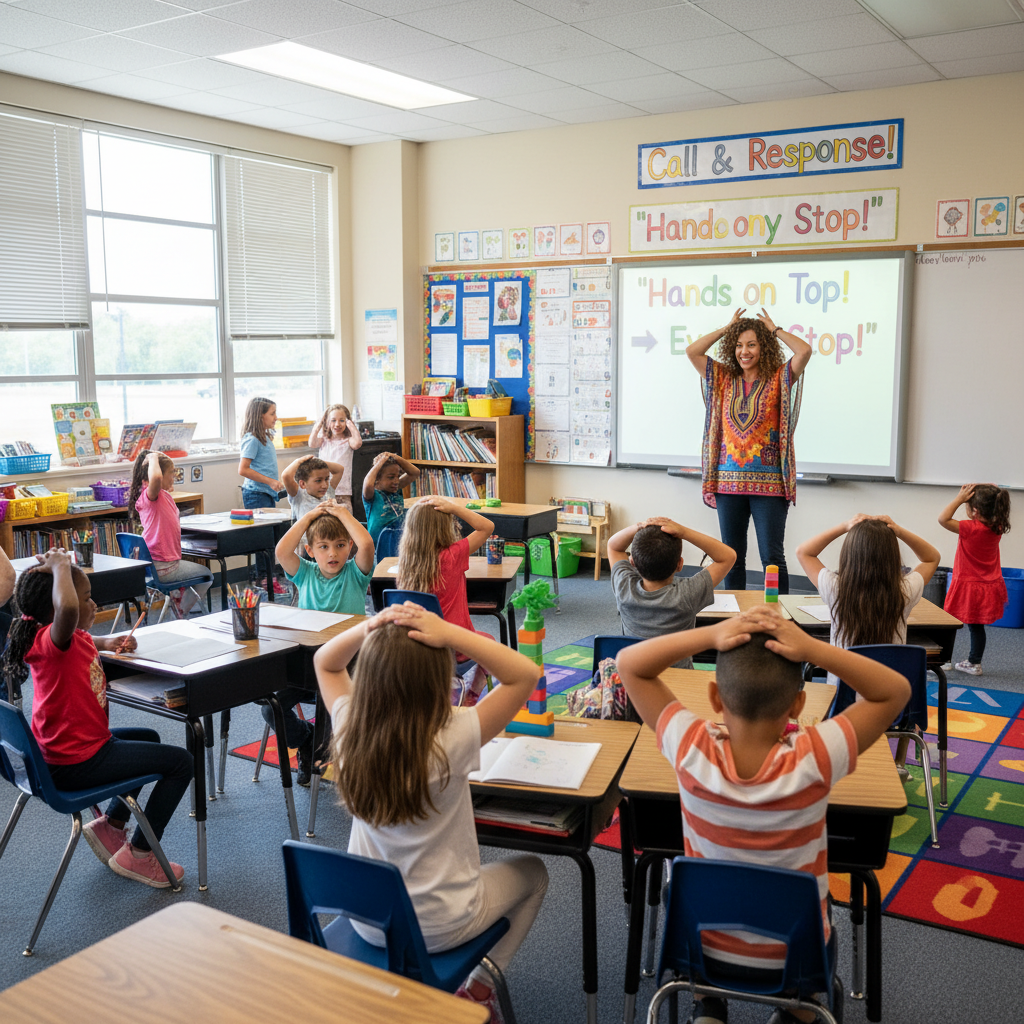
At a Glance
- Time: 10-30 seconds
- Prep: None (establish patterns first)
- Group: Whole class
- Setting: Any classroom
- Subjects: Universal
- Energy: Low-Medium
Purpose
Capture immediate attention and signal transitions without raising your voice by using established call-and-response patterns where teacher initiates a verbal or rhythmic cue and students respond in unison, creating a playful yet efficient attention-getting routine that builds community while respecting students' need for auditory engagement rather than compliance through volume or authority.
How It Works
- Teacher call (3 sec) - Teacher says or claps pattern: "Class class!" or rhythmic clap pattern
- Student response (3 sec) - Students echo back: "Yes yes!" or copy clap pattern exactly
- Attention secured (immediate) - All eyes on teacher, ready for instruction
- Brief instruction (10-20 sec) - Teacher gives next direction while attention is focused
What to Say
Classic Verbal Patterns:
Teacher: "Class class!" Students: "Yes yes!"
Teacher: "Hands on top!" Students: "That means stop!"
Teacher: "Ready to rock?" Students: "Ready to roll!"
Teacher: "All set?" Students: "You bet!"
Teacher: "Give me five!" Students: [Hold up five fingers silently in 5 seconds]
Rhythmic Clap Patterns:
- Teacher claps: clap-clap-clapclapclap
- Students echo: clap-clap-clapclapclap
Closing: "Thank you. Now, here's what we're doing next..."
Why It Works
Call-and-response leverages several powerful mechanisms: pattern completion (our brains are wired to finish patterns), playfulness (reduces resistance), whole-body engagement (speaking/clapping activates attention), and social synchrony (group response creates cohesion). Unlike shouting "Listen up!" which triggers stress responses, call-and-response feels collaborative. The routine becomes automatic—after a few uses, students respond reflexively without needing to be told. This is far more effective than fighting for attention through volume escalation.
Research Citation: Social synchrony and attention (Wiltermuth & Heath, 2009)
Teacher Tip
Establish 2-3 patterns and use them consistently for 2-3 weeks until they're automatic. Don't introduce new patterns constantly—that defeats the purpose of building routines. Wait for 100% response before proceeding; if some students don't respond, repeat the call once, then wait silently until everyone joins. Never proceed without full participation or it stops working.
Variations
Different Response Types
- Verbal: "Macaroni and cheese!" → "Everybody freeze!"
- Bilingual: "Uno, dos, tres!" → "Eyes on me!"
- Rhythmic: Clap patterns of varying complexity
- Silent: Hand signals (raise hand, students raise hands silently)
Different Energy Levels
- Low energy: Quiet call-response for after lunch sluggishness
- High energy: Loud, enthusiastic call-response to wake everyone up
- Calming: Slow, rhythmic patterns to settle class down
Different Ages
- Elementary (K-2): Simple, silly patterns ("Hocus pocus!" → "Time to focus!")
- Elementary (3-5): Add rhythm and movement (snap, clap, stomp patterns)
- Middle/High School (6-12): More sophisticated or inside-joke responses relevant to class content
- College/Adult: Professional but playful patterns or simply rhythmic clapping
Online Adaptation
Tools Needed: None (just audio/video connection)
Setup: Establish patterns early in course
Instructions:
- Teacher says/claps call pattern
- Students unmute briefly (or use reaction buttons) to respond
- Or use chat waterfall: all students type response simultaneously
- Teacher proceeds with instruction
Pro Tip: In large online classes, use "React" features (thumbs up, hand raise) as silent call-response—teacher says "Show me you're ready" and students click reaction icon.
Troubleshooting
Challenge: Students don't respond; ignore the call Solution: Stop everything. Repeat call. Wait in complete silence until ALL students respond. Don't proceed without full participation—you're training the routine.
Challenge: Response becomes sloppy or half-hearted over time Solution: Refresh: "That was weak! Let's try again with energy!" Make it a game: "Can we do it in unison? Try again." Celebrate when they do it well.
Challenge: Students start using call-response to interrupt you Solution: Clarify: "Only I use the call. When you need my attention, raise your hand." Consistency matters—don't let students hijack the pattern.
Extension Ideas
- Deepen: Rotate student leaders—different student each day gets to do the call
- Connect: Create content-specific calls tied to what you're studying ("Photosynthesis!" → "Captures light!")
- Follow-up: Let students invent new call-response patterns; vote on class favorites
Related Activities: Countdown Timer, Silent Line-Up, Attention Clap