
Analogies
At a Glance
- Time: 2-3 minutes
- Prep: Prepare an analogy
- Group: Whole class or pairs
- Setting: Any
- Subjects: Universal
- Energy: Low
Purpose
Develop relational and abstract thinking by identifying patterns between concepts. Use this at the start of class, during transitions, or to prime critical thinking. Students practice seeing relationships, making connections, and understanding that patterns transfer across contexts. Analogical reasoning is fundamental to learning, comprehension, and problem-solving.
How It Works
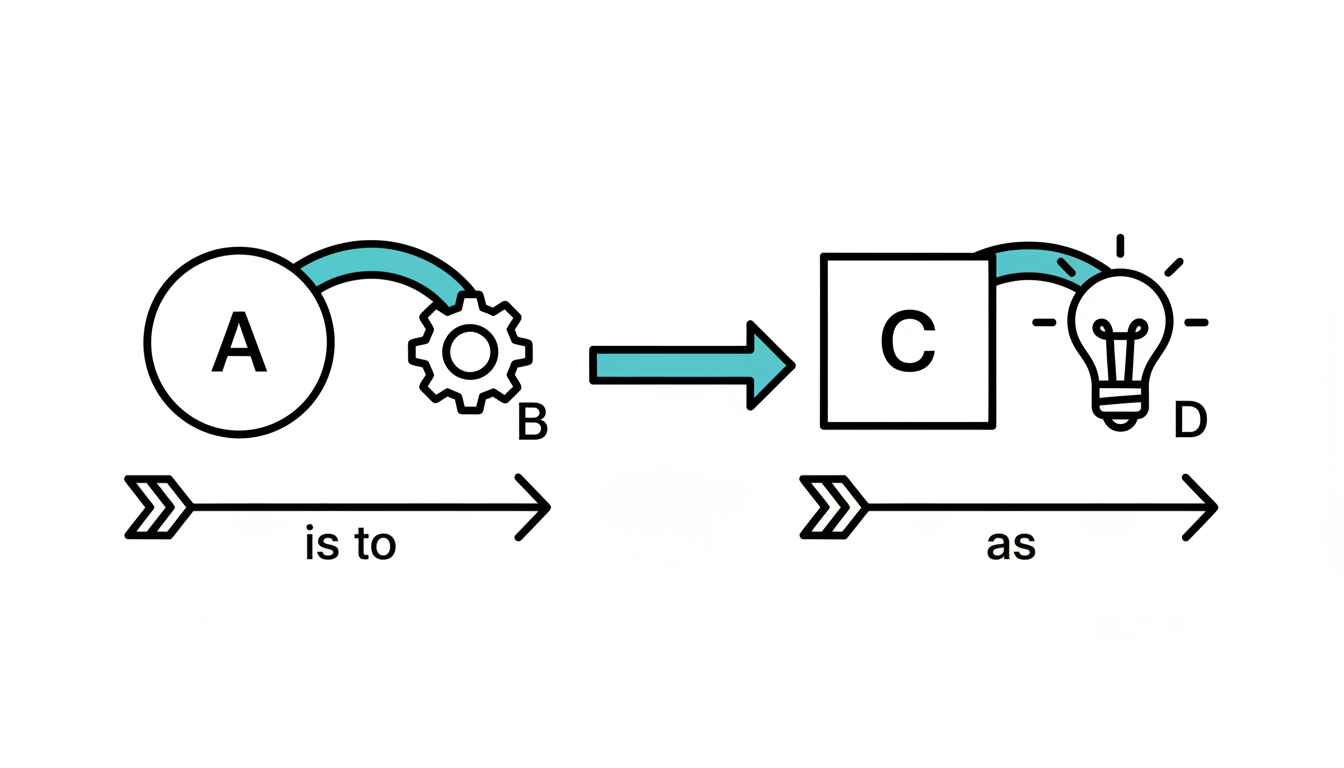
- PRESENT (15 seconds) - Display or say an analogy with a missing term: "A is to B as C is to __?"
- THINK (60 seconds) - Students identify the relationship and determine the missing term
- SHARE (30 seconds) - Students offer answers and explain the relationship
- REVEAL (15 seconds) - Confirm the answer and explicitly name the relationship type
- CONNECT (optional) - Relate analogical thinking to today's lesson
What to Say
"Here's an analogy challenge. Listen carefully: Hot is to cold as day is to __? Think about the relationship between the first pair, then apply it to the second pair. You have 60 seconds. Go!"
(After thinking time) "What's the answer? Explain the relationship."
Student: "Night! Hot and cold are opposites, so day and night are also opposites."
"Exactly! This is an antonym analogy—opposite relationships. Let's try another: Pen is to write as fork is to __?"
Why It Works
Analogical reasoning requires abstract thinking and pattern recognition—core cognitive skills. Students must identify the relationship type (part-to-whole, cause-effect, synonym, antonym, etc.) and apply it to a new context. This strengthens transfer learning—the ability to apply knowledge across different situations. Analogies explicitly teach that relationships matter as much as individual facts. Research shows that students who can reason analogically learn new concepts faster.
Research Citation: Analogical reasoning is central to learning and problem-solving (Gentner & Smith, 2012).
Teacher Tip
Explicitly name the relationship type after revealing the answer: "This was a part-to-whole analogy" or "This was a tool-to-function analogy." This metacognitive labeling helps students recognize patterns and apply them to future analogies.
Variations
Analogy Relationship Types
Antonyms (Opposites):
- Hot : Cold :: Day : Night
- Big : Small :: Tall : Short
- Fast : Slow :: Loud : Quiet
Synonyms (Similar):
- Happy : Joyful :: Sad : Sorrowful
- Big : Large :: Small : Tiny
Part-to-Whole:
- Wheel : Car :: Key : Keyboard
- Page : Book :: Brick : Wall
Cause-Effect:
- Practice : Improvement :: Study : Learning
- Rain : Wet :: Fire : Burn
Tool-to-Function:
- Pen : Write :: Scissors : Cut
- Hammer : Pound :: Broom : Sweep
Category/Type:
- Dog : Mammal :: Robin : Bird
- Apple : Fruit :: Carrot : Vegetable
Degree/Intensity:
- Warm : Hot :: Cool : Cold
- Like : Love :: Dislike : Hate
Content-Specific Analogies
- Math: Addition : Subtraction :: Multiplication : Division
- Science: Roots : Plant :: Foundation : Building
- Literature: Author : Book :: Composer : Symphony
- History: Monarchy : King :: Democracy : President
- Grammar: Noun : Person :: Verb : Action
For Different Settings
- Large Class: Display on board; whole class thinks; volunteers share
- Small Class: Everyone shares their reasoning
- Online: Type in chat or display on screen
- Pairs: Partners discuss before sharing with class
For Different Ages
- Elementary (K-5): Concrete, familiar relationships with visual support
- Middle School (6-8): Abstract relationships, vocabulary building
- High School (9-12): Complex, content-specific analogies
- College/Adult: Discipline-specific, philosophical, multi-layered relationships
Online Adaptation
Excellent for Online:
- Display analogy on screen clearly
- Students type answers in chat with explanations
- Or unmute to share verbally
- Works perfectly in virtual settings
Troubleshooting
Challenge: Students can't identify the relationship. Solution: Give hints: "Think about how the first two words relate. Are they opposites? Parts of something? Cause and effect?" Guide them to see the pattern.
Challenge: Student gives a wrong answer with flawed reasoning. Solution: "I see your thinking, but let's check: Does that relationship match the first pair? Let's test it..."
Challenge: Multiple answers seem valid. Solution: Discuss! "Both answers could work, but which one matches the SAME TYPE of relationship as the first pair?" Celebrate flexible thinking.
Challenge: Analogy is too hard; no one gets it. Solution: Scaffold: "Let's start with the first pair. How do Hot and Cold relate? Now can you think of another pair that relates the same way?"
Extension Ideas
- Name the Relationship: After solving, students identify the relationship type: "This was a synonym/antonym/part-to-whole analogy."
- Create Your Own: Students write their own analogies and challenge partners
- Multiple Completions: "Can you think of MORE than one correct answer? What other word fits the pattern?"
- Reverse Engineering: Give the answer and ask students to explain the relationship
- Content Connection: "We used analogical reasoning. Today when we learn [new concept], think about what it's analogous to..."
- Difficulty Progression: Start easy Monday, increase complexity throughout the week
Related Activities: Word Association Chain, Odd One Out, Pattern Recognition