
Confidence Rating
At a Glance
- Time: 2-3 minutes
- Prep: None
- Group: Individual reflection
- Setting: Any classroom
- Subjects: Universal
- Energy: Low
Purpose
Develop metacognitive calibration—the alignment between perceived and actual competence—by having students predict their confidence level before attempting problems, completing assessments, or demonstrating skills, then comparing those predictions to actual performance, enabling students to recognize patterns of over-confidence or under-confidence and adjust their self-assessment accuracy over time.
How It Works
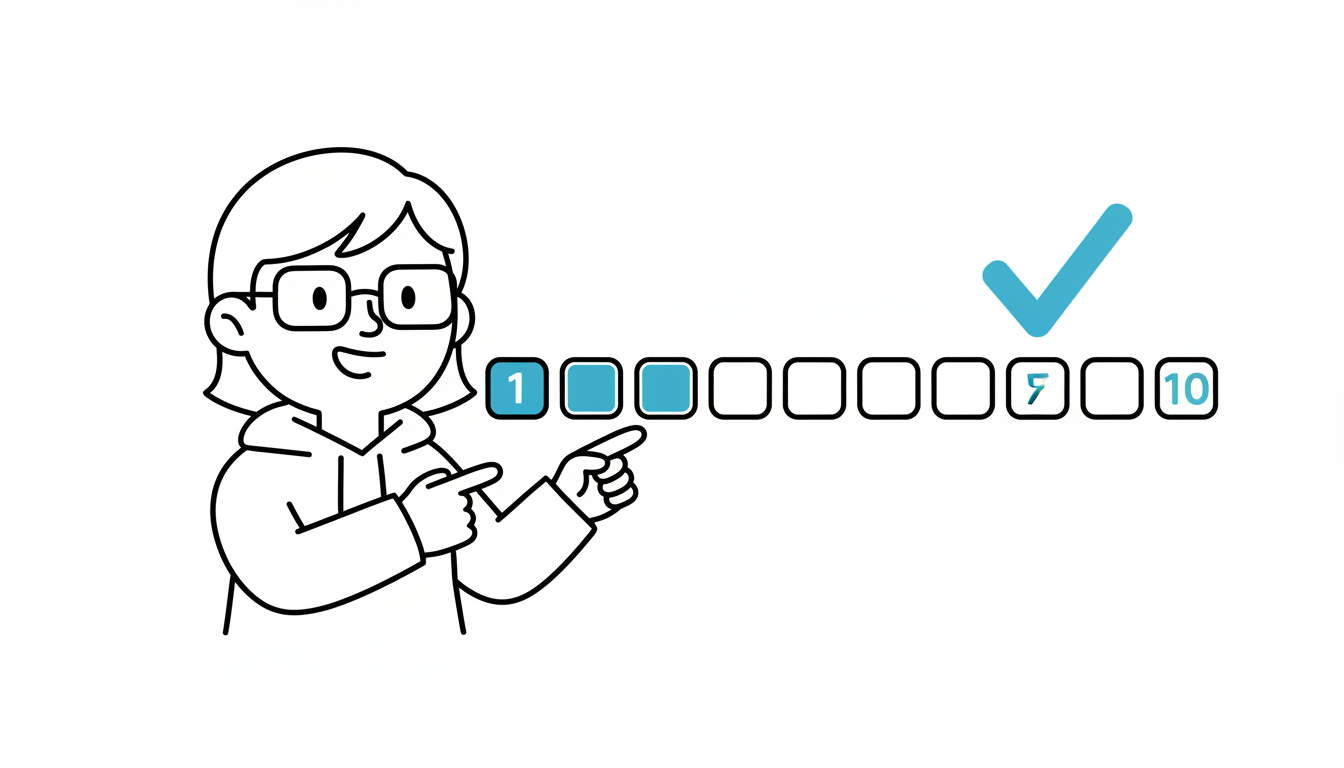
- Pre-task confidence rating (60 sec) - Before quiz, problem set, or task, students rate confidence: "How confident are you that you'll succeed? 1-10."
- Complete task (varies) - Students do the work
- Post-task reflection (60 sec) - After seeing results: "Was your confidence rating accurate? Were you over-confident, under-confident, or calibrated?"
- Pattern analysis (optional, 30 sec) - Over time: "Do you tend to over-estimate or under-estimate your abilities?"
What to Say
Opening (before task): "Before you start, I want you to predict: How confident are you that you'll get this right? Rate yourself 1-10, where 1 = 'I'll definitely fail' and 10 = 'I'll definitely ace this.' Be honest. Write your rating down—you'll need it later."
During task: "Complete the task as you normally would. Your confidence rating doesn't change the task—it just makes you aware of your expectations."
After results: "Now look at your confidence rating and your actual performance. Were you accurate? If you rated yourself 9 but got 60%, you were over-confident. If you rated yourself 4 but got 95%, you under-estimated yourself. Neither is good—the goal is CALIBRATION. Accurate self-assessment."
Pattern reflection: "Do this multiple times and watch for patterns. Do you consistently over-rate your readiness? That means you need to study more OR improve your self-assessment. Do you under-rate yourself? That means you know more than you think—trust your preparation."
Why It Works
Metacognitive calibration—the alignment between confidence and accuracy—predicts learning outcomes (Schraw et al., 2007). Well-calibrated learners allocate study time appropriately: they know what they don't know and focus effort there. Poorly calibrated learners either over-study material they've mastered (wasting time) or under-study material they've misunderstood (creating gaps). The Dunning-Kruger effect shows that novices tend toward over-confidence while experts are often under-confident; explicit confidence rating helps students notice and correct these biases. Comparing predictions to outcomes is the mechanism for improving calibration.
Research Citation: Metacognitive monitoring and calibration (Schraw et al., 2007)
Teacher Tip
The goal isn't perfect confidence (always rating 10), it's ACCURATE confidence. A student who rates 5 and performs at 50% is better calibrated than one who rates 10 and performs at 50%. Praise calibration accuracy, not high confidence.
Variations
For Different Subjects
- Math/Science: Rate confidence before each problem on a problem set; after grading, compare ratings to correctness
- Humanities: Rate confidence on ability to write strong thesis or construct persuasive argument before drafting
- Universal: Rate confidence before presentations, projects, or skills demonstrations
For Different Settings
- Large Class (30+): Quick written confidence ratings before quizzes; teacher tracks patterns to identify over/under-confident students
- Small Group (5-15): Public confidence ratings (raised fingers 1-10) before attempting problems together
For Different Ages
- Elementary (K-5): Simplify to three ratings: "Not confident" "Sort of confident" "Very confident" (thumbs down/middle/up)
- Middle/High School (6-12): Standard 1-10 scale with written ratings
- College/Adult: Add justification: "Why did you rate your confidence this way? What makes you confident or uncertain?"
Online Adaptation
Tools Needed: Poll tool (Google Forms, Mentimeter) or chat function
Setup: Create quick poll for confidence rating before task
Instructions:
- Before assessment/activity, launch poll: "Rate your confidence 1-10"
- Students submit ratings
- Complete task (quiz, problem set, etc.)
- After results, students compare: "Your rating vs. your result—calibrated?"
- Optional: Display anonymous scatter plot showing class confidence vs. performance
Pro Tip: Track confidence ratings and performance over semester—create personalized graph showing whether student is becoming better calibrated.
Troubleshooting
Challenge: Students always rate themselves 10 regardless of actual preparation (false bravado) Solution: Make ratings private, not public: "This is just for YOU to track. No one else sees it. You can't improve calibration if you're not honest with yourself."
Challenge: Students' confidence doesn't change despite repeated evidence of over-confidence Solution: Explicitly confront pattern: "You've rated yourself 8-9 on five quizzes but scored 60-70% each time. What does that tell you? Are you over-estimating your readiness?"
Challenge: Students become demoralized by consistent under-confidence (rating low, performing well) Solution: Reframe as positive: "You KNOW this material better than you think you do. Your low confidence isn't accurate. That means you can trust your preparation more and feel less anxious."
Extension Ideas
- Deepen: "Confidence + Evidence"—students rate confidence AND list evidence for that rating: "I'm 8/10 confident because I did practice problems and understood them all"
- Connect: Calibration tracking over time: graph confidence vs. performance for multiple assessments to visualize calibration improvement
- Follow-up: Pre-test calibration review: "Before the big test, rate your confidence on each topic. Your LOW-confidence topics are where to focus final studying."
Related Activities: Learning Check-In, Difficulty Ranking, Traffic Light Self-Assessment