
My Name and A Thing
At a Glance
- Time: 3-5 minutes
- Prep: None
- Group: Whole class in a circle
- Setting: Any (circle formation)
- Subjects: Universal
- Energy: Low
Purpose
Help students learn each other's names while revealing personal information. Use this during the first week of class when name-learning is critical. The activity uses memory techniques (association and repetition) to make names stick. Students practice active listening, speaking to a group, and building a shared classroom culture.
How It Works
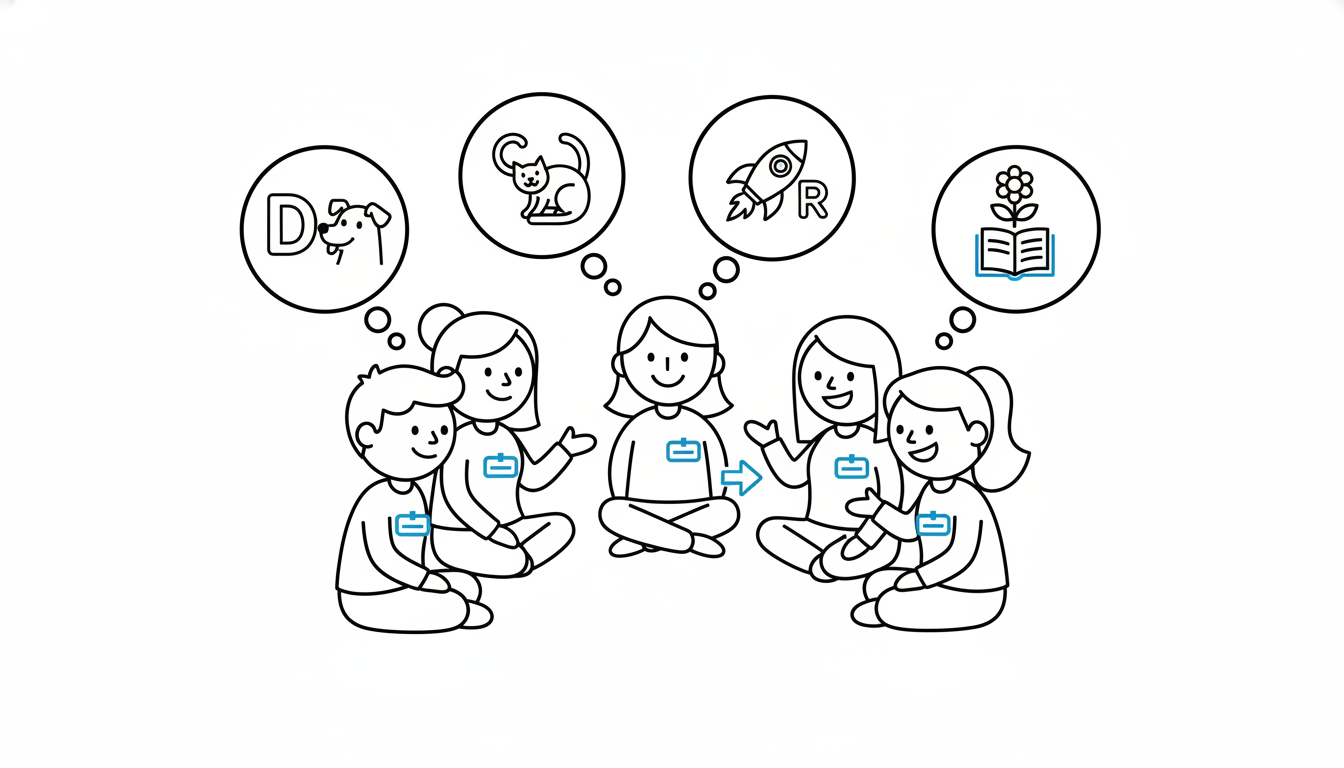
- EXPLAIN (30 seconds) - "Go around the circle. Say your name and something you like that starts with the same letter. For example: 'I'm Sarah and I like soccer.'"
- MODEL (10 seconds) - Teacher demonstrates first
- GO AROUND (2-4 minutes) - Each student takes a turn: "I'm [Name] and I like [Thing]"
- OPTIONAL CHALLENGE: After everyone shares, go around again and see if students can remember others' names and things
What to Say
"Let's learn each other's names! We'll go around the circle. When it's your turn, say your name and something you like that starts with the same letter as your name. It can be anything—a food, activity, place, animal, hobby. For example, I'm Ms. Parker and I like pizza. Got it?"
(Point to first student) "Let's start with you and go clockwise."
(After everyone shares) "Great! Now let's test our memory. Can you remember someone's name and thing? Point to them and say: 'That's [Name] and they like [Thing].'" (Take 3-4 volunteers)
Why It Works
Alliteration (same starting sound) creates a memorable association between the name and the personal detail. This mnemonic device aids recall. The activity gives students control over what they share (low risk), while still revealing personality. Hearing everyone's "thing" helps students find potential connections ("Oh, you like basketball too!"). Repeating names aloud reinforces memory through the production effect—we remember better when we say things out loud.
Research Citation: Associative memory techniques significantly improve name recall (Morris et al., 1977).
Teacher Tip
Go first to model the activity and set the tone. Share something genuine and appropriate. Your vulnerability encourages students to participate authentically. If a student's name doesn't have many options (like "Xavier"), allow them to use any word or be flexible with the rule.
Variations
For Different Subjects
- Alliterative Adjectives: "I'm Cheerful Charlie" or "I'm Thoughtful Tina"
- Content Connection: "I'm Maria and I'm curious about magnetism" (for science class)
- Action Words: "I'm Jake and I jump" (then demonstrate the action)
- Career/Future Version: "I'm Aisha and I want to be an architect"
For Different Settings
- Large Class: Break into smaller circles (groups of 8-10)
- Small Class: Perfect as is—whole class circle
- Online: Go in alphabetical order or by video gallery arrangement
- Seated Version: Stay in seats, go row by row
For Different Ages
- Elementary (K-5): Love this! May need examples: "Food you like? Animal you like? Place you like?"
- Middle/High School (6-12): Works well. Challenge them to be creative, not obvious
- College/Adult: Still effective. Can make it professional: "I'm Jordan and I'm interested in journalism"
Memory Challenge Variations
- Cumulative: "I'm Alex and I like apples. This is Maria and she likes music. I'm Derek and I like dogs, that's Maria who likes music, and that's Alex who likes apples." (Each person repeats everyone before them)
- Popcorn: After going around once, call on random students to name someone else: "Point to someone and say their name and thing"
- Quiz Later: Return to this activity at the end of class: "Can you still remember everyone's names and things?"
Online Adaptation
Good for Online:
- Go in order around the video gallery
- Or go alphabetically by first name
- Can use chat to type it first, then say it aloud
- Works almost as well as in-person
Troubleshooting
Challenge: Student can't think of something that starts with their letter. Solution: "That's okay! You can pick any letter, or we can help brainstorm. Class, what's something that starts with [letter]?" Or allow them to pass and come back to them.
Challenge: Two students say the same thing ("I'm Jake and I like jumping" / "I'm Jen and I like jumping"). Solution: "That's fine! We'll remember that both Jake and Jen like jumping. Now we know you have something in common!"
Challenge: Student shares something inappropriate or classroom-inappropriate. Solution: "Let's keep it school-appropriate. Can you think of something else that starts with that letter?"
Challenge: Students forget names immediately after. Solution: "That's normal—we need repetition! Let's practice. Turn to someone near you and see if you can remember their name and thing." Repeat the activity periodically in the first week.
Extension Ideas
- Create a Class Poster: Make a visual display with everyone's name and thing
- Writing Extension: "Write a paragraph introducing yourself. Include your 'thing' and explain why you like it."
- Ongoing Reference: Use these associations throughout the semester: "Jake who likes jumping, can you share your answer?"
- Deeper Connection: Later in the week, form pairs/groups based on similar interests revealed in this activity
- Follow-Up: "Next week, we'll do this again with a DIFFERENT thing. Think of a backup!"
Related Activities: Two Truths and a Lie, Commonalities and Differences, Birthday Lineup