
Human Knot
At a Glance
- Time: 5-10 minutes
- Prep: None
- Group: Small groups (6-10 students per knot)
- Setting: Requires open space for movement
- Subjects: Universal - primarily a team-building activity
- Energy: Very High
Purpose
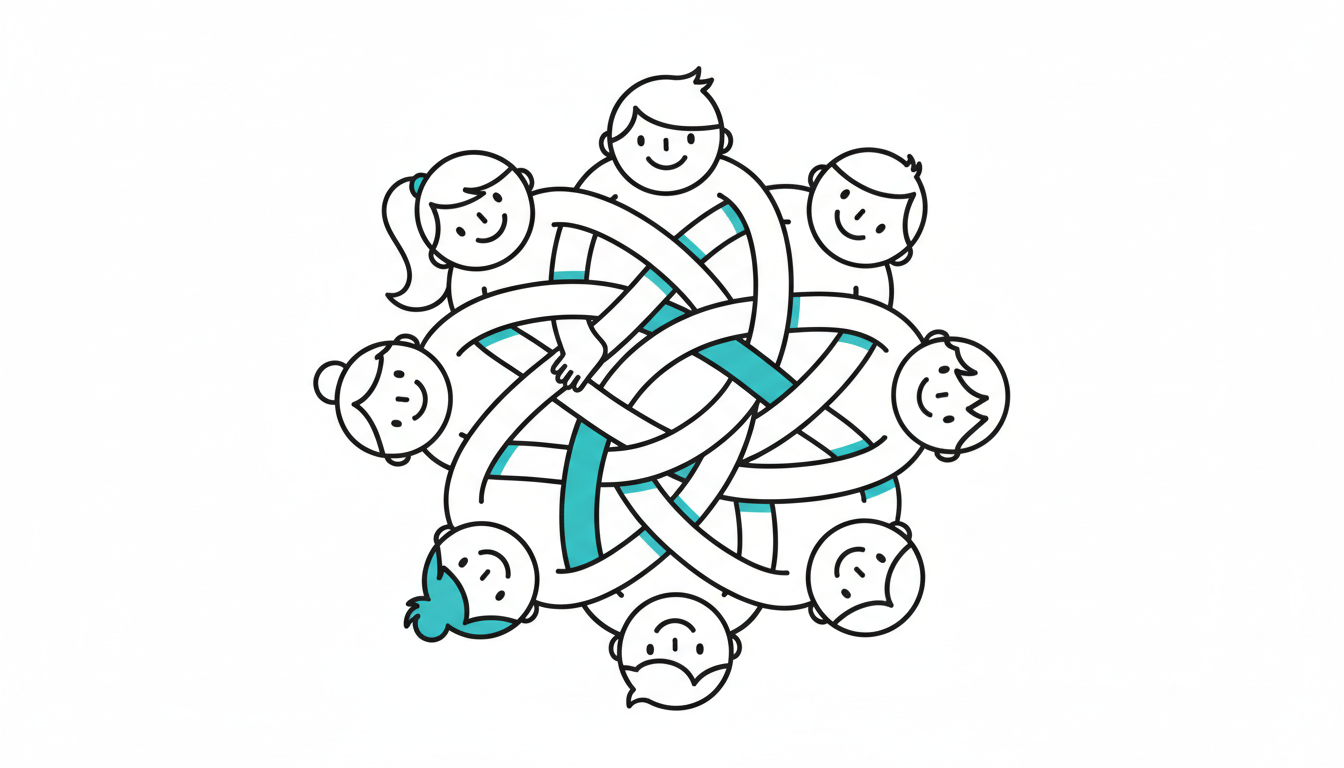
Human Knot is a classic team-building challenge that requires communication, problem-solving, and cooperation. Students stand in a circle, grab hands across the circle to create a "knot," then work together to untangle themselves without letting go. Use this as an energizer, an ice-breaker for new groups, or as a concrete metaphor for collaborative problem-solving. The physical challenge creates bonds and demonstrates that complex problems require patience, communication, and trying multiple strategies.
How It Works
Step-by-step instructions:
-
FORM CIRCLES (30 seconds) - Create groups of 6-10 students standing in tight circles facing inward.
-
REACH ACROSS (30 seconds) - Each person reaches across the circle with their right hand and grabs someone else's right hand (not the person directly next to them).
-
GRAB WITH LEFT (30 seconds) - Without letting go of right hands, everyone reaches across with their left hand and grabs a different person's left hand (again, not someone adjacent).
-
THE CHALLENGE (5-8 minutes) - Without releasing hands, the group must untangle the knot to form a circle (or sometimes two interlocking circles).
-
STRATEGIES - Groups will step over arms, duck under linked hands, rotate their bodies, and communicate continuously about what to try next.
-
DEBRIEF (2 minutes) - Discuss what strategies worked, what communication was essential, and how this mirrors real collaboration challenges.
What to Say
Setup: "We're doing the Human Knot challenge. Form groups of 8 and stand in a tight circle facing inward, shoulder to shoulder."
Creating the Knot: "Reach across the circle with your right hand and grab someone's right hand—not the person next to you, someone across from you. [Wait for everyone to connect.] Now, with your left hand, reach across and grab a different person's left hand. Again, not someone next to you. [Wait.] You should now be in a tangled knot."
The Challenge: "Your goal is to untangle this knot without letting go of any hands. You can step over arms, duck under them, spin around—but you cannot release your grip. Work together. Communicate. Try different strategies. Begin."
During: [Circulate and observe. Listen for productive communication: "Let's try stepping this way," "Can you duck under here?" If groups get completely stuck, you can give a hint: "What if you tried moving clockwise together?"]
Debrief: "How did you solve it? What communication was essential? When did you feel frustrated? How does this challenge mirror real team projects where you have to work within constraints and try multiple approaches?"
Why It Works
Human Knot creates powerful team dynamics and learning moments:
Physical Interdependence: Students literally cannot solve the challenge alone. Success requires the entire group to coordinate.
Communication Practice: Groups must verbalize strategies, give directions, and provide feedback constantly to succeed.
Trial and Error: There's no obvious solution path. Groups must experiment, fail, adjust, and persist—building resilience and creative problem-solving.
Leveling Effect: This challenge doesn't advantage traditionally "smart" students. Physical, spatial, and social intelligence all matter, creating equity.
Metaphor for Collaboration: The knot becomes a tangible metaphor for complex problems that feel overwhelming initially but can be solved through patient, coordinated effort.
Research Citation: Experiential learning activities like Human Knot support team development by creating shared challenges that build trust and communication skills (Kolb, 1984).
Teacher Tip
About 10% of the time, groups create a mathematically impossible knot that cannot be untangled. If after 8 minutes a group is truly stuck (not just struggling productively), you can give them a "redo": release hands and form a new, simpler knot. The real learning is in the communication and strategy, not necessarily the solve itself.
Variations
For Different Subjects
-
Math/Geometry: Debrief focuses on topology—discuss why some configurations are impossible to solve without breaking the connection.
-
Science - Systems Thinking: Use as a metaphor for complex systems where changing one element affects all others.
-
History/Social Studies: Debrief about interdependence in communities, trade networks, or political alliances.
-
Language Arts: After the activity, have students write instructions for how to solve the Human Knot as a procedural writing exercise.
For Different Settings
-
Large Class (30+): Form 4-5 separate knots of 6-8 students each. All groups solve simultaneously.
-
Small Class (6-12): Can do one knot with the whole class if the group size is right (6-10 is ideal).
-
Limited Space: Human Knot requires moderate space. If you don't have room, skip this activity and use a different collaboration challenge.
For Different Ages
-
Elementary (K-5): Use smaller groups (6 students) and be prepared to help guide untangling if frustration builds.
-
Middle/High School (6-12): Standard format works perfectly. Enjoy the chaos!
-
College/Adult: Still fun! Can add competitive element: which group solves fastest?
Online Adaptation
This activity cannot be adapted for online learning. It requires physical proximity and touch. For virtual team-building, substitute with online collaborative puzzles or escape room challenges.
Troubleshooting
Challenge: A student has physical limitations or doesn't want to hold hands with peers.
Solution: Let them be the "coach" who stands outside the circle and gives verbal directions to help the group solve. This is still a valuable role.
Challenge: Groups give up quickly when they can't solve it immediately.
Solution: Normalize struggle: "If you solve this in 30 seconds, I made it too easy. The point is to practice working through frustration together. Take your time."
Challenge: One dominant student barks orders and others passively follow without thinking.
Solution: Add a rule: "Everyone must suggest at least one strategy before you can try it. No one person can direct the whole thing."
Extension Ideas
-
Deepen: After untangling, have the group intentionally create a knot, then hand it off to another group to solve. This adds a strategic layer: "Can you create a challenging but solvable knot?"
-
Connect: Use Human Knot at the start of a collaborative project unit, then reference it throughout: "Remember when we were stuck in the knot? What did we do? Try that strategy here."
-
Follow-up: Reflection prompt: "The Human Knot is a metaphor for _______ because _______." Students complete the analogy connecting to course content or life skills.
Related Activities: Common Thread, Group Juggle, Minefield